Being reviewed:
Advertisement
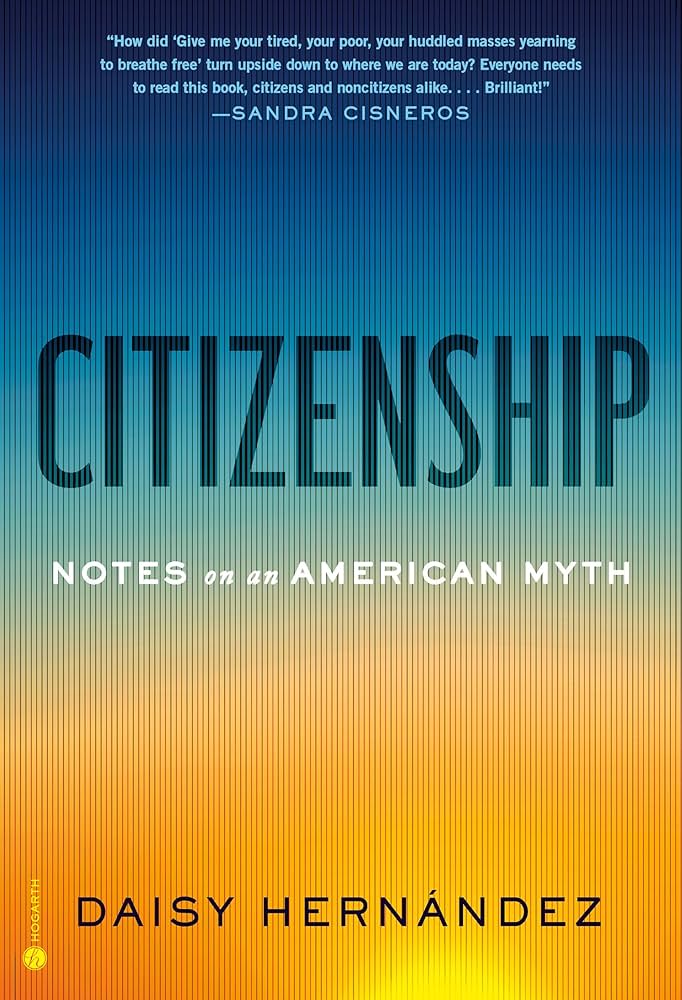
Daisy Hernández’s new book, Citizenship: Notes on an American Myth (Hogarth Press, February 2026), blends in-depth reporting with memoir to interrogate the very idea of American citizenship, highlighting notions of citizenship through exclusion, social citizenship, semi-citizenship, queer citizenship, dual citizenship, and citizenship as membership.
Pulling from her personal experience as the queer daughter of Cuban and Colombian immigrants, Hernández identifies the fictions that make up our conception of American citizenship. She argues that today, state citizenship can be more relevant than national citizenship, with radically different access to healthcare and state benefits across states. Focusing on the Latin American immigrant experience, she explores questions of race, migration, and empire, and how they define experiences of citizenship.
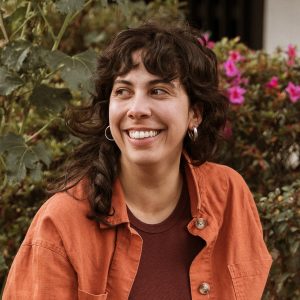
Hernández is an Associate Professor of English and Director of the English Major in Writing at Northwestern University. She is also the author of The Kissing Bug: A True Story of a Family, an Insect, and a Nation’s Neglect of a Deadly Disease (Tin House, 2021), a nonfiction, personal investigation of Chagas disease, which won the PEN/Jean Stein Book Award; and the memoir A Cup of Water Under My Bed (Beacon Press, 2024), which won Lambda Literary’s Dr. Betty Berzon Emerging Writer Award.
In February, I had the opportunity to speak with Hernández over Zoom about her new book, citizenship as an evolving myth, and the importance of mapping our own family histories onto the greater story of citizenship.
Tasha Sandoval (TS): While reading Citizenship: Notes on an American Myth, I was particularly struck by the use of the word “myth.” Initially I thought it was provocative, but then I realized, “Oh, wait, everything is a myth: Money is a myth, countries are a myth. All of these things are stories.”
You also write that citizenship does the work of race through exclusion. Can you tell me a little bit about the use of the word “myth”? And what motivated you to interrogate the notion of citizenship in this moment in relation to the idea of exclusion?
Daisy Hernández (DH): When I was a toddler, my father, who’s Cuban, would love to ask me the question, “Are you Cuban? Eres Cuban, eres Cubana, Colombian, or Americana? ” So, are you Cuban, Colombian, or American? I was a toddler. I was not precocious; I didn’t quite speak yet. But I learned very quickly that the correct answer was the third one, except I couldn’t pronounce it. I could only catch the last two syllables of “cana.” So I was Cana. That’s the kind of home that I grew up in. My dad was a political refugee from Cuba. My mother came here from Colombia. I have uncles from Peru, from Puerto Rico through marriage. I grew up in a community where our friends and neighbors were from Mexico, Argentina, Guatemala, Honduras. I like to tell people, I grew up in the United Nations of Latinos in New Jersey.
Citizenship was always at the center of my life from a very young age. I imagined that all children were being told that they were birthright citizens because my mother was always very clear with me and with my sister that we had been born here, that we were citizens, that we were Americans. I was also growing up in the 1980s. I was around 11 years old when Congress decided to create a legal pathway for citizenship for 3 million people, mostly Mexicans. I’m really struck by the fact that 40 years later, our federal government is violently persecuting immigrants and everyone else, but very much focused on immigrants. How did we get here in four decades? That was part of my work with this book. And the myth comes about because I already had the inkling, of course, that citizenship had been such a North Star for everyone in my family. Everyone in my family just wanted US citizenship. Everyone was working toward that. I write that my uncle married someone for a green card. Other women in my family also married their husbands for green cards.
But when I looked into the history of citizenship, I learned a lot of what we don’t learn in K through 12, like that in 1790 Congress decided you can only naturalize as a citizen if you’re a free white immigrant. Race was there from the beginning. Then a little less than 100 years later, we have a civil war, which we always think of as being about the abolishment of slavery, and also about determining the citizenship of Black Americans. We only get the 14th Amendment about birthright citizenship because we were at civil war first with one another, and we killed thousands of each other. But we don’t really talk about the Civil War as a war about citizenship.
There were so many things I didn’t know until only a few years ago: about the deportation in the 1930s of a million Mexican Americans, more than half of whom were citizens. And in the early 20th century, American women would lose their citizenship if they married a foreigner. So, citizenship is a fiction. It is not this hard legal fact. It changes in response to the political moment. Part of what I also found exciting as I was researching and thinking about my family’s journey is that all our social justice movements of the mid-20th century—the civil rights movement, gay liberation, women’s rights—were all actually for people who had citizenship, but did not have what sociologists called social citizenship. There were all these limits on voting, on your body, who you could be in love with as a queer person. Those social movements were about creating a new citizen. So I felt like, “Oh, we can write the myth as well.” The myth of citizenship is not just written by the elites. Those of us on the ground going through our daily lives and resisting are also creating a definition of citizenship, which is important for us to remember in this moment.
TS: Your book is a history of American citizenship, mostly throughout the 20th century, but then it’s braided with family memoir. You use those family stories to illustrate the history that you’re telling, which made for a very compelling braided narrative.
One of the most striking moments of memoir is when you illustrate how each of your parents became citizens in their own ways: your father coming from Cuba and your mother coming from Colombia. Why did you decide to include your family memoir in this story? And what do you think that memoir achieves in a way that history does not?
DH: I came of age at a time of “the personal is political, and the political is the personal” and when I first found feminism explicitly in college, and in the years after college, it finally gave me language for what I had grown up seeing. I always remember going to free health and dental clinics, walking in there and saying, “Okay, why is it all women and children? Why disproportionately Latina women, poor white women?” Everybody in there was poor. I didn’t have the language, but sensed at a very young age that there’s some bigger story that’s going on here.
Feminism was very affirming to how I think about memoir. My experience in writing and teaching and working as a journalist over the years is that people are so invested in stories about one another. We really love each other, even though that sounds corny. We learn from one another.
It’s more difficult for us to take the hard, cold facts and have feelings about them without there being a human story attached to it. I always think of memoir as essentially the entryway into the history and political context, because that’s where you’re going to have the feelings. Your readers are going to care about the people and especially the people that you love, but even the people that you hate too, because in order to hate on someone, it has to start in a place of love. And then the context and the factual information is there as well because I’m hoping that it will also inspire especially Latina readers to ask, “What is the context for my story? How does my family fit into this larger narrative?”

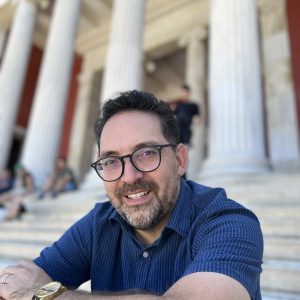
TS: You write of citizenship as membership and as status. But within that you write about social citizenship and semi-citizenship, too. So this idea that there’s a gray area to citizenship and that it’s fluctuated throughout American history. You posit that rather than just having US citizenship, there’s also state citizenship, and there’s a huge gradient within that in terms of the rights a person does or does not have, which makes for unequal citizenship. Can you tell me more about how thinking of citizenship as status or as membership helps us understand the mythology of citizenship and semi-citizenship more broadly?
DH: I came to really appreciate during the process of writing this book that most of us, if not all of us right now, are really citizens of the state where we live rather than the country that we’re living in. Because so many laws that govern our day-to-day lives are actually determined at the state level. The most obvious one is reproductive rights. If you’re a woman or a person who’s pregnant or thinking about it, your access to reproductive care is so different if you live in Illinois than if you live in Florida. If you are raising a transgender child, your access to gender-affirming medical care for your child is dramatically different if you live in Alabama than if you live in New York City. And we know families that have transgender children are really like internally displaced refugees right now because many of them are having to move—we’re not talking about them yet this way, but they are talking about themselves this way. This is a reality that marginalized people have known in the US for a long time. The kind of food stamps that you get in Massachusetts are different from what you will get in Tennessee, et cetera. But I think a larger and larger number of Americans are being affected by how different citizenship is. So when we think about membership—am I really a member of the United States or am I a member of Illinois? I would say I’m more a citizen of Illinois.
Americans have a myth that we are and have always been a beautiful democracy, and that we haven’t been an empire like Britain, France, or Spain, that we haven’t sent people to settle and colonize other lands. But, in fact, we have functioned as an empire. For more than 100 years, the United States has been so involved in the inner workings of so many countries: Mexico and Central America, obviously the Caribbean in huge ways, Colombia as well, and the US just took out the president of Venezuela. Private companies and federal policy here have made the decisions for so many Latinos in Latin America. Stanford law professor E. Tendayi Achiume writes about something that I think is important for thinking of citizenship: Are people from those places actually foreigners if their day-to-day lives have been so determined by the decisions of the White House and private corporations in the US? No. Part of what I argue in my book is: When they reach the border, we can think of them already as citizens, as Americans, because they have been part of the empire.
TS: Your last book, The Kissing Bug, is about Chagas disease, which killed your aunt, so it makes sense that your new book would have a chapter focusing on healthcare and access to healthcare as a defining element of citizenship. And I was really shocked to learn about the 1996 Personal Responsibility and Work Opportunity Reconciliation Act, which allowed states to deny permanent residents Medicaid if they hadn’t been in the US for at least five years. You write about how after this law, the way that folks talked about citizens changed—so that there were just citizens and noncitizens. Noncitizen being criminal and citizen being lawful. Meanwhile, you anchor this chapter in memoir, talking about your mother’s attempt to navigate the medical system when you had a rash on your face, navigating access to healthcare by going to free health care fairs. How did unequal access to health care become such a central part of this book? Why is it something that we need to consider when understanding citizenship?
DH: I actually wrote most of that chapter thinking it would go into my last book. And then I realized, “Wait, I think I need to write a lot more about citizenship. I think this is the beginning of something.”
I had lived in states that used their own Medicaid funds to cover the gap that the federal government didn’t provide for green card holders who needed Medicaid in those first five years. So I had taken for granted that every state of the United States did that. And they did not. It felt like a very urgent question to me: How did we reach a point where your ability to see a doctor is contingent on the piece of paper that you might or might not have that the United States approves of?
There’s a particular part of that chapter where I show you the insanity of it. If you’re undocumented but you live in California or Oregon, you can have access to Medicaid regardless of your age and so forth. But, if you live in this other state, you can only have access once you hit 10 years old. In this other state, you have to be 15.

TS: It almost seems arbitrary, right?
DH: I never use the word arbitrary. And here’s why: because all of these have been political decisions.
Why do we have this legislation in Illinois that helps to provide for people who are elderly and need Medicaid, regardless of their status? I would argue that it’s because we got more Latinas into the state legislature, because we have more people of a particular party who wanted to support that. The expansion for Medicaid for children: There’s a reason we have some of it in Delaware and Connecticut. And it’s because between elected officials and advocates and ordinary voters, people supported it. People got out in front of it. And so that means that it can happen everywhere. It’s not arbitrary. It’s a very intentional decision. And it’s a reflection of the political moment that we’re living in.
The reality is that, yes, there were three laws in 1996: One was the infamous welfare reform law, and then we had other laws around deportation and terrorism. Combined, they completely changed the definitions of citizenship.
Another law professor writes that at one point people with green cards were considered to be citizens in waiting. They had all the rights of a citizen. Somebody who had an asylum case was considered to be in a very different position than someone who was undocumented. But, in 1996, just 10 years after the legalization of 3 million immigrants, mostly Mexican, we had these laws that completely changed the definition of citizenship in this country. For the first time, it made access to the safety net contingent on your citizenship and where you were in that process. It’s been absolutely life-changing for so many Americans. And when I say Americans, I mean, anyone who’s living in this country right now.
TS: I wanted to talk about the chapter that touches on the census. You talk about the Census Bureau potentially adding Latino as a category and how that could affect the races that are accurately counted. My big takeaway from that chapter is that there’s often a mismatch between the way that we see ourselves and the way that others see us. You again use memoir to illustrate deep-seated colorism and racism within Latino communities and families. Can you tell me more about this distinction between self-perception and external perception and why that matters in terms of how we construct our Latino citizenship?
DH: I used the example from my own life, which is that my father identified himself very much as a white man from Cuba. He didn’t walk around saying, “I’m a white man.” But yes, he always let it be known that he definitely saw himself as being white. He was an anti-Black racist, which is still surprising sometimes to people outside the Latino community. I write about this moment in time where I had a friend, maybe boyfriend, who was Dominican and who my father identified as being Black. And I write about this very painful moment in my childhood where my father was verbally abusive toward this teenage boy who was at my house. My father was just so horrible to him because of his own racism. But it was this fascinating moment in which my father identified himself as being white, and he identified me as being white as well—I didn’t identify myself as being white partly because I don’t look exactly like my dad, but also because no one in school or in the community had ever treated me as though I was the descendant of Germans or the Irish or anything like that. And then my dad identified the Dominican boy as being Black.
The boy called me up afterward and said he was so hurt that he had been identified by my father as being Black. He himself had internalized the hate, the racism so much that he did not identify as Black. And I think most people would have identified him as Black, in the US at least. It was this moment where I realized, wait, on the census, this boy and this father of mine, the two of them might have chosen white as a category because that’s how they saw themselves, even though the world saw them so differently. And they might also have put me in that white category. Within my own family and my own community, how we thought about ourselves and how others thought of us were so different.

TS: Your chapter on queer citizenship and queer kinship and how it’s experienced differently is one of the braided memoir sections that was the most effective for me. You illustrate different kinds of queer citizenship through your relationship with your cousin, Primo, a Cuban man who was jailed by the government in Cuba for being gay and who is now in the US, a gay man with all kinds of rights, but also partial citizenship as a result. You write that in 2024, he did not yet have legal citizenship so he couldn’t vote. But, he would have voted for Trump if he could have. So, I’m curious to hear about writing about Primo, knowing that he didn’t really want to be written about.
DH: Writing about my cousin was the first time that it’s been extremely uncomfortable to write about a family member because I knew that he didn’t want me to write about him. It was a process of deciding whether or not to include the chapter. But I took the advice that I’ve always given to my students, which is write it first, and then later decide if you want the world to see it. But first, you have to write it.
I decided to include it because so many people in the US right now are having the exact same experience that I had with my cousin, which is to have these very devastating political differences. And it was important for me to interrogate that relationship.
We ended up having a lot more political conversations than we would have had. The conclusion that I reached was that I was trying to avoid grief in that relationship—the grief that we do not have reconcilable differences. This gave me a very deep appreciation of this country’s history. It helped me to understand there is a reason that we did have a civil war: It was not negotiable whether Black people were human beings or not. And I think that, unfortunately, we are facing some of those same questions. Again, it’s not negotiable whether immigrants are human or not. It’s not negotiable whether transgender people are human or not. They are human. And democracy is not negotiable. So our conversation helped me to acknowledge that there was grief that I was avoiding. It was such a powerful moment for me as I was writing about our relationship, to recognize that this is not about crossing the political aisle. There is no political aisle. This is about whether the person sitting next to me on the bus is a human being or not, and whether I want to live in a country where their humanity is recognized and respected and protected.
But what I also learned through that process is that your relationship with that person determines how you move forward. Part of it is also figuring out, Do we want to continue this relationship with a family member? Is there enough of a history between us that can carry the weight of these political differences? Sometimes the answer is yes, it can. But sometimes it’s not.
I wanted to write about Primo because I don’t have that many queer cousins. And it just felt incredible to me that one of my queer cousins would have such different political views. I also felt that it’s important for readers to know that Trump supporters are not just these heterosexual Christians in Alabama. They’re also gay Latino men in Florida and in New York City. I write about gay men in New York City who voted for Trump because they think he’s gay. They think he’s all camp. And they want the government out of their lives because they’re good now.
TS: I was really excited to see that in the final chapter of your book, you address dual citizenship. I am a dual citizen of Colombia and the US myself. I was born in Bogotá and naturalized as a US citizen at birth because of my mom’s citizenship.
Your book frames dual citizenship as a phenomenon of the 21st century. You write that in 1990, only 25 percent of countries allowed for it, and by 2016, 80 percent did, which is a huge increase. My capacity to live in Bogotá right now is completely contingent upon this relatively new constitution of Colombia and this phenomenon of dual citizenship. So tell me more about this interrogation on dual citizenship and, in particular, your own exploration of what it would mean to become a dual citizen of Colombia.
DH: I didn’t realize how widespread it was until I started researching. I also didn’t know that there were the sort of people who I call the millionaire migrants, people who can afford to purchase their dual citizenship. They don’t have a connection with a country, but the country says, “Oh, if you come here and you buy a piece of property for $200,000, you can basically get a green card and get citizenship and access.” Usually people are trying to get access to the European Union. In the US, we are so mired in this narrative that you cannot purchase citizenship. It’s a myth that citizenship cannot be purchased, that it’s so priceless that you have to almost sacrifice either your life or your children’s lives by crossing the desert or crossing the river to get here or overstaying a tourist visa and putting yourself in danger, when in fact, we also have what they call investor citizenship here. Until recently it’s cost about a million dollars for US citizenship, which is a high price tag but it’s a price tag. I know Trump wants to increase that price to $5 million.
Part of dual citizenship is also globalization and how easy it is to move now.
And then most recently what we have is the rise of the digital nomad who can work remotely in places like Medellín, where they can live more cheaply. They might have jobs in the EU or in the US or Canada, but they can do their job remotely from anywhere; or they’re freelancers. So what’s essential to dual citizenship is also recognizing the role that capitalism plays. Where the majority of digital nomads are white and they are looking for places where they can go have an amazing experience that’s culturally very different from what they grew up in, but also very cheap. And if that country has a political coup and now it’s not pleasant to live there, you get to go back to the United States, which will hopefully still be a democracy by the time you arrive.
The big question that I think a lot of scholars of citizenship have right now is: What is your duty? Because it used to be that you got a lot of protections as a citizen, but you paid taxes, you served in the military, et cetera. But that’s not the world we’re living in anymore.
TS: We can’t have this conversation—and it would be difficult to write a book about citizenship—without talking about this moment itself a little bit more. I understood from the book that some of the writing happened in 2024, but then some of it was edited a little bit closer to publication.
What does it mean to write a book about American citizenship now as a member of several groups who are having their citizenship brought into question? And what do you want readers to be thinking about as they approach this book in this moment?
DH: I finished the book during the month of the election in 2024 and someone asked me, “Is it still safe for you to do this, to publish this? ” And it wasn’t completely. I took out a passage about a family member who was undocumented once Trump got in and the executive orders started coming out. I told my editor, “It’s heartbreaking but we’re going to have to take out this passage because I don’t know who’s going to be targeted right now.” And it has only gotten worse. It was the first time that I could not completely write my story because of the political consequences that could happen for my family member and even for myself.
I grew up reading about the dictatorships in Latin America during the ’70s and ’80s, and in particular reading about dictatorships throughout Eastern Europe. But it’s my first time as a writer living with a fascist government. I’m grateful that I’m not Bad Bunny and I don’t have to think about ICE or DHS showing up at one of my book readings. But I really appreciate that someone like Bad Bunny and other Latinos who are in very high-profile positions do have to think about the gatherings that they go to now, and do have to think about who comes to them, and do have to think about who they communicate with and how and what they’re disclosing. It is just a time of political chaos that we’ve never known in the United States, even though this has been a long time coming.
In a lot of ways, what’s happening now is actually going back to the racist policies that we’ve had around citizenship for more than 200 years. And then in another way, it is very new. We’ve never had a president who has defied court orders, who doesn’t enforce laws. If you described the United States without any reference to the United States, most people would think you were describing a country in Latin America of the past.
But part of what I want my readers to take with them is that citizenship is not a story that people in power exclusively get to write. I want readers to be reminded that we’ve had incredible social justice movements that have written a larger story of citizenship and that it has not been limited to the 20th century. What we have seen now in the 21st century is the rise of young people who have organized around undocumented families, who organized themselves around their undocumented status. For a period in our contemporary history, people stopped using the words illegal alien. The visibility of the transgender community has been an incredible expansion of social citizenship that came about because people in the trans communities and their allies were standing up, marching, speaking back, pushing for visibility. The Me Too movement put so many women into not just public conversations but also new private conversations. So there’s also been an expansion of citizenship within this century. Part of this fascist moment that we’re in is a backlash to the expansion of that kind of citizenship. I hope that readers will take it upon themselves to think and feel like they are also the authors of the story of citizenship. 
This article was commissioned by Geraldo Cadava.