

Being reviewed:
The Pitt
Advertisement

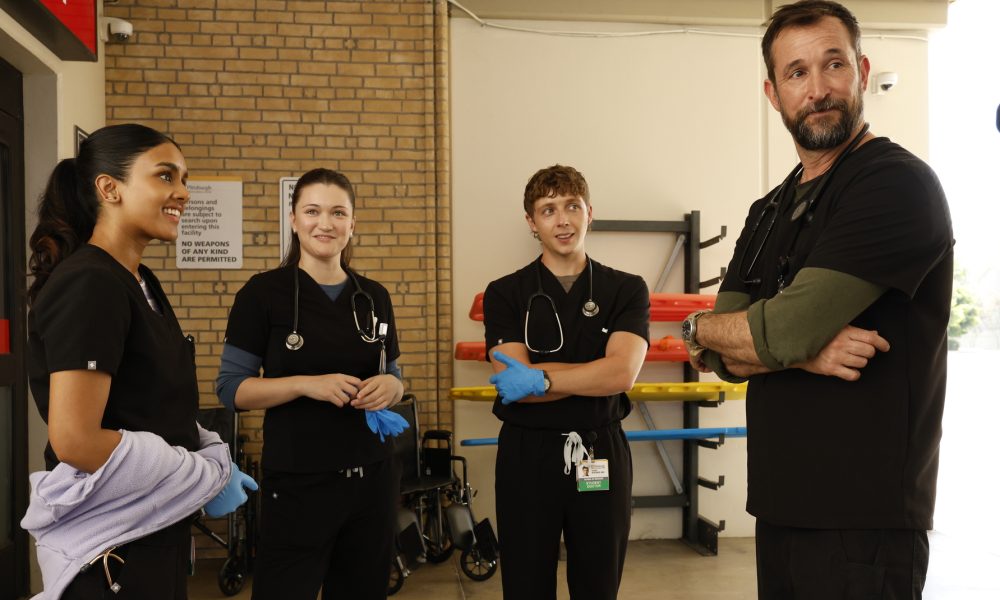
“We are failing young men,” Dr. Michael “Robby” Robinavitch (Noah Wyle) waxes poetic, “because we don’t teach them how to express their emotions.” It is a late-first-season episode of HBO’s The Pitt, and Robinavitch is advising a patient (Joanna Going) to file an involuntary psychiatric hold on her troubled son (Jackson Kelly). “We just tell them to man up,” he continues, “and then we let them get their lessons in manhood from toxic podcasts. These young men then feel isolated from themselves and society, and they find community and comfort in all the wrong places.” Wyle’s speech, of course, is meant to be timely; the show intends here to evoke a whole sphere of social crisis in this immanent medical encounter. But it’s a jarring moment in a show that, by my count, mentions alpha male podcasts on zero other occasions.
This isn’t, in other words, the spontaneous speech of a real person. It’s more like a mishmash of discourse on the Troubled Young Man, about which much digital ink has been spilled in the last few years. For this reason, even as Wyle’s performance is compelling, Robby’s “timely” pontification feels so on-the-nose as to be cringy.
And this is not the only moment when social crises burble up in The Pitt. Each season, the second of which is currently airing, takes place over a single 15-hour shift at the emergency room of the fictional Pittsburgh Trauma Medical Center. During this single shift, employees of the eponymous “Pitt” grapple with post-Covid trauma, the opioid epidemic, anti-Asian violence, mass shootings, violence against health care workers, TikTok influencing, transgender health care, artificial intelligence in medicine, nursing shortages, the corporatization of health care, calcified brain worms, abortion access problems, ICE in hospitals, the Medicaid gap, anti-masking, the underdiagnosis of both eating disorders and PCOS among Black women, treatment for neurodiverse patients, neglect for sickle cell patients, surrogacy, and more.
What’s striking isn’t merely that the show is topical. The series’ strength, and its foible, is to embed its crises in serial subplots, rather than in one-and-done cases. In this, it breaks from its most direct inspiration, ER (Wyle, showrunner John Wells, and executive producer R. Scott Gemmill are all alums of that show), and also from contemporary torn-from-the-headlines procedural shows. The Pitt allows social problems to linger over multiple episodes, in some cases over the entire 15-episode season. A Law & Order: Special Victims Unit detective can handle the Case of the Manosphere Murderer in a snappy 43-minute episode then forget about it by next week; there is no such succor for the doctors of The Pitt, who have to work with the same opioid-addicted tourists, trafficked sex workers, and unhoused patients over multiple episodes.
What we have, then, is a show that is both powerful and insipid. The Pitt burns with the desire to represent totality, but its corny obviousness often quenches its own flame.

Formally, The Pitt is conditioned by claustrophobic compression, literalized in its all-in-one-day conceit. The show does not exactly play out in real time (episodes run between 40 and 60 minutes), but each episode takes place over a single diegetic hour. Ominous captions appear at the beginning of each episode to mark its length, accentuating the sheer amount of problems crammed into that hour. Because of this compression, the protagonists (and the viewers) pinball between crises that are crushing on their own and apocalyptic in their aggregation. From lonely young men to measles, from fentanyl to brain worms, from violence against immigrants to painkiller-swiping doctors, the show feels like a news digest come to life. And this is to say nothing of the “normal” cases, from minor injuries to heart attacks, that occupy the minutes in between crises.
That The Pitt is concerned with a whole assemblage of social problems has not been lost on reviewers. The series “pinpoints the widespread feeling,” New York Times critic James Poniewozik remarks, “that everything now is sick and broken, from systems to people to social compacts.” The emergency room in The Pitt is the imaginative material for performing what Fredric Jameson calls cognitive mapping: “situational representation on the part of the individual subject to that vaster and properly unrepresentable totality” of the world’s social relations.
More than occasionally, this hypercompressed approach to social crisis can provoke an eyebrow raise, a cringe, or a laugh of disbelief. It strains credulity that every 2020s social problem emerges in just 12 hours, all articulated with the precision of an Instagram explainer.
In one scene, cowboy doctor Frank Langdon (Patrick Ball) dryly asks a belligerent anti-masking patient (Mandy Levin) if she wants her own surgeons to remove their masks when they operate on her. “Those of us who save lives for a living believe strongly that masks minimize risk when it comes to spreading disease and infection. But I want to respect your beliefs, so what do you think? With or without for surgery?” She (of course) opts for masks, to which he pithily replies, “Good call.”
Although Ball plays the moment well, the scene is clearly choreographed for online applause—which has come to fruition on social media aftermarket, judging by the clip’s title on YouTube: “Clever doctor turns the mask debate back on a patient.” Personally, I couldn’t help but wonder whether a patient who had just gotten into a fistfight over masking would have really crumbled under Ball’s quippy commonsense.
In a later scene, after the ER’s charge nurse (Katherine LaNasa) is assaulted by a disgruntled patient (Drew Powell), four nurses (Kristin Villanueva, Brandon Mendez Homer, Ambar Martinez, Amielynn Abellera) voice concerns about staff safety to Dr. Robby in perfectly choreographed succession: “What are you going to do to protect the rest of us?” “Violence against healthcare workers is a national problem.” “And it’s only getting worse.” “No surprise, there’s a nursing shortage.”
In a different moment, Dr. Robby fumes over a parent in his emergency room who neglected to vaccinate her son for measles and who, after reading spurious information from her phone, refuses a potential lifesaving diagnostic treatment. “Fucking Dr. Google bullshit,” Robby seethes. “They want medical treatment, but they don’t want medical advice.” The episode’s production preceded the 2025 measles outbreak in Texas—the victims of which were largely teenagers and children—but Robby’s micro-rant was plainly in dialogue with worried commentary about dropping MMR vaccination rates. Critics have since hailed his sermonizing as incredibly timely—but in another way, it feels calculated for precision timeliness.
In all these moments, The Pitt discloses that it is chained to the social discourse beyond it, to online conversations and headlines and talking-head commentary and all the voluminous language through which we engage with social crises. In this sense, the show feels less like aesthetic synthesis and more like a bricolage of tropes; characters can seem less like living beings and more like walking policy briefs, news articles, and tweets.
The problem, in fairness, does not just belong to The Pitt. In our hypersaturated media ecosystem, any crisis is already representationally overdetermined. This glut can be particularly problematic for a series like The Pitt, which, as a medical drama, relies heavily on explanatory dialogue and theatrical exposition. It’s impossible to engage with any one problem without encountering the reactions, clichés, social scripts, and talking points that have already been mapped onto it.
And yet, for all that, The Pitt is not a bad show. Oftentimes, the show is stimulating, involving, and exhausting: it subjects the viewer to both the knowledge of social crisis and crisis’s physical, sensorial intensity. When the show is at its best, omnicrisis is made manifest in cluttered soundscapes, frenetic cinematography, and tight, sometimes gruesome shots. It’s powerful, even as it’s corny.
What might it look like to think of the show’s clumsy corniness as operative in its own right? What might we learn from a series that can be both moving and goofy?
This ambivalence requires different interpretive tools than we might be used to. Typically, literary analysis is predicated on the assumption that whatever a work’s ideology may be, the work works. Take, for instance, Anna Kornbluh’s recent suggestion that “in Fleabag, the streaming form of hyperscrutinous closeness takes the camera as a prosthesis of intimacy that finally reifies banal social isolation.” Irrespective of the critique that Kornbluh levels at Fleabag’s ideology, there’s an implicit assumption that Fleabag succeeds in expressing that ideology.1 The Pitt resides somewhere else, in a middle ground in which a desire for representation never obtains.
What might it look like to think of the show’s clumsy corniness as operative in its own right? What might we learn from a series that can be both moving and goofy?
Corniness lives in affective responses: in the eye roll, the scoff, the cringe. These reactions, visceral and disruptive though they are, can be the genuine output of a text striving for profundity. And because such responses are so overpowering, they can alert us to what’s amiss. They can draw our attention to that which causes us to think something is corny in the first place—in this case, the persistent problem of discursive abundance.
Through its heavy-handedness, The Pitt highlights—unintentionally—how contemporary representations of social crisis are necessarily fraught by the overabundance of cultural conversation. What we are seeing seems like a weaker rehearsal of what we’ve already seen. We’ve heard this dialogue before, and we will inevitably hear it again.
And this feeling is no less than the condition of omnicrisis itself: seemingly constant catastrophes, repeated and dissected over and over again. Every time someone, somewhere, gives a canned speech about the plight of the lonely young man, or the hypocrisy of the antivaxxer, or the greed of corporate medicine, the thought becomes more and more tired, yet no less true. We cringe at having to face issues that we must consider but have already considered a million times.
The Pitt’s critical virtue, then, is that its aesthetic foibles shed light on the very mediation problems that concern it. It helps us understand that, if cognitive mapping is supposed to make the forces governing our lives more comprehensible, it’s hard to do so when everyone seems to be expatiating on those forces at all times anyway. And perhaps, if its successes reveal anything, it’s that representing contemporary crisis means dealing with corniness. 
This article was commissioned by Sarah Kessler.
- Anna Kornbluh, Immediacy, or The Style of Too Late Capitalism (London: Verso, 2024), 134. ↩︎