

Being reviewed:
Advertisement
In his 2005 interview with scholar Françoise Vergès, Aimé Césaire, who wrote in his famous poem Cahier d’un retour au pays natal (Notebook of a Return to the Native Land, 1939) that revolutionary Haiti “was the place where négritude rose for the first time,” pointedly criticized post-independence Haiti. “In Haiti,” Césaire told Vergès, “I saw above all what should not have been done! A country that had supposedly conquered its liberty, which had conquered its independence, and which I saw more miserable than Martinique, a French colony! The intellectuals ‘intellectualized,’ they wrote poems, they took positions on this or that question, but with no connection to the people themselves. It was tragic, and it was something that could well happen to us too.”1 This pessimism about the ultimate relationship of Haiti’s sovereignty to the larger question of decolonization shines through in much of Césaire’s subsequent writing about the country. In his 1963 play, La Tragédie du roi Christophe (The Tragedy of King Christophe), the Haitian king, as Césaire told Vergès, appears “as a ridiculous man, a character who spent his time mimicking the French.”2 In this play, Haiti’s decolonization appears to have been stunted precisely because of the implied despotism of Haitian rulers like Christophe, who sought in Césaire’s estimation to follow in the path of their former oppressors. “What did Christophe do?” Césaire said to Vergès. “He installed a monarchy; he wanted to imitate the king of France and surrounded himself with dukes, marquises, a court. All of that is grotesque.” Rejecting old Europe as a “model,” Césaire insisted, “The Black man must be liberated, but we must also liberate the liberator.”3
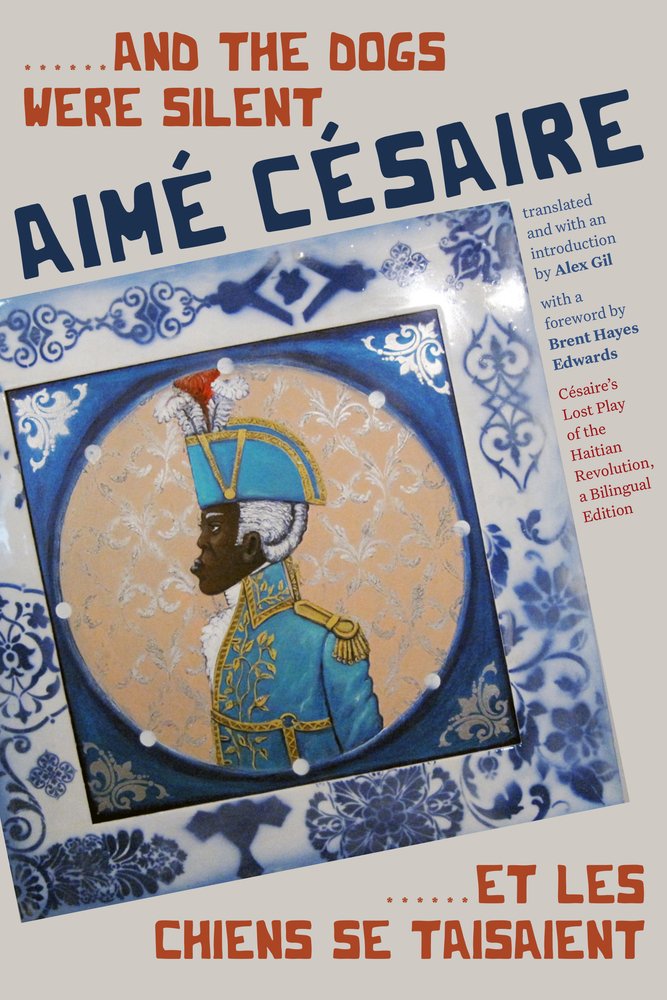
Césaire’s ambivalence (and, at times, outright condemnation) of the relationship of Haitian sovereignty to broader Caribbean decolonization is unwittingly demonstrated through the literary history of another of the author’s plays, ……Et les chiens se taisaient (……And the Dogs Were Silent), originally written in 1943, as discovered by scholar Alex Gil, but only published in entirely revised form as a drama in 1956 (an earlier poetic version had appeared as a part of Césaire’s collection Les armes miraculeuses [miraculous weapons] in 1946). Most students of Haitian revolutionary fictions would not consider Césaire’s 1956 drama to be part of the long history of attempts by foreign writers to portray Haiti’s revolution on the page or the stage. Yet the 1943 version that Gil unearthed while a graduate student at the University of Virginia squarely shows that Césaire’s first foray into historical theater did, in fact, entirely center on the Haitian Revolution and its most well-known figure, Toussaint Louverture, to whom Césaire would later dedicate a more historical treatment in 1960.4
Although Gil did not at first recognize what he had unearthed in French archives, he later determined that the 1943 text of ……And the Dogs Were Silent, though it shared the same name with the 1956 published play, was completely different in not only content and form, but also tone. The 1943 text shows a Césaire who was quite unabashed in his exaltation of how the Haitian people forced négritude to rise up and walk forward in a world that would condemn the violence of Black African revolutionaries while remaining silent about the much longer and broader violence of white American and European colonizers and enslavers. Gil recently translated the play from the French for Duke University Press. What follows is our conversation about the original draft of ……And the Dogs Were Silent and Césaire’s distinctive revision, rewriting, and total erasure of the Haitian Revolution in the later version.5 Gil’s remarkable translation, which offers new biographical information to contextualize Césaire’s interest in the Haitian Revolution, recently received honorable mention for the 2025 MLA Lois Roth Award.
Marlene L. Daut (MLD): First, can you talk about how you located this earlier version, or rather, this different version of Aimé Césaire’s ……Et les chiens se taisaient?
Alex Gil (AG): What an adventure! It’s been almost twenty years now. I had already started working on my dissertation, and like most graduate students, I was struggling to find something new to say. My research database already had more than a thousand entries for secondary sources on Aimé Césaire. Critics had been busy.
I had been trained at the University of Virginia to look closely at the materiality of texts and always pay attention to manuscripts. So I was on the hunt. I started looking for clues in the archives of those who played a secondary role in Césaire’s life.
I found a promising footnote in the biography of the poet Yvan Goll, who was the first to translate Césaire into English. His 1947 translation of the Cahier d’un retour au pays natal (Notebook of a Return to the Native Land), in fact, was the only Césaire book available to English speakers for several decades. The footnote said there was a folder with some Césaire materials among the Goll papers, housed in the small municipal library of the sleepy town of Saint-Dié-des-Vosges in France. The folder was said to include the proofs of the Cahier and a typescript of Et les chiens se taisaient. I made a deal with the Agence Universitaire de la Francophonie. They would finance my research trip, and I would publish with them anything that came out of it.
While I was in town, I only had time to photograph the contents of the folder. I did not realize what I had just photographed until weeks later, back on this side of the Atlantic, when I finally had time to study the images. You could imagine my utter disbelief when I started reading.
This was not the drama we knew at all! No. This was a play about the Haitian Revolution and Toussaint Louverture. It was written for the theater, and it had an avenging violence you could not find in any of Césaire’s whole oeuvre.
My dissertation changed on the spot. My joke today is that the typescript found me, and not the other way around.
For me, a text is worth studying regardless of form; that is, if it helps us understand something new about the world in which it was written, and if it can be useful for our own times.
MLD: All writers produce many drafts of their work before arriving at a definitive one for publication. So, what convinced you that this play was important enough to Césaire’s oeuvre to be worthy of both a published translation and greater literary study?
AG: Let me answer generally for both the typescript itself and for this earlier moment. I was never convinced by the sacredness of the book form; and definitiveness always seemed more like a marketing stratagem than a demand on my attention.
For me, a text is worth studying regardless of form; that is, if it helps us understand something new about the world in which it was written, and if it can be useful for our own times. If it passes both tests, that’s good enough for me.
During World War II, for example, we have an interesting confluence of circumstances that makes this irreverent attitude to the bound volume pay substantial dividends. Paris had fallen to the Germans. What we call “l’édition Française” went into disarray as a result. Paper became even more scarce in Martinique, where printed volumes were already rare even before Vichy took over half the empire. In hindsight, we can see now how much of our own deference to the book form was and still is a deference to Paris—both the real Paris, and Paris the metonymy for all rich centers with the resources to sustain this form of textual production and circulation.
Life was difficult in Martinique during the Vichy period. Due to an American blockade, hunger and disease were rampant. The journal Tropiques, stewarded by the young Césaire couple, was the only cultural publication allowed by the censors. By reading this typescript (and perhaps comparing it to the Césaire poems in Tropiques), we learn an enormous amount about Césaire’s relationship to the writing of freedom and the freedom to write in Martinique during this period. And all this we wouldn’t otherwise learn, if we waited for the imprimatur of the postwar version (as part of the poetry collection Les Armes miraculeuses [Miraculous weapons]) published in Paris in 1946.
That said, understanding the past just for the sake of understanding the past is, of course, not enough for me to dedicate my time to a project. The typescript also had to be significant and useful for our own time. And, for me, the resurgence of fascisms all around the world, the dangers of having a reasonable conversation about the fight for freedom in Palestine, and the insidious perpetuation of myths about Haiti, all meant that Césaire’s unknown play passed the test of timely significance. I hope, of course, those who read my translation and edition will agree.

MLD: Translation is a notoriously subjective genre. In some circles, it is considered a science, while in others, it is an art. What was the process of translation like for you?
AG: Translators tend to have two fears: The first fear we could call the fear of reduction: If you can’t capture the thing itself without loss, then why bother. The second fear is the fear of distortion: replacing the signature of the author with yours. If we’re going to encourage translation as a practice, I propose we make room for both the author and the translator.
All of that to say that translating Césaire was an exercise in courage for me. Some scholars and students can’t read in French but want to learn about Aimé Césaire, so I translated partly for them. I also wanted to wrestle with the meanings and artistry on the page, to reconstruct the whole, albeit in another language.
Whether this takes courage or foolhardiness, it is sometimes hard to tell. How many of us today feel brave enough to sit down with a difficult text and dare a line-by-line reading?
In the end, I leaned into it and dared a translation of everything into English, without mourning losses too much. I tried to preserve Césaire’s original tone as much as possible. Characters in the play could be angry, merry, tired, ironic, et cetera, in such transparent ways that it was not difficult to convey those tones in English. Humor was the most challenging one. Césaire’s sense of humor is a whole mood: somewhere in between laughing-not-to-cry, dark humor, and dad jokes. I doubt most readers could pick up on his jokes. They’re that bad.
Style is a whole other story. I can think of so many other writers in French that would have been more straightforward to translate for style. Césaire’s style is a mixed bag for the translator. Barring nuances, let’s say there are two dominant styles in the play: the prophetic and poetic voice of Toussaint and the Chorus, and the vernacular voices of everyone else.
The latter were relatively easy to translate. The former presented many challenges. On the one hand, Césaire’s choice of free verse let me have more flexibility and worry less about regular meter. In terms of rhythms and sounds, my job was to write new music in English inspired by the original French score. That was a challenge I enjoyed immensely. On the other hand, Césaire joins clauses all too often with the ever-elusive French “de.” Anyone would be hard pressed choosing between “of,” “from,” “with,” or “by.” I did not enjoy that challenge very much.
Like a few other important writers in the 20th century, Césaire transforms the historical revolution into a founding myth for Black freedom, at a time when there were still anticolonial battles to be fought…
MLD: Digging into the plot of the play itself, what would you say is the overall message of ……And the Dogs Were Silent? Where does it fit within Césaire’s broader legacy as one of the greatest anticolonial writers of the 20th century?
AG: The play overall celebrates the historical Black victory of the Haitian Revolution, and dreams of future ones. Like a few other important writers in the 20th century, Césaire transforms the historical revolution into a founding myth for Black freedom, at a time when there were still anticolonial battles to be fought; or, rather, antifascist battles, in Césaire’s understanding of colonialism. As there are today, we might add.
The play does a decent job of covering and synthesizing the outline of the revolution, from the rebellions in the north that sparked it to the ultimate victory in 1804. When you read it, though, time itself becomes more fluid; you see vast temporalities converging on the revolution, from the slave trade to the present. In this sense, the play uses a similar device to the one we find most recently in that glorious dance scene in Ryan Coogler’s Sinners.
The place of the drama in Césaire’s legacy is still to be determined. I’m too close to the text to speak with any measure. I can declare with confidence, though, that the play is by far his most violent and anti-French literary work. If we choose to bracket his support of departmentalization for Martinique, barely three years after he sent the text to Breton, we might be able to read this as a text that supports Martinican independence from France.
Despite all his regrets—and they came quickly after departmentalization—he was never a strong advocate for Martinican independence throughout his political career. This text speaks to a younger version of himself, who may have been entertaining the idea. The play also shows him writing for a popular audience, decades before he would return to the theater. We were supposed to understand this period in his trajectory as his surrealist period. Yet his play belies that characterization.
We see in this text many of the themes and moves that would play out over the decades in his writing. Here, in the typescript, we already find the notion of the imperial boomerang, the centrality of Haiti to his thinking, the unmasking of French doublespeak around equality and freedom, the tragic bind of the political leader fighting against colonialism, the idea that freedom in poetry can lead to freedom in the polis, and much more.
MLD: Why do you think Césaire so often turned to the theater—and, within that, to poetry—to communicate? Why do so, especially when he was also a brilliant essayist, and later, a historian?
AG: He was not much of a historian, to be fair. His work on Toussaint reads more today like the work of a brilliant essayist than the work of a serious historian. I personally think it is a masterpiece of political rhetoric, since he was writing it to prove that the French parliament had always been hypocritical when it came to freedom and equality for the colonies. The National Assembly of his own time, where he was an elected official, was the main audience for that text.
His theater, on the other hand, had a different audience. He even named it on the title page of his last play, Une tempête (A Tempest), first performed in 1969: “Adaptation for a Black audience.” As opposed to the closet drama with the same title, the typescript of ……And the Dogs Were Silent was written for an actual theater. The former 1946 version was part of a collection of poetry, and Césaire had removed all references to the revolution; but, equally important, he had reduced its theatricality to a bare minimum. The 1943 typescript is quite a spectacle, in contrast, and I imagine it would do well on an actual stage.
If I had to generalize, I would hazard that Césaire wrote for the theater when he wanted to get over himself and get outside of his bubble. In his poetry, the poetic “I” reigns supreme. That poetic I slips quite easily into a real I.
But in the drama, that I is forced to be in dialogue with others. The voice of Toussaint in the typescript is not that different from the I in the Cahier d’un retour au pays natal, which he had published in 1939. They sound almost the same, but with a very important difference: Toussaint must now talk to his people and to French delegates. The I must confront the other.
MLD: Tell us a little about the differences between this earlier version of the play, written in 1943, and the later version that most people know, which was first published in 1956. Why do you think Césaire rewrote this play in the way he did?
AG: Ah, the big question. To get at the big one, we can probably break it down into three smaller questions: Why erase Haiti and Toussaint Louverture? Why erase the theater? Why erase the avenging violence and Black victory?
The first one is the only one he answers directly in his correspondence. He told Breton in a 1944 letter that he wanted the original version destroyed because he wanted to remove the “subject matter.” This can be understood as Césaire declaring allegiance to what he understood to be one of the core tenets of surrealism: a rejection of the subject matter for the sake of a more direct and free way of writing. Césaire called it “daring life” in that letter. Ironically, Breton was moving in the opposite direction and was ready to embrace subject matter, after he saw what Césaire could do with it. Too late by now. Compounding ironies, Césaire erased all references to the revolution and Toussaint while sojourning in Haiti for much of 1944.
Why erase the theater? The second one we can derive from the first. On the same letter, Césaire confesses to Breton that he had come to realize that the drama was an internal drama, a drama of one. With that realization, the transition to a closet drama becomes easier to imagine. We should make a distinction here between drama and theater. While Césaire did remove most traces of theatricality in his revisions, the drama on the other hand is condensed, perhaps intensified, into a single form: the scene of temptation and refusal. A parade of characters—a lover, a mother figure, the bespectacled son, et cetera—all make their case to try to convince “The Rebel” to stop rebelling. The Rebel, of course, refuses and dies a tragic figure. In the typescript we do have some of these scenes of temptation, but these share the stage with other scenes that don’t even involve Toussaint/The Rebel and don’t fit the archetype of temptation/refusal. The typescript also uses many techniques suited for a theatrical spectacle, like screen projections and songs. These things become discardable when Césaire convinces himself this was an internal drama, if we are to take him at his word.
Why erase Black victory? That one is a harder nut to crack. The closet drama leaves the question of victory unresolved. The tragic hero dies after his rebellion failed. We are left only with the prophecy of a Black freedom to come, provided we agree that the tragic hero embodies its true spirit. This way of going about prophecy sadly replaces the historical fact of Black victory with a timeless failed rebellion. Too bleak, if you ask me. I much prefer a prophecy that was once fulfilled and remains open.
If we’re being perfectly frank, Césaire probably realized how hard it would be to stage a play with the refrain “death to the whites” during the Vichy years, even for the more hopeful and decidedly mixed audience of Free France. Maybe it was not the right time to remind everyone that the people of Haiti had vanquished the armies of Napoléon Bonaparte? Too soon?
MLD: What was the most surprising thing you learned about Césaire while researching the history of this play?
AG: Nothing can beat the surprise of reading the play for the first time in the crappy JPEGs I took after I returned from Saint-Dié-des-Vosges. Still, I’ll share two other surprises that do stick out.
The first one was learning that Aimé and Suzanne Césaire were having some difficult marital problems in 1944, and that these problems may have had something to do with some of the changes that were being introduced in the play around this time. In the same letter to Breton, where he declares the drama to be an internal drama, he also asks for Suzanne’s name to be erased from a poem he had sent previously. It is also around this time that he introduces the character of The Lover, which The Rebel eventually rejects in the first published version of the work.
The second surprise, I alluded to above. With some computational wizardry and some old-school codicology, I teased out the first stages of composition of the typescript. To my surprise, during the first stages of composition, Toussaint wasn’t as central to the action; instead, he shared the stage with other historical figures of the revolution like Dessalines and Biassou. At least, when Césaire sat down to write, circa 1941, he wrote over 20 pages where the hero of the revolution was not Toussaint as the tragic hero but rather was simply the people of Haiti.
To me this was astonishing, considering that the future representative of the Communist Party was already considering a work without the need for the tragic hero. In the Cahier, we already see him wanting to speak for his people, the I blown out of proportion. But there’s this one blip in time where he leaned in the opposite direction and tried to imagine a literary text without an individual at the center.
Sadly, once Toussaint started speaking and Césaire regained a taste for the tragic hero, there was no turning back. And these pages dissolved back into the silencing of drafts. 
- As transcribed in Françoise Vergès, Nègre je suis, nègre je resterai: Entretiens avec Françoise Vergès (Albin Michel, 2005), 56. ↩︎
- Vergès, Nègre je suis, 57. ↩︎
- Vergès, Nègre je suis, 57, 62. ↩︎
- Aimé Césaire, Toussaint Louverture: la Révolution française et le problème colonial. ↩︎
- Césaire, perhaps, alluded to his reason for converting Toussaint Louverture into simply “The Rebel” in later versions when he wrote to the cultural attaché at the Free French consulate in New York, Henri Seyrig, in 1944: “I don’t think that it will ever see the light of day. I’ve taken the wrong road. In spite of numerous modifications my attempt remains too historic. And that’s stupid. In my mind, it can’t be worthwhile unless I situate it boldly in the context of myth.” (Quoted in Kora Véron. “Césaire at the Crossroads in Haiti: Correspondence with Henri Seyrig.” Comparative Literature Studies 50. 3 [2013]: 437. [Emphasis in original]). ↩︎