Being reviewed:
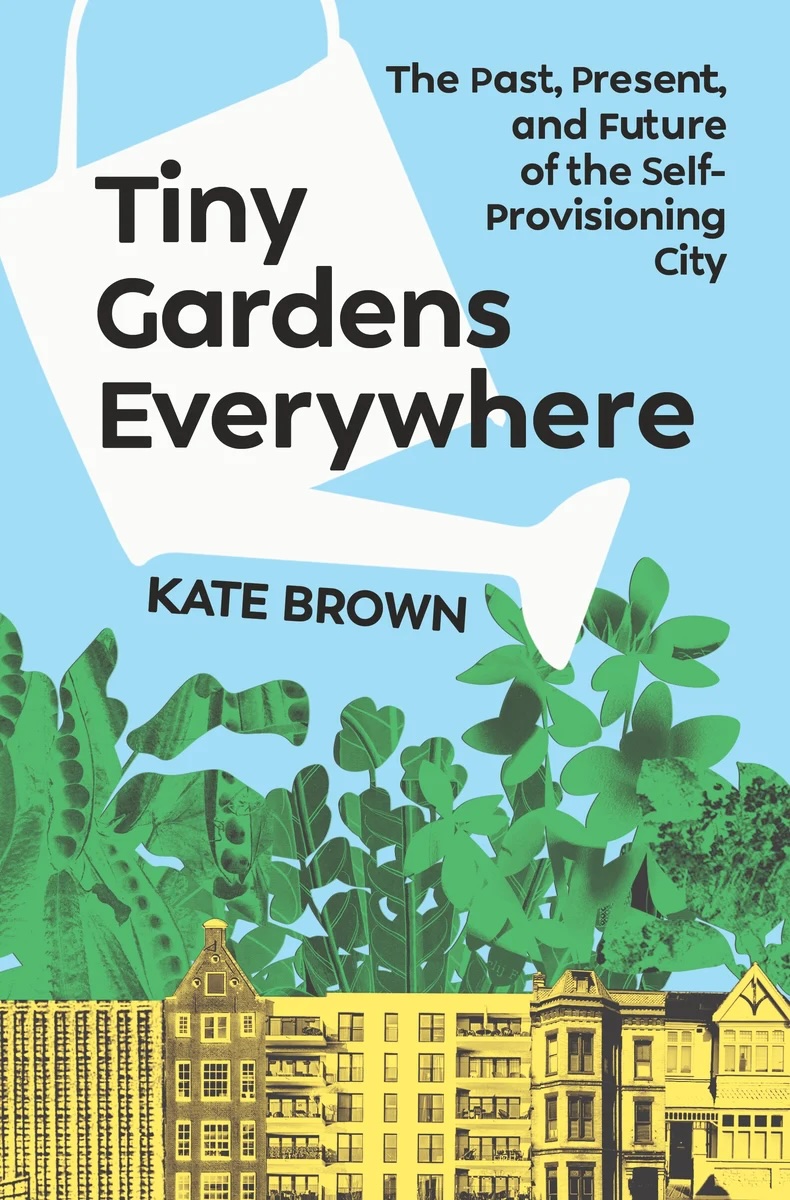
Tiny Gardens Everywhere: The Past, Present, and Future of the Self-Provisioning City
Advertisement
Kate Brown is a writer and a historian, an editor and a curator, a Soviet scholar and a gardener. She is the Thomas M. Siebel Distinguished Professor in the History of Science at the Massachusetts Institute of Technology, with a reputation for integrating archive-based, journalistic, and creative modes of writing. It’s a well-earned reputation, with five esteemed books—most of them on the environmental history of nuclear landscapes, a new one on urban gardens—plus fellowships from the Guggenheim Foundation, Carnegie Foundation, National Endowment for the Humanities, American Council of Learned Societies, and more, and recognition with awards inside and outside the academy from the likes of the American Historical Association, American Society of Environmental History, and Organization of American Historians, and as a finalist for a National Book Circle Critics Award in nonfiction. Beyond the listing of the accolades is Kate Brown the person, someone colleagues look to for creativity and literary spark and readers look to for pushing conventional writing norms and opening up new forms of expression—someone, I found out, who is very easy and fun to talk to. We caught up during a conference at a loud hotel café that had us huddled in a corner making sure we could hear, trying to rise above the din. She spoke about her new work, Tiny Gardens Everywhere, on the way to a longer conversation about her career, her ideas, and her passions.
B. R. Cohen (BRC): You’re a renowned Soviet historian and environmental historian of despoiled spaces, nuclear damage zones, and the like, plus someone fiercely committed to the craft of writing. You’ve now written a book about urban gardens, which seems like a departure from the earlier work. The question, then, is how did—
Kate Brown (KB): How did I get there?
BRC: Basically, yeah.
KB: I spent 20 years writing about modernist wastelands, especially, as you said, nuclear history. I’d go into the archives and think, When people find this out, it’s going to change everything. And … and you’re giggling, right, Ben? Because nothing changes and, in fact, not only does exposing the archive not deter things but we’re having a nuclear renaissance. …
BRC: The “If they only knew” dream.
KB: That’s the one. And still, I keep writing catastrophe narratives about wastelands that contribute to a populace that feels paralyzed and anxious and unable to do anything. The problem is too huge and overwhelming. So there’s that, my despondency over wasteland history, and, to your question about how I got here, there’s this: I like to garden. And when I garden, I’ve noticed, we don’t have to go to the store to get produce. My garden is growing, we just go back there and pick something and make it for dinner. And I was thinking, as opposed to nuclear policy, that’s something I have control over, my little tiny garden. It isn’t helpless and hopeless. That got me more and more curious about the history of gardens and the history of how people gain control over their space and their food. Were people in the past like me, did they feel like they were in some historic maelstrom? If they did, how did they scrape by? I got into that question because of gardening, but then I connected the issue of self-provisioning with my other curiosity about cities of the future. As in, what place have small garden spaces, urban gardens, household garden, public gardens, played in ideas about the future?
BRC: When I saw your title, my first thought was that it’s a Victory Garden history. …
KB: That’s part of it yes, though the book is really about commons and people who are in the commons. Places where people have recreated common law right to food, fuel, and shelter, which they make manifest as land on the edge of the city. Like sand dunes and gravel and empty lots. People take the nutrients from growing food and return them to disparaged lands, they turn degraded dirt into productive soil, the most productive agriculture in yield reported in human history. But it goes beyond that, because they also create social conditions and ways to build connections, like with garden associations.
BRC: They create community.
KB: They create community. Ebenezer Howard was a big name in the garden city movement—
BRC: This is in?
KB: He’s in England, it’s the late 1800s, early 1900s, and he witnesses the social value and he goes, “Oh, garden communities create the first signs of a social welfare state. We have people with TB in a sanatorium all coming together to volunteer in their building. People’s homes are burning down without fire insurance, let’s take up a collection. We don’t have anybody to look after the kids, let’s create a child care center. Let’s start summer camps.” And later, the state picks up on these things and mimics them.
BRC: I take it you’re thinking about commons in today’s society.
KB: Yes, because we have a lot of commons left in our cities, it’s just that we don’t talk about them that way. They are the spaces we devote to moving and parking cars, and I’m thinking we’re not going to need these big arteries and streets and parking lots because we’re going to have little electric people movers, and so we’re going to grow this space. We could let developers take it over, but with a change of ordinances and zoning permits and the like, we could instead keep these spaces collective and turn them into things like edible landscapes. Instead of curbside parking, you could have curbside gardens. Instead of needing parking spaces every time you build a condo, put garden spaces in the ground each time you build a new condo.
BRC: Recover what too many think is not “usable,” right?
KB: That’s it, recover, replant, return. The book is about people doing just that in Europe and North America in the long 20th century, using urban agriculture as a kind of transformative politics.
BRC: When we started, I admitted I know you for historical work, true, but also for the ways writing is important to you. Not just scholarship, but for you as a person, as a voice in the world. I want to ask more about that. As in, how did you learn the craft, was that interest innate?
KB: I always wanted to be a writer. But I didn’t know anyone who was one and so didn’t know how to become a writer. I landed in grad school at the University of Washington, less to get a PhD and more for insurance and to pay the bills while I pursued a freelance journalism career. I worked for the public television station for a weekly news show. Then I switched to a local NPR station, where I was a beat reporter. It was like “Boeing’s on strike!” at 8:00 a.m, and I’d have the story out by 4:00 p.m. It had to air, I had to get it done. The next day was a different story, say a controversy between Indigenous rights and hydropower, so I’d go to Snoqualmie Falls. Daily stories on deadline. That taught me a lot.
I had another problem. I’m there in grad school, I’m supposed to be writing long-form history, and nobody is teaching me how to write. There was no such thing as creative nonfiction at the time, so I started taking fiction writing classes just to learn things like narrative arc, dialogue, and plot.
BRC: Were you reading a lot? Fiction too?
KB: Yes.
BRC: Did the reading passion come first?
KB: It really did. I got my first degree in Russian literature and I always thought, I know a lot more about what happened in the past from novels than from histories. Most histories fell flat for me. They didn’t tell me how it felt, or what it looked or sounded like to be there. That’s what I wanted to know.
BRC: I remember how much I felt I learned about Russian agriculture from Anna Karenina.
KB: That’s so great. And you learn about the War of 1812 from War and Peace, the feeling, the mood, the tone. Which means, I was reading all these amazing dense theoretical texts in grad school, and I would also go to the movies or read a novel and I could see how the authors or directors were appropriating the big ideas I found in the scholarly texts and placing them in their art. So why can’t we do that as historians? Why do we put the big ideas through filters and make them less readable?
BRC: Did you get pushback on that impulse?
KB: Oh yeah. I wanted to write my dissertation as an intermittent first-person travelogue! It made sense to me that way. Most of my advisors thought that was a bad idea.
BRC: What was it?
KB: It became my first book, A Biography of No Place. It was about a border zone between Poland and Russia in the early 20th century densely populated with different ethnic groups. There were Jews, Poles, Germans, Czechs, Swedes living relatively peacefully and then, after 25 years, they’re all gone. Except for Ukrainians. The Soviets came in and emptied it. The Germans came in an emptied it. The Chernobyl accident finished No Place off. To tell the story, I had to travel. I had to go to places where people were deported or fled. I wanted it to be a first-person narrative in order to talk about the quest and problems involved in trying to tell the history of a place and people that no longer existed.
BRC: How did you get to Russia? Like, how did your training from grad school lead you to Russia and Ukraine?
KB: I went to Russia when it was still the Soviet Union as a student. Then I worked for the American Collegiate Consortium for East-West Cultural and Academic Exchange run out of Middlebury College, which was part of a Bush-Gorbachev student exchange agreement. It was an older retired diplomat and me, a 21-year-old. My job was to arrange to send the American students wherever they wanted to go in the Soviet Union. If they wanted to go to Yakutia, we would send them to Yakutia. And then after three months and then six months, I would check on them, and I would solve their problems. That was ’88 to ’91. The Soviet Union was on fire during those years. I’d watch as people dug in a church courtyard, pulled out some skulls, and said “Look, see this bullet hole, our Communist Party did this, they killed our people.” Soviets were using history to take apart the Soviet Union. That is power. I remember thinking, “I want a piece of that.”
I wanted to talk about the quest and problems involved in trying to tell the history of a place and people that no longer existed.
BRC: Your background in Russian literature led you to an interest in Russian history, I can see that, but how did radioactivity and nuclear energy and nuclear pollution become a research focus for you?
KB: In that first book, A Biography of No Place—which wasn’t about nuclear power—I included an epilogue about Chernobyl because that really was “No Place.” Nobody was living there. So I put an epilogue there, and then I went to Chernobyl in 2004 when they first opened it to tourists.
BRC: You visited from professional curiosity, or—?
KB: Honestly, I was interested because I came across a website by a Ukrainian woman named Elena. She had a motorcycle, a green Kawasaki, and a pass to go into the Chernobyl zone because her father had been a nuclear physicist there. She could just go in, saying it was the best place in the world to ride your motorcycle because there’s no traffic and you can just zoom around. The thing that jumped out at me from her photos were those of letters and photographs people left behind in their apartments. Chernobyl occurred five years before the collapse of the Soviet Union. I felt in 2004 like our US empire was collapsing, and I wanted to know if late Soviet citizens could tell their country was collapsing ahead of time. So, I thought I would go to Chernobyl, not to look at the accident, but as an informal archive to read through people’s journals and diaries.
BRC: That was all from the website?
KB: Yes. But hold on, because I went to the Chernobyl zone with an LA Times stringer and our guide on the ground, Raita, asks me, “What do you want to see?” and I say, “I want to see everything that’s in Elena’s website, those rooms with letters and photos.” And she says, “That website was a fake.”
BRC: What?
KB: She tells me, “Yeah, this woman showed up, she has this motorcycle helmet, and I was like, do you think that’s going to protect you from the radiation?”And Elena supposedly told her, “Well, my husband has a fetish for photographing me with my helmet on,” so she just took a bunch of photographs and added props to make it look better. I’d been totally set up, she made it all up. There were very few real letters. Her website was staged.
BRC: Well that took a turn.
KB: Right? But worse yet, then the LA Times stringer wrote about me, stupid professor. But you asked how I got interested in Chernobyl and that was it. After that whole experience, an editor saw the story and I ended up writing about being hoodwinked and how without the gatekeepers of an archive, it’s really hard to tell what the truth is. I used the whole episode to talk about how stupid I was, but also about all the work that happens before historians can substantiate a story. And without those people there, without a town anymore and archivists and heat and lighting, there is nobody to say “This is real and this isn’t.”
BRC: But you didn’t write about Chernobyl right then, right? I’m not sure if I have your timeline right.
KB: An editor asked me to write a history of Chernobyl after A Biography of No Place, that was 2004, 2005, but I thought, There’s too much attention on Chernobyl right now.
BRC: This is despite your ill-fated trip after that website duped you?
KB: That’s right, but what I was reacting to was that even before that, in the ’90s, I’d spent a lot of time in Ukraine in the fallout zone, and when I was there I noticed that in Siberia there was a place where Soviets made plutonium called Mayak that had two times more spilled radiation than Chernobyl. And everybody was talking about Chernobyl and nobody had heard of Mayak, so I thought I’d write about Mayak. That’s in Plutopia [from 2013]. But the thing is, I thought if I only wrote about Mayak everybody would say, “Yeah, the Soviets are just screwed up. First they had Mayak and then they had Chernobyl, they just don’t know how to manage nuclear power.” Except I’d been living in Washington State for 10 years and I realized that Hanford, where Americans made plutonium, had almost the same number of spilled contamination, about 350 million curies. How did that happen? Two totally different societies and economies and one is supposed to care about its citizens, the other is supposed to not, but they have the same volume of environmental toxins. I decided to write about them alongside each other.

BRC: This might sound like a digression, but I saw the panel at AHA you organized last year (2025) on “History Unclassified,” which is a section of the American Historical Review. Years earlier, your grad school advisors warned you away from going rogue inside the profession by violating common professional writing protocols. But in that panel, you mentioned an experience trying to get an article published about Ukraine that went against common convention too, and led to the “History Unclassified” series. I promise I’ll get us back on track, but can you say more about the origin story of that series?
KB: Well, I was getting sick of reading, oh, I shouldn’t say this—
BRC: Oh, go ahead, please.
KB: Okay, so I sent an article to the AHR and, yes, it was a weird submission. It was a screenplay that was fully footnoted. It was based on research I was doing in archives in Ukraine and Belarus having to do with Chernobyl. So your question isn’t actually a big digression. As part of the research, I had to pay a former Soviet journalist who was elected as a deputy to the parliament before the fall of the Soviet Union. She was on a commission in 1991 investigating who was responsible for the Chernobyl accident and all of the health problems that ensued. Three nuclear plant operators went to jail, but nobody believed they were solely responsible for the accident. The journalist-parliamentarian realized the Soviet Union was falling apart and she xeroxed the commission investigation documents during one long night because she understood the whole parliamentary commission would disappear with the collapse of the Soviet Union.
BRC: And she was right?
KB: She was right. She cited a snippet of what turned out to be a 45-page transcript of a top-secret politburo meeting with Gorbachev. All the big players were there. It occurred July 6, three months after the Chernobyl accident, and they were discussing what happened, who’s responsible, was this American sabotage or the KGB?, things like that. The head of the KGB says something to the effect of, “Actually it wasn’t American sabotage as much as we wish that were the case.” In the midst of this, guys like Gorbachev are making moves. He’s a real player, he’s using the accident to clean house and get rid of the people he thinks are standing in the way of his proposed reforms and put in new people.
BRC: That’s dramatic.
KB: Exactly what I thought. So I made this document into a screenplay. I liked the format of the stage—action from different times could be configured alongside one another onstage, a spatial rather than chronological narrative form. I figured out where they met at this gilded, mahogany table, an oval table with Gorbachev at the front and all these guys showing up who were bald because they had been at the Chernobyl site and lost their hair. I set the scene and they are talking and I wrote stage directions to give the context.
BRC: What’s a screen direction in that case?
KB: I couldn’t write extra dialogue because that would be fiction. So I put all the historian interpretation in the director’s notes. Screen directions would say characterize historical actors and give their biographies, like that. On another side of the stage the lights would go up on a man, a former nuclear operator, in a hospital ward—he says what he wrote in a letter I found in the archive to somebody in the Soviet government, where he says, and I’m paraphrasing here, “You guys told us how to run these plants, but this exact same accident occurred in 1975 in Leningrad and you revised the manual, but you put in special instructions in small normal print where you needed upper case letters.” Then I wrote how other people came in and gave their view of the accident to the politburo men. It was a way that I could have things happening asynchronously but brought together by the stage.
BRC: This was your submission to the AHR?
KB: Yes, I sent it to AHR, and it was all footnoted, it was my interpretation of the accident. I say to the editors, “I know this isn’t your normal format. I know you expect a thesis paragraph and then the author goes through a discussion of sources, and then another discussion of the historiography, and so on.” I tell them I don’t know why AHR has to have this one boilerplate for an article, but I would like you to consider my screenplay written in a fictional format, but it’s nonfiction, it’s history. I told them the story about how I got that document. I had to buy it from that woman, that former journalist, former parliamentarian. She charged me 600 Euros for it and it was a cloak and dagger transaction. Alex Lichtenstein was the editor and he sent it just to members of the board.
BRC: And?
KB: They hated it. I mean, except for one who said, I guess you could publish it, though I knew that was my friend. I told Alex, “Look how mad they are! Look how engaged they are!”
BRC: Was it the style violation that upset them?
KB: That’s the long and short of it, yes. They didn’t engage with the format, let’s put it that way. Alex was great, he was trying to decolonize the AHR at that time and that was part of my message too—only certain people can have the research support to produce the kind of article that gets published in the AHR. It takes hundreds of archival references and the funding for that travel and time. So we talked and he asked, “Do you want to start a section that does something different?” Of course I said yes, I’d love to. I thought, “If this kind of experimental narrative format could be published in the AHR, a journal of record for historians all over the world, maybe that could start to chip away at the boilerplates of history writing we’ve adhered to since the 19th century.”
BRC: It’s been going for about eight years now; it looks like you’re nearing 60 separate contributions.
KB: Yeah, and that’s what the AHA session (New York, 2025) was about.
BRC: I should let us get back on track then. We were talking about Soviet history before I jumped in to brag that I was at AHA.
KB: Though still, the two are connected, for sure. For me, it’s been about finding the most effective ways for people to care about history. And a lot of my work after the earlier stint in journalism did feel, indeed, journalistic. It was just through other venues.
BRC: Your book Manual for Survival, from 2019, was a finalist for the National Book Critics Circle Award in Nonfiction. I saw a review in the Economist that called it “a magisterial blend of historical research, investigative journalism and poetic reportage.”
KB: I worked on that after Plutopia, from 2013, where I also tried hard to bring a more journalistic sensibility to the work.
BRC: Like what you said about grad school days, freelance reporting on Boeing in the morning, working the NPR beat.
KB: It felt that way. I’ll give one more example, if we have time. This is from what became Manual for Survival. I found a treasure trove of documents in Ukraine’s Ministry of Agriculture records, and I knew it was a story. The papers were about the food chain, they were measuring food contamination, and it all keeps coming up radioactive. They’re trying to figure out what to do next, I read in the documents; how to keep people safe. I hired a research assistant in Belarus and one in Ukraine and we tracked the story. We got down to the county hospital records. I felt like I was working like a journalist again, but with far more time and resources than a beat reporter. I knew I was fortunate, I had three years straight to work on this project thanks to Carnegie and NEH grants.
BRC: What did you spend the time doing?
KB: A lot of it was talking to people, because, at the time the records were produced, thousands of people were writing to their government to say, “In our town, the fallout clouds passed us by, but the trucks come from Chernobyl and they drive right through the town and it goes right by the school and the kids are all sick. It’s this radioactive dust. And could you make a bypass?” Just thousands of letters like that.
In our travels to the old sites, we saw all these people picking blueberries, industrial-scale blueberries along the swamp where the Chernobyl plant had been. Women and children would come out with these wooden baskets of blueberries and they’d sell them to people with vans on the street. There were hundreds of vans buying blueberries.
So then we decided to go undercover blueberry picking. We went into the swamps and we picked berries and we sold them to the buyer, and then we followed the buyers to the warehouse, where the wholesaler was purchasing all the berries. She had a Geiger counter. I said, “How many of these berries are radioactive,” and she said, “They’re all radioactive, some are just really radioactive, like 3,000 bequerels a kilogram.” The threshold at the time was 450. Some were cleaner berries, some were dirtier; they were all purchased and mixed together to get to the threshold. I wanted to know how far they went in consumer markets.
I got all the way to the US and kept searching. There I am in a Whole Foods in Washington, DC, with a Geiger counter in the freezer, scanning all the berries that are labeled “wild.” I didn’t know if they were from Ukraine, it wouldn’t have said.
BRC: Did you get looks? Or everybody’s like, this is normal?
KB: No, actually, nobody looked at me. There was a woman poking in the next freezer with her phone—it looked a lot like my Geiger counter. But I didn’t find any radioactive blueberries. So I checked homeland security records and I found trucks coming across the border from Canada to the US where the Geiger counters were going off. When I called the officer who signed that record, I asked, “What was in the trucks?” And he says, as if I scripted him, “Blueberries from Ukraine.” I needed to find that, because I knew that for the American audience, even if they felt sorry for Ukrainians, it’s still a distant remote story. But when the blueberries are on their own breakfast table, then, suddenly, Chernobyl takes on new meaning.
BRC: I like that we started in urban gardens as spaces of vitality and uplift, and we’re ending along the traces of radioactive blueberries. They’re the produce you left behind for your new tiny gardens.
KB: That’s true, and in all of it, whether Soviet, Ukrainian, or in a tiny garden, I’d like the sum result of my history to be about people and their care around these issues. If that’s about how you, the reader, thinks more carefully about waste, thinks more carefully about living in places where there aren’t accidents, thinking about, in the least, not dumping nuclear contaminants and running away, then that’s a good direction. If it’s about spaces of uplift instead of places of desolation and decay, either way, I’d like to have a political impact. You spend a lot of time and energy on a book, it drives you crazy, but still, for me, it should have a political objective. 
This article was commissioned by B. R. Cohen.