Advertisement
When Boston University sociologist Susan Eckstein made plans to present her latest book in Miami in late 2022, she and her hosts at Florida International University were not expecting a public scandal. Cuban Privilege explored the comparative advantages Cubans fleeing communism had traditionally enjoyed under US immigration law.1 For most US migration scholars, the monograph did not advance groundbreaking arguments; it offered a fresh, meticulously documented portrait of a widely established fact.
Locally, however, the mere announcement of Eckstein’s talk touched a nerve. At the time, Cuba had entered its worst crisis since the fall of the Soviet Union: the product of the pandemic, “maximum pressure” US sanctions held over from the first Trump administration, and stubborn internal resistance to liberalizing reform. That crisis had fueled unprecedented civic discontent, culminating in island-wide protests in July 2021 and a subsequent exodus: 250,000 in about a year.2 Some of Eckstein’s Miami critics focused on defending their parents’ legacies as anti-communist exiles and refugees that were deserving of admission into the United States. Others expressed concern for new Cuban migrant families that the Biden administration was permitting to cross the southern border with only indeterminate legal statuses.
Needless to say, few actually read Eckstein’s work. In fact, Cuban Privilege acknowledged that Cubans had found it more difficult to access immigration benefits in the United States over the last decade. Regardless, to label the Cuban experience “privilege”—at a moment when so many were undertaking harrowing journeys to the US-Mexico border—understandably struck many in South Florida as the epitome of liberal insensitivity. Local officials and self-anointed Cuban exile leaders demanded an opposing perspective be added to the event, or that it be canceled outright. These same voices, not surprisingly, were also supporters of Donald Trump’s tough talk against Cuba’s communist government and already lining up behind his reelection campaign.
What a difference three years makes. Today, Trump is back in office and Cuba’s crisis has gotten worse. So has the exodus, which now stands at over a million. By January 2025, 850,000 came just to the United States, making this the largest cumulative out-migration in the island’s history, both in absolute numbers and as a percent of the population: around 13 percent.3
And yet, since returning to the White House after a decisive 2024 election victory, the MAGA movement has not only further closed legal Cuban migration channels, but also aggressively pursued migrants from the recent exodus for detention and deportation. All the while, Cuban Americans who called for picketing Eckstein’s 2022 presentation because of her alleged bias against Cuban exiles have been conspicuously quiet.
Put another way, those most offended by the notion that Cubans possess “privilege”—those most insistent that Cubans had a moral right to seek refuge in the United States—have had little to say as the second Trump administration tries to bury Cubans’ access to the American dream for good. Now, in the wake of the administration’s dramatic capture of Venezuelan President Nicolás Maduro, a close Cuban government ally, more Cuban Americans also seem to be implying that the role of Cubans on the island is to stay and fight, especially if Havana might be Washington’s next target.4
In part, this thinking reflects a double standard and instrumental logic from an immigrant group that has tied its political fortunes to both the most anti-immigrant president in modern US history and one who has explicitly revived Monroe Doctrine–style pretensions of getting his way in the Western Hemisphere. But whatever the mind meld among most Cuban Americans in South Florida on foreign policy, bonds within the community have become more fragile due to differences over immigration affairs. Faced with a choice between Trumpism and migrant solidarity, Cuban America has marshaled, at best, an equivocal response. What will come next?
How We Got Here
When Cubans first began leaving the island in the early 1960s—after the Cuban Revolution’s turn to communism—the United States famously opened its doors, influenced by the politics of the Cold War. Throughout the 1960s and ’70s, US presidents leveraged the so-called parole authority granted to the executive branch under the Immigration and Nationality Act to award Cubans a de facto refugee status, quite different from the standard of individual persecution required by US refugee law today. Combined with support from the federally funded Cuban Refugee Program (1960–1973) and the Cuban Adjustment Act (CAA) of 1966, which allowed any Cuban legally admitted to the United States to claim permanent residency after two years (reduced to one in 1976), liberal immigration policies helped exiles from Castroism begin climbing the ladder to economic success and political influence as Cuban Americans.5
This open door first began narrowing during the 1980 Mariel Boatlift, when the Carter administration detained upward of 50,000 predominantly single, Black, and working-class Cuban migrants temporarily on military bases, and then deemed 3,000-plus excludable from entry permanently. It inched further closed when the rafter crisis of 1994 led the Clinton administration to implement the “wet foot, dry foot” policy. While still guaranteeing entry and a path to legal status to any Cuban who reached US shores, the United States now committed to turning back those interdicted at sea. It was Barack Obama, however, who nailed the open door shut, just days before Trump’s first inauguration, when he ended guaranteed entry for “dry feet” arrivals completely. If the United States under Obama had made historic strides to normalize diplomatic relations with Havana, it stood to reason that Washington might also move to handle Cuban migrants more like migrants from other countries.6
Ironically, this shift set the table for Trump to treat Cuban migrants in line with his restrictionist immigration priorities, even as he broke with Obama’s normalization efforts with Cuba, cultivated conservative Cuban American voters, and reimposed harsh sanctions on the island’s government and economy. As conditions on the island worsened in 2018 and 2019, and as consular services for legal migration ground to a halt after US diplomats reported mysterious “sonic attacks,” Cubans reaching the US-Mexico border by tortuous land journeys through South and Central America now had to file difficult-to-prove asylum claims. For the first time, Cubans arriving at the border were subjected to expedited removal (often back to Mexico) and immigration detention.7
Faced with a choice between Trumpism and migrant solidarity, Cuban America has marshaled, at best, an equivocal response. What will come next?
Such challenges faded from view in 2020, as pandemic border closures and travel restrictions reduced migration. But Cuba was now in a full-blown economic emergency, with GDP declining 10 percent that year, as tourists from around the world stayed home. Island-wide protests on July 11, 2021, were repressed. As soon as Cuba reopened its borders several months later, the Cuban government’s close ally Nicaragua announced a convenient visa waiver that let Cubans bypass the Darién Gap via a direct flight to Managua. A summer of discontent quickly turned into an unparalleled rush to the exits.
The Non-Crisis Crisis
The Biden administration responded with a mix of generosity and improvisation. As Cubans joined Venezuelans, Nicaraguans, and Haitians among the top nationalities arriving at the southern border in 2022, authorities admitted them under a patchwork of statuses.
The problem was that no clear logic determined who qualified for which. Thousands bypassed removal, detention, and formal asylum protocols to receive humanitarian parole: a limbo of “we’ll figure out what to do with you later.” Yet much like the original grants of “parole” in the 1960s, this counted as legal “entry,” and thus set them on a path to permanent residency per the CAA. Thousands of others, however, were given I220A forms—notices to appear in immigration court that did not count as legal “entry”—leaving their status unresolved.
Facing political backlash nationally over surging border numbers, the Biden White House introduced a third pathway: “advanced humanitarian parole.” Channeling carrot-and-stick logic, the administration made border entry more difficult, but allowed Venezuelans, Haitians, Nicaraguans, and Cubans to fly directly to the United States, if a family member or friend sponsored them. Marketed as “temporary” relief, the parole was valid for two years.
Even here, though, Cubans retained access to special immigration benefits. As another form of legal “entry,” Biden’s advanced parole program still made Cubans eligible for permanent status thanks to the CAA, whereas it did not for Venezuelans, Haitians, and Nicaraguans. More than 100,000 benefitted through 2024, while Cubans also were among the top nationalities continuing to enter via land using CBP One, a new asylum-appointment app.8 Meanwhile, the administration slowly resumed consular services at its embassy in Havana for family reunification and other legal migration categories.9
Oddly, this surging migration from Cuba—and elsewhere—generated only passing concern in Miami. The issue was certainly present in public conversation and media coverage. But aside from criticism of families renting mobile homes in their driveways to recent arrivals, local leaders’ response to the historic numbers never matched the intensity or crisis framing that accompanied other Cuban mass migration events like the Mariel Boatlift or the rafter crisis of the 1990s.10 With most arrivals entering through the US-Mexico border, it was as if Cuban Miami was expanding through a back door. Many Cubans were also settling in cheaper-rent cities like Louisville, Las Vegas, and Houston.11

Nor did debates in the run-up to the 2024 elections focus extensively on the uncertain fate of as many as 400,000 Cubans with I220As or other precarious statuses vulnerable to policy reversal. Some I220A holders organized to raise awareness of their circumstances, but nothing slowed the growing momentum behind Donald Trump’s candidacy for reelection among Cuban Americans.
If anything, a kind of collective disassociation set in. When Trump claimed that Biden had misused parole authority—as with “advanced humanitarian parole”— many Cubans reassured themselves: Trump isn’t talking about us. He’ll target the criminals and the gangs for deportation. We still have the Cuban Adjustment Act. He owes Cuban Americans our votes. Such thinking led families who had welcomed relatives under Biden-era programs to help deliver an outright Republican victory in Miami-Dade, the county’s first in 36 years.12
The Dragnet and the Response
Since then, many of these families have had a rude awakening. On his first day in office, Trump issued an executive order ending Biden’s advanced humanitarian parole program. Within weeks, Cubans already in the United States with parole began receiving notices that their status was being revoked. Those who had been in the country long enough to claim permanent residency under the CAA could ignore directives to self-deport. But some 26,000 who had entered less than a year earlier were out of luck.13
At the same time, recent and not-so-recent Cuban migrants began being detained during routine check-ins with Immigration and Customs Enforcement (ICE) or at immigration hearings. They included I220A holders from the post-2021 surge.14 But authorities have also targeted migrants from years ago with pending deportation orders, due to criminal convictions or even minor criminal records now being used to justify the revocation of status.
Cuba has long resisted the deportation of Cuban nationals with criminal records in the United States, and it is not prepared to accept tens of thousands of deportees. Over the course of 2025, though, Havana allowed twelve deportation flights, with nearly 1,500 on board.15 Bilateral relations with Washington have sunk to a familiar nadir since Trump’s return, yet Havana clearly has been hoping that limited cooperation might show anti-immigrant MAGA stalwarts the value of pragmatic ties. Meanwhile, Washington has been quietly sending others to third countries like Mexico or faraway Eswatini.16
These developments have generated significant outrage and anxiety in the Cuban community. An aerial photo of Cuban detainees spelling “SOS” in the yard at Miami-Dade County’s notorious Krome Detention Center went viral.17 So did the case of Heidy Sánchez, who was separated from her still-breastfeeding baby when she reported to an ICE check-in and deported within a day.18 Legal migration has become next-to-impossible, too, after Trump listed Cuba as part of a partial travel ban in June, leading to the rejection of family reunification petitions years in the works.19
The most politically combustible cases, however, involve dissidents tied to recent protest movements on the island. Threatening them with deportation most directly undercuts Cuban Americans’ traditional conceptions of the United States as a refuge from repression.
Rapper “El Funky,” coauthor of the popular protest anthem “Patria y Vida” that helped fuel the historic July 2021 protests on the island, saw his Cuban Adjustment Act claim initially denied over a past drug conviction in Cuba.20 Oscar Casanella, a member of the dissident San Isidro Movement artist and intellectual collective, endured a seven-hour hearing but did not receive a definitive ruling on his asylum claim.21 A former activist of the dissident group Ladies in White has one son jailed in Cuba for participation in the July 11 protests and another in US immigration detention.22 Even the seven-year-old daughter of Cuba’s most prominent dissident, José Daniel Ferrer, faces deportation and separation from her mother, who arrived in 2019.23 Ironically, Ferrer himself was recently granted formal refugee status after the Cuban government released him from prison on the condition that he leave.24
Sympathy, to a Point
This flurry of stories has put the Cuban American political class—at the apex of its power with Marco Rubio as Secretary of State—in a bind. Congresswoman María Elvira Salazar has been the most outspoken. She has called for relief for Cubans with I220As, defended a path to adjustment for those who entered under Biden’s parole program, and aided several high-profile dissident cases. She has also introduced her own more comprehensive—if in many ways draconian—immigration reform bill: the so-called Dignity Act.25
Yet in trying to stay close to the Trump White House while advancing a more moderate line on migration, Salazar and other Cuban American Republicans are attempting to have it both ways. Echoing Trumpian rhetoric, Salazar accuses Biden of “abus[ing]” the parole program to “indiscriminately” allow too many migrants into the country “without a plan for their future.” At the same time, she claims to want solutions for the program’s now vulnerable beneficiaries.26 Getting publicly in Trump’s crosshairs has rarely proven a winning strategy for Republicans pressing for concessions. But when Salazar and Cuban American congressional colleagues have had behind-the-scenes leverage—such as during the tight vote on Trump’s “Big Beautiful Bill” last spring—they used it to temporarily get their way on US policy toward Venezuela, not migrant relief.27
For some constituents, Cuban American elected officials’ verbal support for at-risk Cubans rings hollow. Billionaire ex-Republican donor Mike Fernandez has funded billboards across South Florida, accusing Rubio, Salazar, and Representatives Mario Díaz-Balart and Carlos Giménez of betraying their immigrant heritage.28
Still, in many corners of Cuban America, the dam of Trump support is holding, buoyed by the recent, spectacular, albeit still unfolding ouster of Maduro in Venezuela in early January. The hope is that knock-on effects for Cuba, which relied on Venezuelan oil, will finally bring the government in Havana to its knees.
At the same time, competing narratives about recent arrivals have eroded ethnic solidarities. For instance, influential right-wing influencers have taken to criticizing supposed “pan con bistec” (“steak sandwich”) recent arrivals—that is, those who only care to enjoy capitalism’s bounty without taking a stand against the Cuban government.29 Naturally, few of these influencers ever took much of a stand themselves when still living in Cuba or in their early years in the United States.
Some Cuban exile groups and elected representatives have also been circulating lists of alleged Cuban security officials, human rights abusers, or regime-connected elites admitted under parole programs, echoing Trump’s charge that Biden flooded the nation with criminals. Their concern is not without basis. But the McCarthyite form these campaigns have taken—and the fact that Trump’s law enforcement agencies are acting on such tips—fuels an uglier debate over which Cuban migrants are most worthy.30 It is hard not to see the campaign as a smokescreen for the administration’s wider immigration crackdown, which many Cuban Americans might otherwise struggle to justify openly.31
Parallel developments have struck at another sacred symbol of the Cuban American story: the Cuban Adjustment Act. In summer 2025, US customs officials began aggressively questioning Cubans with permanent residency—including migrants from the past five years—when they returned from trips to the island.32 Such visits remain legal, and they serve as lifelines to families amid Cuba’s dire humanitarian crisis. But officials have now implied that return trips violate the immigration benefits recent migrants received under the CAA, leading to a sharp drop in demand for flights.33 For Cubans who claimed they had a credible fear of returning back to Cuba to gain admission at the border, detractors may have a point. Regardless of whether migrants pursue an asylum claim to a final ruling or avail themselves of other immigration pathways first, visiting the island after reporting a credible fear could be considered lying to an immigration official, which is grounds for the revocation of legal status. Yet for decades, Cubans have used the CAA as the most expeditious path to permanent residency, and in most cases (including under the recent advanced parole program), doing so has not required making a formal asylum claim or been interpreted as a bar to returning home.
The difference is that today more Cuban American leaders are openly talking about ending purported “abuses” of the CAA, or abolishing it outright, as a corollary of sanctions maximalism and regime change.34 That is, they believe maximum pressure on the island cannot bring about the collapse of the Cuban government as long as migration offers a safety valve for discontent, or a vehicle for remittances to bail out struggling families. By this, they imply that Cubans in Cuba should stay indefinitely and resist, even though they themselves or their parents did not.35
those most offended by the notion that Cubans possess “privilege” have had little to say as the second Trump administration tries to bury Cubans’ access to the American dream for good.
With the administration announcing in late November that it is pausing all remaining legal immigration filings available to Cubans (including asylum and adjustment of status under the CAA), as well as a post-facto review of all grants of asylum and permanent residency, proponents of such a migration lock-down appear to have gotten their wish.36 And, again, with Maduro’s removal prompting excited speculation about follow-on actions for Cuba, the ugly stakes of the intertwined foreign policy and immigration discussions have come into sharp relief. Reading between the lines of comments by influential nativists in Trump’s orbit like Steven Miller, or even Trump himself, it is plausible they think one benefit of regime change in Cuba, like in Venezuela, would be to facilitate the greater removal of recent “third world” migrants they distaste and believe the United States does not need.37
A Fraught Centennial
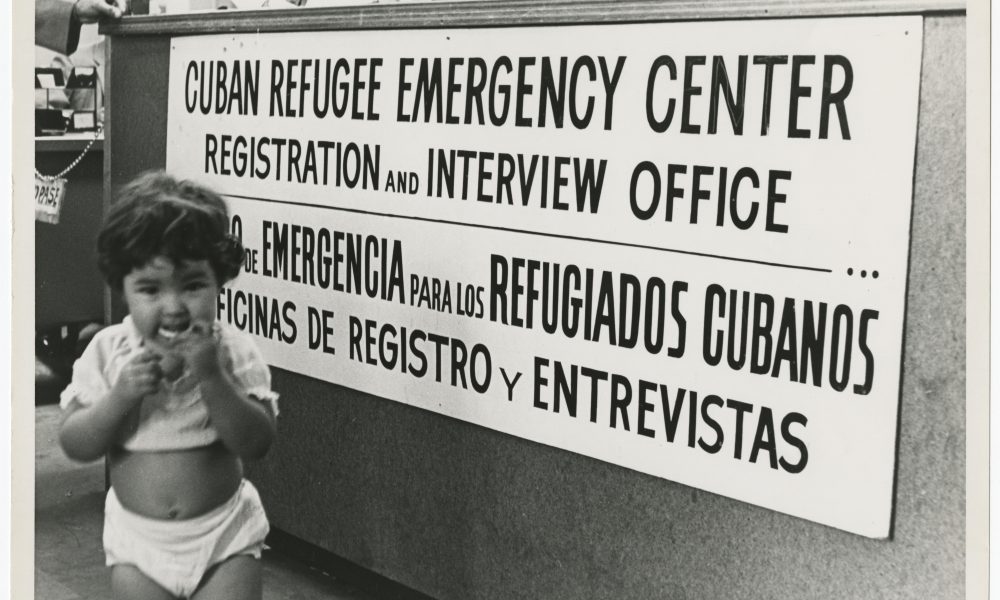
Against this backdrop, it is painfully ironic that the city of Miami is celebrating the centennial of a structure ingrained in Cuban American memory as a site of refuge, openness, and migrant support. The so-called Freedom Tower on Biscayne Bay has had several lives over the past century. Most well-known was its turn as the Cuban Refugee Emergency Center, or el refugio: the headquarters of the federally funded Cold War program referenced earlier that disbursed roughly $2 billion in aid to help 400,000 exiles from Castro land on their feet in the 1960s and ’70s.38 Incidentally, that is the same number of Cubans in immigration-status limbo today.
Owned by Miami-Dade College since 2005, the building recently reopened with moving new exhibitions, a “symbol of opportunity” and the dreams of “hundreds of thousands of Cubans [who] fled Cuba in search of refuge and freedom from political oppression and economic hardship,” per a video in the opening gallery.39 Are these not the same forces that drove so many Cubans and other Latin Americans to the United States recently? Can a monument to Miami’s immigrant history ignore the fears and anxieties confronting Cuban and other migrants today? In their remarks at the official unveiling, not a single official or dignitary acknowledged these elephants in the room.
Worse, two weeks later, Miami-Dade College’s Board of Trustees—composed largely of Cuban Americans—quietly voted to transfer title for a parking lot across the street to the state of Florida. Florida’s Attorney General then promptly announced that the land would be the site of a future Trump library and adjoining hotel. Valued at a minimum of $60 million and possibly tens of millions more, the prize of the downtown plot more than cancels out the $25 million state appropriation that helped fund the Freedom Tower’s renovation, raising questions about a financial giveaway and influence peddling.40 Activists were granted an injunction against the gift on procedural grounds. But after a rescheduled board vote with opportunity for public comment, the injunction was lifted, and the project is free to proceed.41
It may be ahistorical to refer to the Freedom Tower as the “Ellis Island of the South,” as many Cuban Americans lovingly do. Ellis Island processed multiple immigrant groups and served as a detention facility; the Freedom Tower did not. Still, to see Miami erect a monument next door to a president who openly disdains most immigrants, especially those from Latin America, will be a tragedy. Just as sadly, an ostensible symbol of Cubans’ flight from communism to democracy will be abutted by a shrine to a US president who still refuses to accept his 2020 election loss.
One hopes the restored Freedom Tower can still serve as a call to action. It can offer a reminder of when Cubans were welcomed by a robust federal policy, as well as an implicit plea to a splintered community to recognize itself in the struggles of its newest arrivals. But given its future neighbor, the restored space could just as easily reinforce a belief in Cuban American exceptionalism, as if our migrant pasts bear little relation to so many Cuban and other migrants’ needs for refuge and solidarity in the present. Returning to Eckstein, that may be the most enduring form of Cuban “privilege”: not a benefit under immigration policy, but a founding segment of the community’s belief in its own superiority.
In the meantime, far from triumphalist talk of freedom and opportunity, thousands of recent Cuban arrivals—from Homestead to Houston—face legal uncertainties most of their predecessors avoided. This highlights the need for new paradigms in Cuban migration studies that pay closer attention to processes of exclusion, marginalization, and return. Over the summer, Secretary of State Marco Rubio went so far as to suggest that too many Cubans find it “easier” to “abandon” the island than build its future, echoing the Cuban government’s traditional equation of migration with betrayal.42 But there is nothing “easy” about being returned to a country that might be a future objective of the White House’s revival of gunboat diplomacy—and that, by most measures, is already falling apart. 
This article was commissioned by Geraldo Cadava.
- Susan Eva Eckstein, Cuban Privilege: The Making of Immigrant Inequality in America (Cambridge University Press, 2022). ↩
- For a good summary, see Andrés Pertierra, “The Cuban Exodus,” Dissent, vol. 72, no. 2 (2025), pp. 29–36. ↩
- Yilena Héctor Rodríguez and Alejandro Oswaldo Anzardo Álvarez, “Cuba en datos: ‘La población cubana envejece, decrece y se urbaniza,’” Cubadebate, June 12, 2025. Independent demographers estimate the decline may be even more dramatic; see Carla Gloria Colomé, “From a Population of 11 Million to Little More than 8.5 Million: The Real Toll of Cuba’s Migratory Crisis,” El País, July 23, 2024. ↩
- Maria Abi-Habib, “After Venezuela, Trump Says Cuba is ‘Ready to Fall,’” New York Times, January 5, 2026. ↩
- Mauricio Castro, Only a Few Blocks to Cuba: Cold War Refugee Policy, the Cuban Diaspora, and the Transformations of Miami (University of Pennsylvania Press, 2024). ↩
- Eckstein, Cuban Privilege, pp. 74–286. ↩
- Noah Lanard, “‘This Country Is Worse than Cuba’: The Trump Era’s Cruel Reality for Cuban Asylum Seekers,” Mother Jones, July 16, 2019. ↩
- US Customs and Border Protection, “CBP Releases October 2024 Monthly Update,” November 19, 2024. ↩
- Megan Janetsky, “Facing Migration Flood, US Resumes Services at Cuba Embassy,” Associated Press, January 4, 2023. ↩
- Lorena Inclán, “‘This is Deplorable Housing’: Fight Continues over Illegal Mobile Home Rentals in Hialeah,” NBC News Miami, January 10, 2024. ↩
- Miriam Jordan, “The New Little Havana: Why Cuban Migrants Are Moving to Kentucky,” New York Times, August 26, 2023; Anna-Catherine Brigida, “Record Numbers of Cuban Immigrants Are Choosing to Make Houston Their Home,” Houston Landing, December 28, 2023. ↩
- Joe Gorchow, “Miami-Dade Republicans Basking in Red Wave,” CBS News, November 6, 2024. ↩
- Carla Gloria Colomé, “Estados Unidos entierra por primera vez el sueño de una green card para 550.000 migrantes cubanos,” El País, April 1, 2025. ↩
- Syra Ortiz Blanes, “Cubans with I-220A Forms Are Suddenly Being Detained. Here’s Why—and What They Can Do,” Miami Herald, March 21, 2025. ↩
- “Vuelo de cierre de año a la Habana: 128 cubanos deportados; record histórico de Trump asciende a 4,883,” Café Fuerte, December 19, 2025. ↩
- Clare Healy and Syra Ortiz-Blanes, “Cientos de cubanos residentes en el sur de Florida desde hace años están siendo deportados silenciosamente a México,” El Nuevo Herald, October 21, 2025. ↩
- Claire Healy and Syra Ortiz-Blanes, “Cuban Detainees Launch Protest at Krome Detention Center,” Miami Herald, June 5, 2025. ↩
- Patrick Oppmann, “Deported from Florida to Cuba, This Mom Saw Her 17-Month-Old Daughter—and Her American Dream—Ripped Away,” CNN, May 5, 2025. ↩
- David Ovalle, “Travel Ban Separates Cuban Families, Divides Community Loyal to Trump,” Washington Post, October 19, 2025. ↩
- After an outcry, his case was reopened and eventually resolved. See “Rapero cubano El Funky obtiene la residencia en Estados Unidos tras apelación,” Cubanet, September 18, 2025. ↩
- Maylín Legañoa, “Tras más de 7 horas de juicio termina sin una decisión final el caso del opositor cubano Oscar Casanella,” Telemundo Miami, June 24, 2025. ↩
- Carla Gloria Colomé, “Un hijo secuestrado por el castrismo y otro por el trumpismo. La agonía de la dama de blanco Yaquelín Boni,” El Estornudo, August 19, 2025. ↩
- Carla Gloria Colomé, “Daniela Patricia, una niña cubana de siete años frente al laberinto de las cortes migratorias de Estados Unidos,” El País, April 17, 2025. ↩
- David Adams, “Cuban Dissident Leader Leaves Prison for Exile in the US,” New York Times, October 13, 2025. ↩
- Jesus Mesa, “Can a Lawmaker Be Fully MAGA and Still Push for Immigration Reform?,” Newsweek, July 22, 2025. ↩
- Sherrilyn Cabrera and Helen Acevedo, “Miami Congresswoman Wants ‘Protection’ for Migrants with Temporary Permits under Biden Program,” WLRN, January 24, 2025; Adriana Gomez Licon, “3 House Republicans from Florida with Cuban Roots Carefully Navigate Trump’s Immigration Policies,” Associated Press, April 26, 2025. ↩
- Marc Caputo, “How Trump Saved His Big Bill by Killing a Venezuela Oil Deal,” Axios, May 23, 2025. The victory proved pyric, as the White House greenlit a slightly more restrictive license from Chevron to resume pumping oil in Venezuela in July. ↩
- Patricia Mazzei, “The Billionaire behind Mysterious Immigration Ads Targeting Miami Republicans,” New York Times, August 3, 2025. ↩
- “‘Cuban Bread with Steak’: The Symbol of Double Standards in Miami,” Cibercuba Noticias, October 24, 2025. ↩
- “Carlos Giménez Will Deliver a New List of Repressors and Frontmen of the Cuban Regime to the DHS,” CiberCuba, July 22, 2025; Eduardo “Yusnaby” Rodríguez, “Exfuncionario cubano relacionado a los Castro es arrestado por ICE en Las Vegas,” Telemundo Miami, July 22, 2025. ↩
- It is also reminiscent of how some Cuban Americans in 1980 expressed solidarity for relatives who migrated via the Mariel Boatlift but distanced themselves from the larger group when national and local media painted Mariel migrants with a criminalizing brush. See Alexander Stephens, “Making Migrants ‘Criminal’: The Mariel Boatlift, Miami, and US Immigration Policy in the 1980s,” Anthurium, vol. 17, no. 2 (2021). ↩
- “Una cubana con residencia denuncia maltrato en aeropuerto tras regresar de la isla,” Univision, August 18, 2025. ↩
- “Another Blow to US-Cuba Flights: Southwest Reduces Operations between Tampa and Havana,” Cibercuba, August 7, 2025. ↩
- Alberto Arego, “Ley de Ajuste Cubano: El debate cíclico que genera miedo,” El Estornudo, August 29, 2025. Rubio first began criticizing alleged “abuses” of CAA a decade ago. See Michael J. Bustamante, “Is the Cuban Adjustment Act in Trouble?,” Cuban Counterpoints, June 4, 2015. ↩
- See remarks by Mauricio Claver-Carone, former Special Envoy for Latin America, at Miami-Dade College in early 2025, summarized in Nora Gámez Torres, “Trump Envoy Warns of ‘Short-Term Pain’ as Administration Cracks Down on Cuba, Venezuela,” Miami Herald, April 3, 2025. Also see “Congressman Carlos Giménez Calls for Cancellation of Flights and Remittances to Cuba,” OnCuba, April 5, 2025. ↩
- Announced in response to the shooting of US National Guard members by an Afghan refugee in late November 2025, the measures are part of a deeper crackdown on and review of migrants from nineteen so-called “countries of concern” included in the administration’s June 2025 partial and complete travel bans. See Anna Faguy, “Trump administration will re-examine green card holders from 19 countries,” BBC, November 27, 2025; “Administración Trump suspende procesos de asilo en medio de escalada contra inmigrantes,” Café Fuerte, November 28, 2025. ↩
- Reuters, “Trump Speaks After US Strikes Venezuela and Captures Maduro,” YouTube, January 3, 2026; CNN, “Stephen Miller Says US is Using Military Threat to Maintain Control of Venezuela,” CNN.com, January 5, 2026. ↩
- Castro, Only a Few Blocks to Cuba, p. 4. ↩
- Full disclosure, I was a consultant on the project. ↩
- Patricia Mazzei, “Florida Hands over Prime Miami Property for Trump Library,” New York Times, September 30, 2025. ↩
- Claire Heddles, “Miami Judge Lifts Block on Trump Library Land Transfer, Tosses Sunshine Law Case,” Miami Herald, December 18, 2025. ↩
- NoticiasCubanet Cuba, “Mensaje al pueblo cubano de Marco Rubio, Secretario de Estado de Estados Unidos,” YouTube, July 9, 2025. ↩