
Being reviewed:
Advertisement
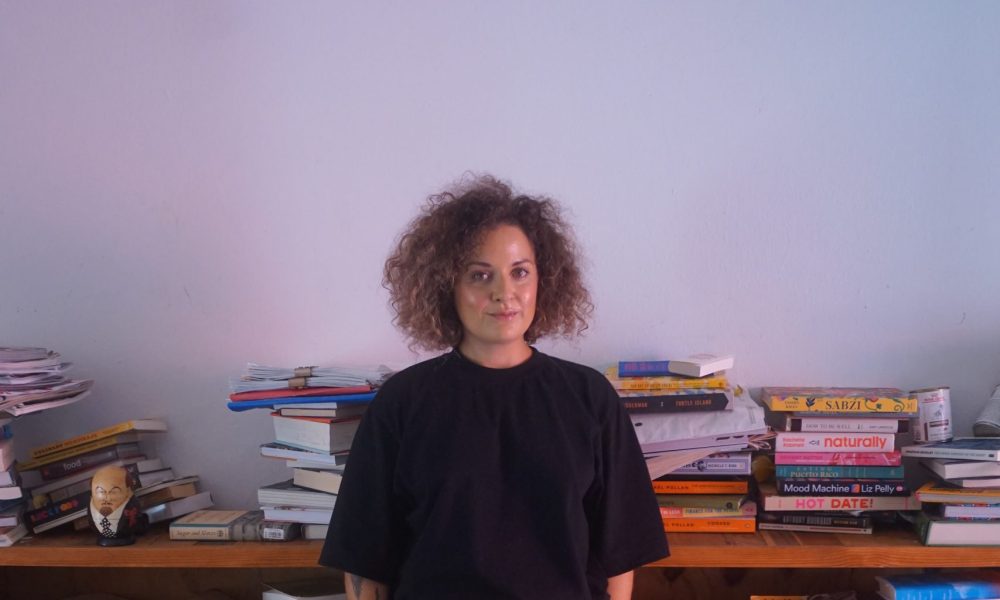
I met Edna Bonhomme after a mutual friend’s book reading in Berlin. When we first spoke, and when I began to read her work in earnest, I realized: This is what public health can look like. A clear articulation of freedoms. A close tracking of often-hidden historical figures or moments, the thing that medicine and public health might call “a case.” An alchemy of scientific and social curiosity that traverses scales from one human’s actions to the resonances of that singular action for all of us.
But it was also health transitions that shaped our connection. The year we met in Berlin, we were scanning QR codes everywhere, digitally affirming our COVID-19 vaccination status in the city. The Corona-Warn-App would ping us about proximity-detected positive tests among contacts. We were living in the supposed aftermath of an epidemic. The demos in the epidemic, the population affected by the disease, almost felt like it had faded from view. Techno-fixes and risk took center stage, far more than individual lives.
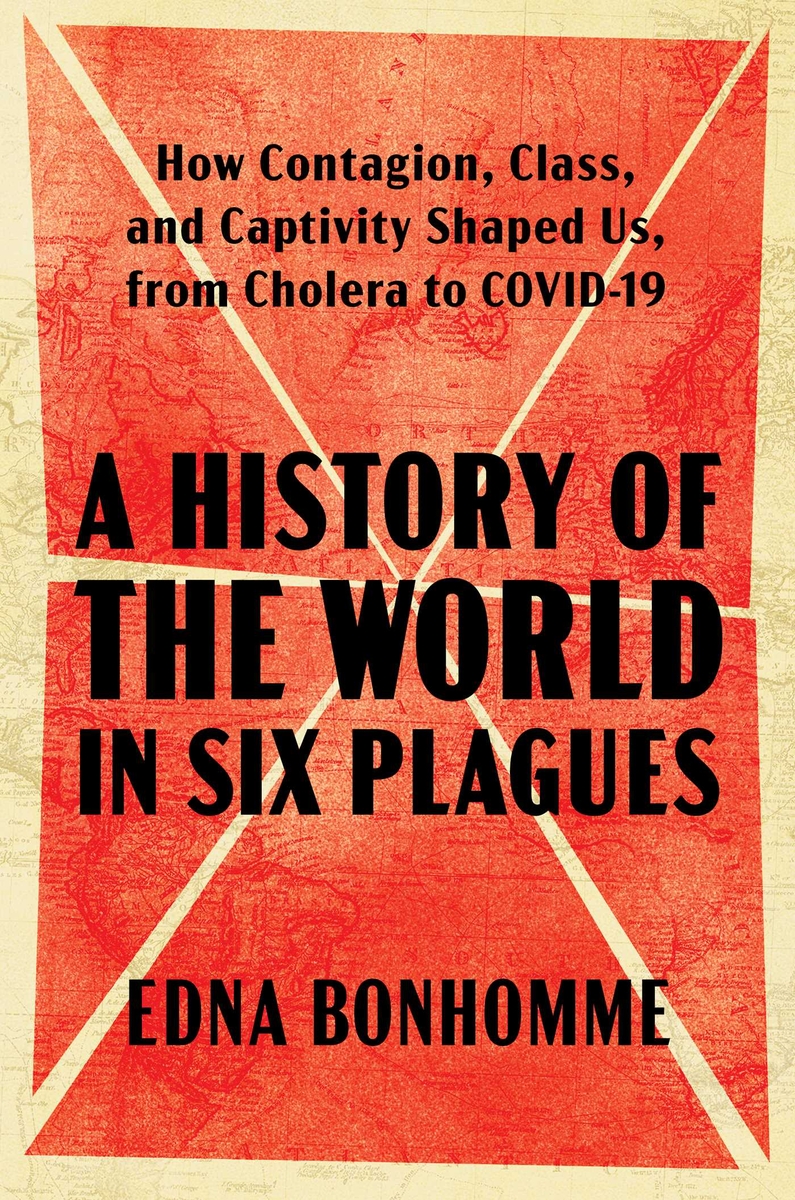
Yet actual lives and the embodied aftermaths of disease ground the commitments in her text A History of the World in Six Plagues. I connected with Edna soon after the book’s publication to chat about her writing, science and art, and putting the “public” in public health.
Harris Solomon (HS): In A History of the World in Six Plagues, you share stories of being a child experiencing illness. Can you tell us about the growth of the project from this angle?
Edna Bonhomme (EB): For any person who’s authored a book, there is a circuitous route. For me, the book felt like it was coming to life when it felt like meditation, when I was looking not just at my notes and the books I was reading, but also at my past—and, more specifically, at psychoanalysis and psychoanalytic theory.
After all, I was writing a book about disease and why people might feel anxious about it, and I was doing this when COVID-19 was widespread, and there were lockdowns. So, people were trying to understand what was happening, just as I was reflecting on my childhood and that experience of confinement when I had typhoid fever and was hospitalized. This psychoanalytic approach seemed like a way to think about the various uncertainties and anxieties emerging worldwide and being experienced by specific individuals.
Nevertheless, I didn’t want to dwell solely on the psychoanalytic realm. I also wanted to consider that we are not just in our minds, but also living in environments, states, countries, and cities and rural settings that shape who we are and how we engage with the world. And given that I was trained not just in public health but also in biology, I was fascinated by the extent to which people were engaging with this in the public realm, both online and with each other, and so forth.
HS: How did you come to think of these as “episodes”? Were you trained to think about instantiations of disease in certain historical moments because you are trained as a historian of science?
EB: Before I became a historian of science and earned a PhD in history of science, I loved and was fascinated by history. I was being told history in real time, mostly by relatives. And it came through the form of song. It went through the form of folklore. It came through not necessarily oral history, but through the griots in West African and African diasporic traditions. That made me a student of history, well before I earned my PhD.
Importantly, it also allowed me to love and have an affinity for different cases, like states of exception. One could imagine a state of exception in which enslaved people rose up in a successful Black revolution. A state of exception could entail something like cholera in the 19th century, and the sense of what this disease meant, well before people fully understood biological transmission and debate. Some disease theories are now debunked, but it wasn’t necessarily clear at the time why one theory was more legitimate than the other.
And so, the way I thought about which diseases to focus on involved considering the relationship between disease and its spread at specific moments in our history.
For example, I looked at how disease spreads on the plantation and at ideas about sickness there. That’s the chapter that focuses on Harriet Jacobs, a formerly enslaved person; disease and colonization; and particularly the European colonization of the African continent. And I look at Robert Koch, a German who finds himself in what used to be British and German East Africa, and how that is also a political moment that helps to open space for our understanding. The chapter on flu looks at disease and war, and how we try to understand and look beyond the question of people fighting each other. We’re still living through multiple wars right now. It’s no accident that in Palestine, there was also a polio outbreak that emerged in Gaza as the assault on Palestinians in Gaza was happening.
So, the choice of episodes was very much tied to these violent moments in history, which also dovetail with an epidemic and people trying to work through it. It’s not just about the epidemic, what’s happening, and why extra lives were lost. It’s also a way of asking questions like: How do we make sense of what it means to do better by each other as we go through these major political shifts that still impact how people move? What do land and country mean, in terms of the question around inheritance? So the case studies on the surface might feel disconnected. But they actually reflect major historical events that still impact human relations today.
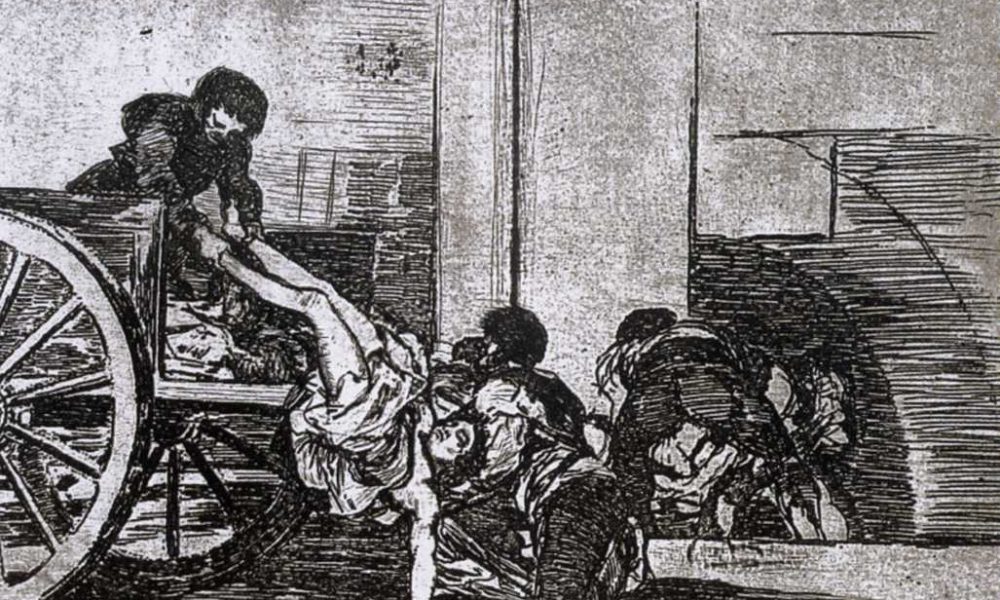
HS: You mapped how, for example, the flu chapter engages with global war, and how another chapter focuses on the plantation as a critical site. I wondered what it was like for you, as you put the book together, to reorient material or ideas. For example, the chapter in East Africa reorients us from the laboratory as a place in a building, with lots of people in HVAC-sealed rooms with pipettes, to East Africa.
What was this reorienting like in terms of your thinking, your design, and your reading? If one wants to think about the lab, how does one get out of that building to see where science plunders its expertise?
EB: As a recovering biologist, and someone who spent a lot of time working in a lab during my undergrad, as well as the year after I graduated from college, I loved the lab at the time that I was working in it. Because of the mystery, the sense of doing, and having a rigorous discipline and methodological approach, and being embodied in a space where, at least at the time, I felt like I could change the world somehow. I was enough of a nerd—not anymore, hopefully—that I felt empowered by being in that space where precision or the idea of precision could be seen as a way to fully understand a disease, or hopefully find at least a good treatment, or maybe even a cure.
But at the same time that I was doing that lab work, in undergrad, and after undergrad, I was volunteering at a clinic/center that was providing free healthcare, as well as social services to homeless people, intravenous drug users, sex workers, and so forth. And I saw how in that space, like in the lab, there was precision. But there was also care.
I was really affected by this dichotomy. On the one hand, here was a pristine, well-established place tied to people with university degrees. Here, we’re advancing science in a very formal way. And then, on the other hand, here were real people—struggling with addiction or other life insecurities—coming in and working through them. I realized both had similar methods, but the lab, for me at the time, felt very expensive.
When I was doing my PhD, I came to think about playing with the laboratory, being curious about it, in the sense of thinking deeply about the relationship between colonization, scientific thought, and African knowledge.
How do we form a collective unit, whether it’s mutual aid or labor unions? How do we make sure organizing is popular again so people can actually have strikes and so forth?
HS: What was it like to train in public health when you did? What languages and vocabularies were you taught to make sense of questions of mass death, abandonment, captivity, bodily intervention, all of these major themes that emerge in your book?
EB: So, I was studying public health at a very unusual time. I moved to New York City in August 2008. So, right as the financial crash was about to happen. And I was personally experiencing financial precarity. But I was also seeing precarity at this broader scale: being at the heart and the center of capitalism, as Wall Street is being shown to be quite predatory, a big Ponzi scheme. At the same time, Obama was elected in the fall of 2008 on a platform centered around healthcare reform. On the one hand, I’m witnessing this excitement for someone who claimed to be providing hope and change in a very broad sense, and on the other, there’s this major financial crisis in which banks were bailed out rather than people who needed real assistance.
So, while I was studying public health, I also developed a class anger. It was the language I used to make sense of what was happening. Simultaneously, one of the many jobs I had was working part-time for the public health department, interviewing people for the HIV division outside of gay clubs and in the middle of the night at bus stations outside of the Staten Island Ferry. This experience of being among different communities, some of the most vulnerable, really shaped my approach to public health, encouraging me to avoid limiting my mind, limiting the possibilities of discourse, and limiting my engagement with and presence amongst the working class.
HS: If you were to hand this text over to students in public health right now, what are some of the conversations you hope would happen? What conversations and ideas do you think merit further discussion in public health?
EB: The progressive and leftist organizers that I knew before think about three things: educate, organize, and agitate. And that could apply to the public health students and public health people.
Take education. People need to educate themselves about the history of biology and public health more broadly. When I was studying, public health often treated the social determinants of health—race, class, and so forth—as categorical analyses, which one could use to understand what is happening at a population level. This is beneficial up to a point, but it has also been vital for me to get a sense of what it means for people dealing with illness, to theorize about it in real time, and to see how that can help us be more humane in population studies. What are the stories we tell each other and ourselves as we are dealing with disease?
Next, organizing. That’s essential, especially in this moment: How do we form a collective unit, whether it’s mutual aid or labor unions? How do we make sure organizing is popular again so people can actually have strikes and so forth? All this was quite effective at times in the 1920s and 1930s. So too were having communist leftist parties that created fear for bosses and the elites. They should be afraid of us; they should be scared of a silent majority of people who do the labor, and that labor is tied to who’s working at the hospitals, such as janitors, nurses, physicians, interns, teaching assistants, and so forth.
Finally, agitation, which can happen when we have collective coalitions that can really feel confident challenging those trying to make our lives inhumane. But that actually requires getting together collectively and creating a vision of the future that works for us, not just scapegoating people. This is the part that needs a bit of ingenuity from everyone. What does it mean to work together to make the world more just? Especially when there are very few spaces that people can gather to make that possible right now? But in looking to the past and looking at our histories, we can figure it out: When did it work, when did it not? And how do we come together for that?
HS: Recently, you have been writing extensively about art, often in spaces of installations and galleries and museums, where ideas and politics come to life for publics in a different way. What has it been for you to be an art critic? And what is that writing like in relation to some of the ideas that we have talked about?
EB: Georges Braque said, “Art is meant to disturb, science reassures.” Writing about art for me, and more specifically, writing profiles about artists who have a long career, has been quite fascinating. The visual artists I have followed aren’t just thinking about putting something on a canvas or making a sculpture; they are also reading philosophical texts. They are engaging with the world, thinking about the environment, and considering what to work with in a more ecologically friendly way. They are thinking about histories of colonization, retribution, and the redistribution of land, and the implications that may arise from them. At least for some of the artists I’ve looked at and interviewed, including Ellen Gallagher, who has a prolific career that looks at both art and science, and Paul Purgas, who has researched electronic music from the ’60s in India.
Thinking about the people who are both creating and reflecting on history, looking to science, and tapping into it, feels quite organic to me. It feels nice to be in a world where you get to see someone thinking in real time about creating for the world, thinking deeply about the implications, and trying to create a legacy for how to do better. And this doesn’t mean that the art world doesn’t come with its issues, in terms of the money and provenance, what gets stored and how and where, and the finance around it, how things travel, and the carbon footprint. I’m not going to pretend like it’s perfect. But I would say that engaging with art production alongside some of the most fascinating thinkers has actually enriched and enlivened how I think about science and how I see that art and science are deeply connected.
HS: One of the other connections that I detected in this text, and in reading some of your other work, is the continuity and curiosity about the question of freedom and constraint as it pertains to sex and reproductive justice. That comes to bear in Six Plagues, certainly. But it also comes to bear in other projects that you’ve published and those that you’ve discussed working on. What are those other projects in progress? What are the interests and curiosities guiding them?
EB: Over three years have passed since Roe v. Wade was overturned. To remove people’s bodily autonomy—that is, to remove the ability to have an abortion in the United States, at a federal level—for me, ultimately reflects the anxiety that not just American society, but many societies have about sex and sexuality. Anti-abortion legislation, anti-trans legislation, the “Don’t Say Gay” bill: all of these are part of a broader, anti-sex, anti-LGBT rhetoric that is very much alive in the US. So, it is up to those of us who actually want more freedom—and not just freedom in this empty way, but consenting freedom for people—to theorize about sex and sexuality with a bit of nuance, with a bit of flair, and to be unapologetic about it.
Doing that work obviously can be a bit messy. Nevertheless, I was inspired by various people who’ve written nonfiction about sex and sexuality: Silvia Federici, Dorothy Roberts, Harriet Washington, and Melissa Febos. Garth Greenwell has written excellent pieces about sex writing and has a syllabus of good sex writing and literature. There’s also literature by Raven Leilani and Sophie Lewis, and I interviewed Shon Faye, a transgender writer who has written about love and exile. The list goes on and on. These people are doing this work; now we need to come together to figure out how that gets articulated on a policy level, not just in the empty way of “more sex for everyone.”
Another next step is just asking: What does it mean to live in a world where people feel like they have control over their bodies? The evolution of how we move into the world of true freedom is something that we really haven’t witnessed. But I do hope that we can get there, to the point that people truly feel free. 
This article was commissioned by B. R. Cohen.