


Advertisement

Nowadays, if you wish to seek the wisdom of past ages—to look for wisdom or help from Socrates or Machiavelli or Abraham Lincoln—there is ChatGPT for that. LLM-generated pap aside, though, what if you wanted something a bit more from the giants of the past: to force them to look at what they’ve done, to hold them accountable for the world we now inhabit, thanks to them. For that, you need Lydia Millet’s 2005 Oh Pure and Radiant Heart.
It begins with bizarreness: Robert Oppenheimer, Leo Szilard, and Enrico Fermi are snapped forward in time from July 16, 1945—when the Trinity atom bomb they designed exploded at Los Alamos—into George W. Bush’s United States. The protagonist of the book is Ann, a librarian who befriends these men who “learned how to split the atom by chiseling secret runes onto rocks.”
In Ann’s presence, the three atom splitters begin the perhaps impossible process of holding themselves to account for what philosophers since Bernard Williams have labeled “agent-regret.” All three are seeing their deeds loosed into the world, cascading one (very likely unintentional) consequence after another. These particular figures of the Authority and Accountability of History are human, all too human. In fact, they are almost vaudevillian: Oppenheimer has a Buster Keaton–like unflappability; Szilard is a kind of nuclear physicist Lou Costello, confidently asserting (in English) to any Japanese passerby that he’s the Szilard who predicted the Szilard complications in 1943, his youthful (and living) appearance unexplained. “What else?” Szilard asks a skeptic. “Are we supposed to believe in time machines or reincarnation or something? I like H. G. Wells as much as the next guy, but please. We are men of science”—as though science could accommodate men thrown 60 years into the future any better than reincarnation.
These and other endearing foibles—Oppenheimer’s cigarette jags, Szilard lusting after donuts he needs Ann to buy for him, Fermi’s running away to go on hikes—serve a familiar function, puncturing the foreboding greatness of great men. However, these cheerful presentations also blunt the enormity of what these scientists did, the list of lives they blew up.
Once they’re present in 2003, they start learning about their lives post–atomic test, which they have no memory of, and they go on a tour of relevant sites, beginning with Hiroshima. Viewing the Peace Museum causes Oppenheimer to run away to a monastery and Oppenheimer to remark, understatedly, that he “had not expected the weight of the evidence.”
Perhaps he should have; as Millet writes, in a kind of introduction on the book’s first page, “when a speck of dust acquires the power to engulf the world in fire, suddenly, then, all bets are off.” When the scientists regroup, they take on an admirable goal. Led by Szilard, they will right whatever wrongs they are responsible for by demanding nuclear disarmament by the United States and the rest of the world.
Millet’s structure overlays three incompatible narrative forms: the scientists as symbols of the peace they want; the scientists as characters; the scientists as the effective causes of incredible destruction.
The novel forces us to contemplate the gap between the meaning of three nice (if sometimes frustrating) men who want the world to forswear nuclear weapons, and three men, among others, who brought about a world in which a relatively small number of atoms (say, 1.9 x 1024?) can reduce cities to nearly nothing. History is what hurts, according to the most rueful of Fredric Jameson’s slogans. He goes on to say, in The Political Unconscious (1981), that history “sets inexorable limits to individual as well as collective praxis” and “can be apprehended only through its effects, and never directly as some reified force.”
The temptation is for Millet’s readers to take Oppenheimer as history reified, History in a porkpie hat. But Millet shows how unstable making meaning from history is. As the scientists go through 2005, from the Trinity site to Hiroshima to the Marshall Islands, they acquire hangers-on. First, a rich stoner and his friends with whom they stay in Japan; then groups of Deadheads and yoga fanatics, a Belgian food activist, bodyguards, and a documentary crew. Finally, they attract an army of chiliastic evangelicals who have convinced themselves that Oppenheimer is the second coming of Jesus Christ. For all these new fans, the meaning of the scientists becomes negotiable.
Their historical specificity dissolves into celebrity; toward the end of the book, Szilard starts wearing a T-shirt with his own face on it, and various followers hold signs with images only of Oppenheimer’s iconic porkpie hat. Oppenheimer reflects: “Increasingly, he was allowing the literal to recede. He was becoming figurative … he was less a self-determined organism than outside views of him and so it was easy to defer to the perceptions of others.” The novel begins with Ann and the scientists researching their biographies, trying to see what their work might mean, and what they’re responsible for. By this late stage in the novel, Oppenheimer means too much: neither he nor his followers can pin down where responsibility begins and ends.
How can that “too much” be managed? Where the hippies and doomsday preppers in the book find too neat a narrative in their hero Oppenheimer, Millet herself presents a messy story. The main account is punctured with small sections that aren’t clearly connected to the consciousnesses of any characters. She reports thoughts of various Manhattan Project scientists after Trinity and devastating statistics and anecdotes about the effects of the bombs dropped on Hiroshima and Nagasaki. She traces the wisdom (or “wisdom”) of the past in our shared present through residuals like the fallout from other test sites and the “tactical” nuclear warheads that Bush and Putin negotiate over. None of this information is digested, or reified. It’s just the historical past, disjoined from fictional narrative, and generally dire.
Millet’s structure overlays three incompatible narrative forms: the scientists as symbols of the peace they want; the scientists as characters; the scientists as the effective causes of incredible destruction. Ann comes closest of anyone in the novel to confronting this formal problem herself:
She had been waiting for something to happen for months now, yet nothing ever did, nothing on a grandiose scale. Events were swiftly part of the past, receding, and the wait was thankless. But more than that it was misguided, she had come to suspect. You could wait for an event but once it came it would only slip into history and be gone.
There’s no smooth connection between character, public meaning, and historical effect. Oppenheimer thinks so too, in the end: “He could almost laugh now at the smallness of his good intentions, how paltry they had been against his mischief and the mischief of the neighborhood boys he had played with.”
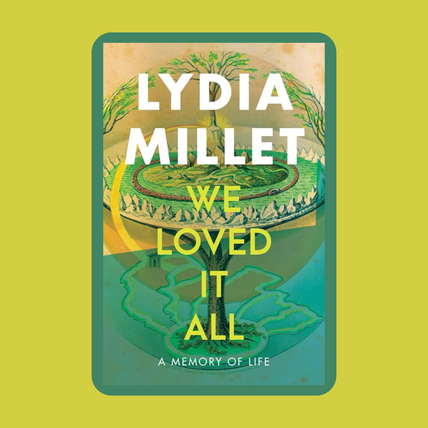
In some ways it is hard to write about Oh Pure and Radiant Heart. It unfolds both meanderingly and deliberately and is a lot funnier than the quotes I’ve provided may make it seem. But also, it’s hard to write about because it’s doing a hard thing—trying to really embody the fractured feeling we have in relation to our history. No easy resolution to that.
Millet does offer one very unexpected aesthetic resolution: cranes. Millet has written beautifully about the power of animal life to disrupt the expected tracks of our human lives in books like How the Dead Dream (2008) and Dinosaurs (2022). In Oh Pure and Radiant Heart, after an attack on a rally by the scientists in Washington DC, Oppenheimer and Fermi are transported by whooping cranes who suddenly appear and fill the sky (poor Szilard meets a sadder end). The appearance of these birds—aves ex machina—is so flagrantly strange as to make the impulse to learn a tidy lesson from history ridiculous. This final disruption gives us a small way to learn from the past—to just look at all of it; to try to find meaning as we can, and to hope for better results when we chisel our own runes onto rocks.