


Being reviewed:
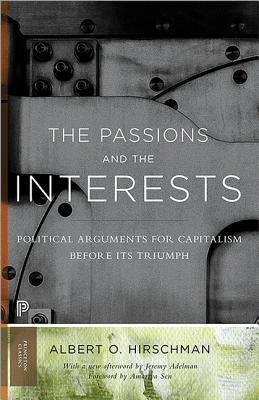
The Passions and the Interests: Political Arguments for Capitalism before Its Triumph
Advertisement

It is a short book, an elegant book, and an erudite one. And once you have read it, you will never forget its argument. The pursuit of economic self-interest was condemned as one of the seven deadly sins by Christian theologians and before that reviled by ancient philosophers as an insatiable appetite. In the blood-stained 16th and 17th centuries, though, it was enlisted to combat the still more destructive passions of political ambition and religious fanaticism. By the mid-18th century, the Christian sin of avarice had improbably become le doux commerce: tamer of the passions, guardian of political freedom, and engine of civilization.
I first encountered Albert O. Hirschman’s The Passions and the Interests: Political Arguments for Capitalism before Its Triumph (Princeton University Press, 1977) while writing my doctoral dissertation. I hardly knew anything about his august reputation as an economist and political thinker, much less his earlier career fighting against fascist forces first in the Spanish Civil War and later in the French Resistance. Nor did I realize that its lucid, witty English prose had been written in what was probably the author’s fourth language (at least), acquired after his native German, plus French, Spanish, Italian, and no doubt Latin and Greek.
I thought of Hirschman as a historian, indeed, the most beguiling historian I’d ever read. He seemed to have read everything, from Saint Augustine to Machiavelli to Montesquieu among the greater figures but also La Rochefoucauld and Sir James Steuart among the lesser. Yet by the standards of historians (especially a fledgling historian writing her doctoral dissertation) the number of footnotes was shockingly small, and the citations to secondary sources smaller still. Most historians would rather go out naked in public than prune their copious footnotes. Hirschman’s minimalism in this regard seemed to me an act of daring akin to waving a red flag in front of a charging bull—as I imagined reviewers for historical journals.

In retrospect, I realize that Hirschman’s book was not a monograph but a historical essay. That genre has become almost extinct since Leopold Ranke and his devotees professionalized history in the 19th century. A monograph is just what it says: a piece of writing about a single, specific topic treated in detail. It aims to be authoritative about just that one thing. In contrast, an essay is licensed to wander over many centuries and contents, to connect apparently disparate ideas, and to charm as well as illuminate.
The Passions and the Interests charms the reader as it persuades. Much of that charm is about its content as well as its style. At one level, it is a history of the invisible-hand argument that emerges everywhere in the late 18th and early 19th centuries, whether in Adam Smith’s political economy, Kant’s universal history, or Hegel’s “ruse of reason”: how the selfish decisions of individuals can unintentionally promote collective welfare and progress.
In its most famous version, Adam Smith tells the story of a Scottish warlord of the sort who used to terrorize the countryside with his private army of rough-and-tough mercenaries. Like the Mafia protection racket of a later era, peasants and townspeople who refused to pay tribute to the warlord risked rape, pillage, and worse from his minions. As trade quickened in the 16th and 17th centuries, all manner of enticing commodities began to tickle the warlord’s fancy.
At a deeper level, though, Hirschman’s book is a history of the invisible hand at work even within those very arguments for the existence of the invisible hand.
In Smith’s example, the warlord covets a pair of diamond buckles to adorn his boots, and, to gratify his egotistical vanity, spends the money that ought to have paid his private army to buy the baubles. Gradually, the disgruntled mercenaries drift away; the warlord can no longer terrorize the surrounding countryside; peace reigns and commerce flourishes. Like an alchemist, the “invisible hand” has transformed the base metal of the warlord’s vanity into the pure gold of peace and prosperity for all. The invisible hand performs the work of divine providence, but without God.
At a deeper level, though, Hirschman’s book is a history of the invisible hand at work even within those very arguments for the existence of the invisible hand. If the pursuit of self-interest will rein in barbaric passions and thereby promote freedom and peace, the appetite for peace and prosperity may culminate in the unintended consequence of stifling the desire for freedom. Hirschman ends the book with a few 19th-century witnesses who realized that le doux commerce had become le commerce sauvage. A people who value their comfort and calm more than their freedom are all too prone to accept a despot, as long as the stock market continues to boom. Read now, almost 50 years later, those words sound chillingly prescient.
A German version of this text first appeared in NZZ Geschichte Nr. 61 (Dezember 2025).