
Advertisement

What strange bedfellows Trump 2.0 has made:
Bringing his discourse to a close, Pope Leo quoted Hannah Arendt’s The Origins of Totalitarianism, warning that the ideal subject of totalitarian regimes is not someone ideologically committed, but rather someone for whom “the distinction between fact and fiction, and the distinction between true and false no longer exist” … Against the dangers of post-truth and approximation . . . “the world needs free, rigorous, and objective information.”
I am with Leo on this one. In the past hundred years, who has been better than Arendt in offering ways to hold onto truth as a solid bulwark against the deceits that fuel and abet authoritarianism and brutal inhumanity? In recent Public Books pieces, I have tried to highlight some unexpected aspects of her defense against the worst threats—looking, for example, at the moment in the early 1940s when Arendt warned about parvenu politics and advocated thinking like a pariah and hence like a refugee; or at what Arendt had to say about the gap between truth and falsehood during the Nixon era, from which I made out her case against not just anticipatory obedience but also against anticipatory despair in the face of what seems to be authoritarianism in training.
Both those pieces praised Arendt’s arguments for the redemptive power of thinking and acting in public. This is familiar ground: her most passionate defenders and interlocutors, from Judith Butler and Julia Kristeva to Seyla Benhabib and Bonnie Honig, have responded, each with enthusiasm and each with their own particular objections, to her interest in natality, or the basic distinctiveness of each human being that emerges into the world possessed of unique attributes and perspectives on our shared existence.
Nonetheless, Arendt’s defense of public deliberation against unthinking acquiescence or despairing conformity to temporary public irrationality has sometimes struck readers and critics as a little … chilly. If Arendt is committed to wholehearted praise of public-and-nothing-but-the-public, she risks leaving out what happens in the shadows, the places where agora activity grinds to a halt. In brutal times like our own, that less visible part of our makeup may also prove indispensable in the fight against government-sanctioned outrage.
Those who oppose Trump’s new ethnonationalist vision of America and its standing in the world order are increasingly realizing our shared public life, ringfenced as it is by a warped media ecosystem, is arid as a desert: a place you can’t quench your thirst and where, ultimately, you can’t breathe. We have demonstrations, we have counterpublics, we even have off-years elections signaling Republican weakness. Yet many have come to doubt the efficacy of this traditional array of standard forms of political resistance in a democracy: just look at the forms that despairing protest took in Minneapolis in January 2026. We are entering a year when many of us will have to find out what it means to live a life on the ropes, thrown back on our own resources as grounds for outward action slip and slide away. I am no fan either of meek submission nor anticipatory despair, both easily spawned by the blunt indifference to any signals we are sending. How then do we cut a new path toward meaningful and effective acts of resistance?
That question, Arendt realized seven decades ago, had to be answered not just in terms of what we do collectively, but also, crucially, what we accomplish alone. The great advocate of knowing ourselves in public is also the little-known champion of a surprising and moving defense of what we might think of as solitary solidarity. Seeing this means attending to her account of the imagination, which reassures us that what we do in the shadows may live on in the daylight.
In the years since Arendt wrote her 1958 paean to the world of public action, The Human Condition, political currents on the left have swung around. What scholars have seen as her impulse to praise the active word of public conversation seems to accord with a warning against the empathic impulse to reduce politics to compassion. But Arendt also offered a third way, neither purely public, nor rooted solely in imaginative activity. This is exceptionally messy terrain. However, in her 1967 essay, “Truth and Politics” and in a rarely reprinted university lecture from 1955, we can see Arendt grappling with the complex relationship between our public life of action and our inward state by way of a tricky preliminary question. Where does the mind go when we are by ourselves?
Representative Thinking
In “Truth and Politics,” Arendt asks a seemingly simple question: What allows us to be imaginative enough to inhabit another’s perspective even in solitude? The key political insight for Arendt is that learning how others think and experience the world, we gain access to their thoughts in their unique and distinctive individuality; we create an intellectual space within our own thoughts to comprehend what a different response would look and even feel like.
Political thought is representative. I form an opinion by considering a given issue from different viewpoints, by making present to my mind the standpoints of those who are absent; that is, I represent them. This process of representation does not blindly adopt the actual views of those who stand somewhere else, and hence look upon the world from a different perspective; this is a question neither of empathy, as though I tried to be or feel like somebody else, nor of counting noses and joining a majority, but of being and thinking in my own identity where actually I am not.
To think oneself out of one’s narrow first-person perspective for the purpose of creating an imaginative alternative state relies on our capacity for thinking ourselves into that other standpoint. This kind of representative thinking is far from an emotional connection, Arendt insists. But neither is it simply polling.
The more people’s standpoints I have present in my mind while I am pondering a given issue, and the better I can imagine how I would feel and think if I were in their place, the stronger will be my capacity for representative thinking and the more valid my final conclusions, my opinion. (It is this capacity for an “enlarged mentality” that enables men to judge; as such, it was discovered by Kant in the first part of his Critique of Judgment, though he did not recognize the political and moral implications of his discovery.)1
How useful is this kind of self-estranging thinking? Opinions may differ. It is reasonable to ask here: How do we know that representative thinking actually gets other people right, rather than merely putting ourselves in their place and conveniently substituting our own thoughts and feelings for their own?2 For Arendt, getting it right may matter less than the cognitive widening necessary in the attempt to do so: the point of thinking like others is to push ourselves, imaginatively, to think differently. What comes through is her sense that imaginative extension makes many reasoned perspectives on a situation available.
The way Arendt lifts representative thinking from Kantian aesthetics for a new political vision offers a useful handhold in 2026 politics. It is a welcome alternative to the ways her legacy has been miscast. Over the years, and especially recently, Arendt’s case for rational deliberation at moments of affective flare-up has been taken principally as an argument against excessive emotionality, or the dangerous fuzziness of unquestioning compassion, which can just as easily tip ethnonationalist as universalist.
True, Arendt makes various memorable arguments for shunning the improper or excessive intrusion of private life and its attendant feelings into the shared realm of public action. Her vision of solidarity can easily be understood as arguing (to steal a phrase from Paul Bloom) Against Empathy in favor of disinterested but well-reasoned camaraderie. When Gershom Scholem accused her of failing to “love the Jewish people” sufficiently, she had a starchy response: “I have never in my life ‘loved’ any people or collective … the only kind of love I know of and believe in is the love of persons … Generally speaking, the role of ‘heart’ in politics seems to me altogether questionable.”3
For Arendt, getting it right may matter less than the cognitive widening necessary in the attempt to do so: the point of thinking like others is to push ourselves, imaginatively, to think differently.
Arendt’s account of love run amuck in the public sphere has a number of interesting 2026 counterparts. The editor of First Things may invoke the idea of a “big love” founded on the “return of the strong gods”;4 and J. D. Vance may think he is on the side of the angels by citing Augustine’s ordo amoris (the order of love) against immigrant’s rights. Arendt, whose own dissertation was about the pitfalls of love in Augustine, sees unchecked cordiality quite differently. It does not follow, though, that we should read Arendt as proposing deliberative thinking as a pure and simple negation of love in public.
Rather, “Truth and Politics” allows us to see the alternative pathway Arendt charts for seeing as others see. In praising our imaginative capacity to think ourselves into others’ shoes, Arendt sidesteps empathy, not to argue for the cold clear light of reason but to animate imagination, with its dual commitment to attachment and detachment. Imagination may stop short of love, but it is loyal to the existence of others and offers a way to conjure up their concerns even when (in fact especially when) we are spending time alone.
In the desiccated world of 2026 politics, Arendt’s interest in torquing Kantian aesthetics into a political methodology is strangely moving. To her the judgment Kant characterized as aesthetic is a political power, to be wielded politically:
The very process of opinion formation is determined by those in whose places somebody thinks and uses his own mind, and the only condition for this exertion of the imagination is disinterestedness, the liberation from one’s own private interests. Hence, even if I shun all company or am completely isolated while forming an opinion, I am not simply together only with myself in the solitude of philosophical thought; I remain in this world of universal interdependence, where I can make myself the representative of everybody else.
Representation, especially by way of the imagination, means forsaking the claim of absolute knowledge, and relying instead on a formalization of imagination, whereby other minds can be made present to us in their absence—present through our reliance on the power of imagination to represent what another person’s perspective on our shared world may be. Hillary Clinton probably did not lose the 2016 election with her “basket of deplorables” line; but Arendt’s representative thinking seems a useful barrier against any form of emancipatory politics that begins by drawing a line in the sand against contemptible foes.
The real danger is that we grow tempted to imagine that politics could take place without representative thinking, and without imagination. “Never am I less alone than when I am by myself,” wrote the ancient stoic philosopher Cato; it’s the epigraph for Arendt’s final book, The Life of the Mind. To Arendt, that non-solitude of the thoughtful person is proof of thought’s truly dialogic, truly solidaristic nature. Without representation, we have “thoughtlessness,” the prelude to totalitarianism and other abdications of political responsibility, or ruptures of public life. But how is this solitary and solidaristic imagination to be nourished?
Deserts and Oases
A decade earlier, Arendt had formulated one answer. Oases are those fields of life which exist independently, or largely so, from political conditions—not places of “relaxation” but life-giving sources that let us live in the desert without becoming reconciled to it.
These days, I feel increasingly alone in our fractured country, although I take some solace in thinking I’m probably not alone in that. In the final days of 2025, for example, I arrived at the entrance to Rocky Mountain National Park. Looking for a trail map, I instead found an excerpt from a recent executive order, instructing visitors to be vigilant for “any signs or other information that are negative about either past or living Americans or that fail to emphasize the beauty, grandeur, and abundance of landscapes and other natural features.” I shivered at this insistence that every National Park has an obligation to glorify an imaginary superabundant American past and stay mum about any deficiencies.
Still, even with the Rockies towering cold and impossible ahead, it can be hard to know the right way forward. Although I respect the bold steps some progressives are willing to take right now, the two most obvious alternatives to pointed vocal resistance—pointed direct acts of defiance and slinking off into the frozen wastes like Frankenstein’s creature, but with gaiters and handwarmers—strike me as offering little scope for action, and few immediate rewards.
That is where Arendt’s notion of the oasis comes into play. Representative thinking aims to offer an imaginative, cognitive expansion that offers up solidarity as an alternative to sympathy. But representative thinking turns into something quite different when paired with a surprisingly capacious metaphor for finding hope and rejuvenation while living in an ominous authoritarian or totalitarian world that she calls desert. That metaphor is the keystone of the final lecture of “The History of Political Theory,” a class given at UC Berkeley in spring 1955.
In a world from which truth is rapidly departing, Arendt sees us as tempted to hear only what we want to; which means we often choose not to check what we are told against actuality. This, she calls worldlessness.
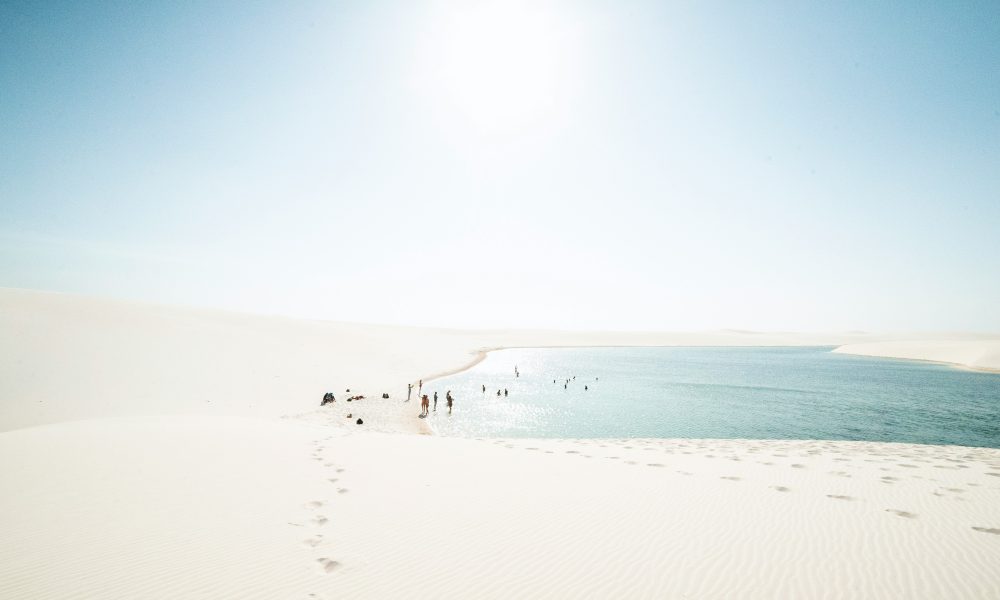
The modern growth of worldlessness, the withering away of everything between us, can also be described as the spread of the desert. That we live and move in a desert-world was first recognized by Nietzsche, and it was also Nietzsche who made the first decisive mistake in diagnosing it … he believed that the desert is in ourselves.5
Arendt is arguing against totalitarianism here, which takes advantage of what she elsewhere called “organized loneliness.” But she also refuses to accept that this state of affairs is inescapable. The sort of atomization of experience Nietzsche evoked (familiar to midcentury readers of David Riesman as the “lonely crowd”) seems readily avoidable to Arendt. Nietzsche’s mistake, believing “the desert is in ourselves,” is to overlook the still available chance to turn aside and think intimately with a friend.

However, loneliness also arises the moment we see solitude as the only alternative. The effect of that is to throw us back on our own narrow psychological resources. That sort of retreat, which she thinks of as the fallacy of “adjustment,” leaves us short of real resources to counter the BS from above:
Modern psychology is desert psychology: when we lose the faculty to judge—to suffer and condemn—we begin to think there is something wrong with us if we cannot live under the conditions of desert life. Insofar as psychology tries to “help” us, it helps us “adjust” to those conditions, taking away our only hope, namely that we, who are not of the desert though we live in it, are able to transform it into a human world.
Psychology teaches head-duckers and get-alongers to conform. No wonder that it is the logical complement to another mode of thinking that also succeeds in a desert of worldlessness: totalitarianism, which thrives on its arid certainties, its violent simplifications: “totalitarian movements … are extremely well-adjusted to the conditions of the desert … false or pseudo-action suddenly bursts forth from deathlike quiet.”
Succumbing to psychological adjustment—head-in-sand individualism or, worse, solipsism—or to totalitarian thinking are equally bad. Courage, though, is to be found in oases, “those fields of life which exist independently, or largely so, from political conditions”:
In the isolation of the artist, in the solitude of the philosopher, in the inherently wordless relationship between human beings as it exists in love and sometimes in friendship … Without the intactness of these oases we would not know how to breathe … oases … are not places of “relaxation” but lifegiving sources that let us live in the desert without becoming reconciled to it.
We need such oases to catch our breath. That metaphor seems particularly apt right now, as academics, activists, scholars, and students, who see the traditional protections afforded to academic inquiry eroded, search for ways to rely on both older protected spaces—libraries, seminar rooms, lecture halls—and other newer extended ways to “think in public” potentially available even on the web.
Adjustment is the pits, a sanctioning of organized loneliness. But the perils of totalitarian thinking (today’s ethnonationalist platitudes and certitudes included) mean we should be careful not to live a life that brings desert thinking back behind closed doors:
To escape from the world of the desert, from politics into … whatever it may be, is a … form of ruining the oases … In attempting to escape, we carry the sand of the desert into the oases.
What does Arendt, that noted advocate of political thinking, have in mind? Partially what she would go on to explore as The Life of the Mind: thinking properly depends on our setting up windshields, walls perhaps of canvas not of brick, behind which we can draw a breath and focus our eyes more acutely on what lies out there in the glare. Writing poetry, making art, even musing wordlessly with friends are ways to keep fighting fit. If for no other reason than that they remind us of the abnormality of our present normal, the mistake of adjusting ourselves to what defies real adjustment.
Arendt sees the oasis as a way to save our self-understanding from the psychological cry of adjustment as well as the totalitarian demand for conformity.
This lamentable passivity in the face of the everyday awful—treating it as the inevitable—had some of its roots, in Arendt’s day, in the rise of a behaviorism that treated people as bundles of conditioned impulses rather than as agents endowed with responsibility, judgment, and the capacity to make decisions. Brilliant as Erving Goffman’s Behavior in Public Places (1963) may be, its focus on “moments and their men” (not “men and their moments”) swerves away from any account of the inward reflection, the thinking and the imagination, required to bring people to act (rather than just to behave) as they do.
For Arendt, though, there do remain spaces apart where solitude and the imaginative space it opens up turns from a danger into a strength. That is what makes the all-important act of judgment both a cause of suffering (because representative thinking puts us in the place of those we judge) and a source of strength. Strength because despite our capacity to imagine the world otherwise, we retain assurance in our own capacity to decide and act according to what our reason tells us.
Can an Oasis be a Pu Sto?
I remain puzzled by though grateful for Arendt’s willingness, in 1955, to go so far in praising the virtues of non-public life. I wonder if this may be in part because of her situation in California, far from her husband, Gerhard, evidently lonely and newly skeptical of the horrors of compulsory public performances. Her time at Berkeley resolved her never to be a professor because “I really cannot appear in public five times a week”.6 That may help explain this turn toward the oasis: it is her vocabulary for the space that lies beyond even the best sorts of public disputation, as well as the worst kinds of social chaos, and the sorts of arid contradictions that lend themselves to easy contradiction or simple obedience.
But it remained a largely hidden vocabulary; apart from her own poetry, never meant for others’ eyes, Arendt only rarely put into print her belief in a refuge ruled principally by its refusal to be ruled, the oasis that she believed could be found in “the isolation of the artist, in the solitude of the philosopher, in the inherently wordless relationship between human beings as it exists in love and sometimes in friendship.” These are tricky spaces to find and hard to stay in when we arrive there.
Wordlessness is not worldlessness, but you can understand why the two categories might seem to run together. My own preference for her praise for “pariah politics” means that I am inclined to think Arendt sought solitude as a way out of the endlessly intrusive world that we can see modeled today in the impulse toward social mediation, toward the likes and upvoting that reassures us we are seen and approved. By that reading, the problem, and the breeding ground of totalitarian thought, the desert space that Arendt warns about, is common, social, and corrosive. This danger aligns with that warning about the way that psychology can preach adjustment so persuasively that even alone, I catch myself striving to get synchronized to what I imagine will be a successful form of common thought.
Even with this account of oases functioning as preemptive sites for privacy to take root, you may end this essay genuinely puzzled over the relationship Arendt imagined between the allure of the oasis, with its night and its silence, and the threatening totalitarian world she condensed into the desert. I think a partial answer, maybe more than partial, can be found in those rare moments where she turned to literature for consolation.
Arendt sees the oasis as a way to save our self-understanding from the psychological cry of adjustment as well as the totalitarian demand for conformity. (Oases: not just for deserts anymore.) That makes the moments when she carved out a space apart, neither public nor problematically private, especially worth attending. Arendt singled out few novelists for praise: Herman Melville was one of them.
He too, it turns out, offered up a fleeting glimpse of the oasis. In chapter 87 of Moby Dick, “The Grand Armada,” Ishmael pauses mid–whale hunt to describe his chance passage into a nursery of mother whales who are contentedly nursing their young even as the Pequod stalks them. When he leaves that transient interlude, eye of the killing storm, he notes the enduring effect of his space apart.
Surrounded by circle upon circle of consternations and affrights, did these inscrutable creatures at the centre freely and fearlessly indulge in all peaceful concernments; yea, serenely revelled in dalliance and delight. But even so, amid the tornadoed Atlantic of my being, do I myself still for ever centrally disport in mute calm; and while ponderous planets of unwaning woe revolve round me, deep down and deep inland there I still bathe me in eternal mildness of joy.
It is hard to think of Arendt in mute calm, let alone conceive of her praising anyone for centrally disporting or serenely reveling. However, Arendt’s oasis thinking opens a door or two for me. Melville here offers an illuminated expansion of how the oasis makes space for friendship as an imaginative augmentation of one’s own way of being in the world.

Arendt’s friends, amazingly enough, called her “Chutzpah Hannah.” This seems to have been because of her boldness in forging imaginative connections to others, her willingness to imagine she knew what they were thinking and feeling. Her brief excursus on the virtues of oasis thinking uncovers her unexpectedly strong vision of artists in isolation, philosophers in solitude—and the wordless friend or lover who sticks around after dark, when the talking dies down. Arendt’s laminated conception of a complete life, poems, wordlessness, and all, might not surprise us coming from a Romantic writer, or from someone who spent less time than she did cheering on the powers of representative thinking in an agoraphilic mode. In 2026, as we reckon up the moments when we know standing up and speaking out becomes unavoidable, I think it helps to know that even Arendt versified, that even she worked hard to find places out of the sun and wind; her husband and her friends loved her for it, with the kind of love that never gets turned into direct political action but that nonetheless thrums behind the walls.
“Give me a place to stand [pu sto] and I can move the world,” said Archimedes. Conscious as she was that naming shadowed spaces might destroy them (those poems remained long unpublished for a reason), Arendt recognized the oasis as her pu sto—those dismal months in Berkeley when she contemplated becoming a professor, public lecture–giver for a living, turned something over in her mind. That she wrote so little of what her glimpses of the desert revealed is understandable. Still, I’m grateful she gave us just enough to put together imagination, solitude, and amicable wordlessness as the sort of places Arendt imagined bathing inland in eternal mildness. 
- Hannah Arendt, “Truth and Politics,” The New Yorker, February 27, 1967. ↩
- I am grateful to Alex Star for this question—as well as to Ivan Kreilkamp, Sean McCann Phil Joseph, and the editors of Public Books for comments on an earlier version that greatly improved this piece. ↩
- Hannah Arendt, “Eichmann in Jerusalem: An Exchange of Letters,” Encounter, January 1964, 51–6. ↩
- Laura Fields, Furious Minds (Princeton University Press, 2025). ↩
- Reprinted as “Epilogue” in Hannah Arendt, The Promise of Politics, edited and with an introduction by Jerome Kohn (Schocken Books, 2005), 201–204. ↩
- Elisabeth Young-Bruehl, Hannah Arendt: For Love of the World (Yale University Press, 1982), 296. ↩