
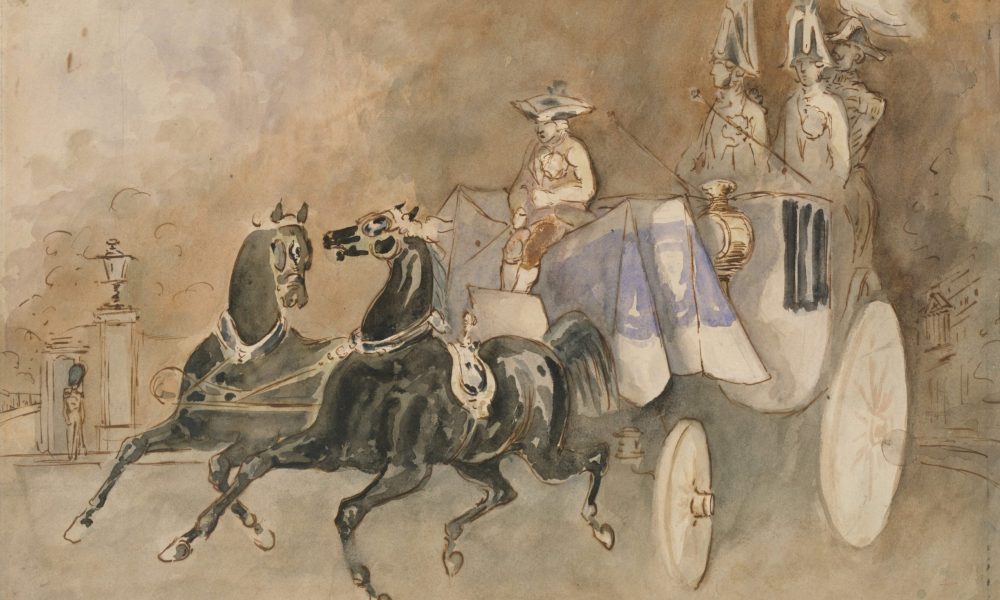

Being reviewed:
Advertisement

Thomas De Quincey was famous first for his opium eating, second for his prose style, and in both he pressed to the extremes. Although we celebrate him today for scandalizing 19th-century London with his Confessions of an English Opium-Eater (1821), in his own day he was also known for the musicality and intensity of his prose. His essays on the knocking on the gate in Macbeth, on the last days of Immanuel Kant, and even on “murder considered as one of the fine arts” can seem simply pretexts for the exertions of that De Quincey voice: singularly baroque, sensuous, and hallucinogenically elastic.
Though we place him today as a late Romantic, an unhinged acolyte of Wordsworth and fellow addict Coleridge, his work as an essayist, critic, and philosophical belletrist continued through the age of steam and speed, culminating in 1849 with “The English Mail-Coach.”
“The English Mail-Coach” is, like much of De Quincey’s writing, a reckoning with private trauma: it replays, with battering repetitiveness, the horrors stalking the inner chamber of his mind. Such terrors, broken loose from the past, recur with strange persistence, worming into his dreams and, eventually, into ours.
The essay begins as a light-hearted portrait of a vanished England. Horse-drawn mail coaches crisscross the island bearing news of British victories in the Napoleonic Wars. Perched on a box seat, De Quincey, then a young Oxford student, flirts with a lovely girl named Fanny, raising her hand to his lips while her grandfather—a coachman with a back so broad that, like a crocodile, he cannot turn around—drives on obliviously.
But “images originally gay” have a way of “opening … into sudden capacities of horror.” Step by step, gallop by gallop, the essay’s nostalgia gives way to terror. The mail coach thundering along a country road, trumpet blasting, horse muscle straining, all speed and haze, becomes an indelible image of onrushing death.
It was perhaps his experience with opium that made De Quincey sensitive to what he calls, in the essay’s subtitle, “the glory of motion.” The opium eater “lies under the weight of incubus and night-mare … he curses the spells which chain him down from motion.” The mail coach, by contrast, represents unimpeded action, scorching a line across the map “like fire racing along a train of gunpowder.” Roaring along in the wake of British military triumphs, the rumbling coach draws screaming crowds, women waving handkerchiefs, rows of heads cheering from windows.
“The English Mail-Coach” is one of the great meditations on mortality, on the speed with which life runs through our fingers, on how easily existence in all its radiance can be snuffed out.
De Quincey credits the mail coach with sponsoring a sense of national belonging. Citizens high and low take pride in the gleaming carriage, the magnificent horses, the coachmen in their royal livery. As the coach whips through towns announcing victory, spectators feel united in a “grand national sympathy.” Exhausted washerwomen brighten at the rumble of the wheels: “For this one night they feel themselves by birthright to be daughters of England, and answer to no humbler title.”
Yet the instrument charged with forging national consciousness is itself perilously ungovernable. De Quincey sees the mail coach as more sublime, more evocative of human smallness and helplessness, than the vast screeching railways that replaced it (in this, he stands apart from his Victorian peers). The mail establishment relies on animal power, “incarnated in the fiery eyeballs” of a surging horse with “dilated nostril, spasmodic muscles, and echoing hoofs.” The hurtling coaches lay waste to their routes, toppling applecarts and smashing spilled eggs to frothing puddles beneath the frantic pounding hooves.
The essay’s climax, entitled “The Vision of Sudden Death,” recounts the moonlit night when De Quincey, high on laudanum, finds himself in sole charge of a mail coach whipping along at 13 miles an hour on the wrong side of the road. The coachman is asleep, gripping the reins like a vise. Suddenly there is, in the moonlight, an interval of silence. The coach, headed north from Manchester, is passing by England’s burgeoning centers of industry, “upon which … more than upon any equal area known to man past or present, had descended the original curse of labour.” De Quincey’s thoughts turn, accordingly, to “that counter vision of rest, of saintly repose from strife and sorrow, towards which, as to their secret haven, the profounder aspirations of man’s heart are continually traveling.” The mail route bends toward the sea. The water, the light, and the silence of the surrounding expanse converge in a “silvery mist, motionless and dreamy,” earth and sky together veiled in “the same majestic peace.”
But then, a whisper of wheels: and the lull is exposed as cruel counterpoint to the events that follow.
A young couple out for a midnight ride in a flimsy carriage are directly in the coach’s path, unaware of the colossal vehicle bearing down on them. De Quincey shouts a warning. The mail coach thunders on, its “over-towering shadow” eclipsing the tiny gig. Time dilates horribly.
The collision is a terrible blow, striking one of the carriage’s wheels. The last thing De Quincey sees is the lady “as she rose and sank upon her seat, sank and rose, threw up her arms wildly to heaven, clutched at some visionary object in the air, fainting, praying, raving, despairing!” Then the mail coach rounds the bend, and “carried the scene out of my eyes in an instant, and swept it into my dreams for ever.”
Another essayist would end there. But De Quincey, for whom reality was always less real than the “floral luxuriations of dreams,” ascends to a bravura finale: a “Dream-Fugue” that still, two centuries later, seems authentically experimental.
In the dream fugue, the young lady’s encounter with sudden death is restaged over and over. In one variation, she is lost at sea, the water surging in foamy violence as she clutches the rigging. In another, she writhes in quicksand, hands waving as the wet soil closes over her head. Finally, De Quincey, drawing on imagery from the book of Revelation, brings us to a distant kingdom, a “city of sepulchres.” Trumpets blast, an enormous golden organ resounds, and the young woman clings to the altar of a celestial cathedral whose aisles stretch 70 leagues long. An essay that begins as a reminiscence of spirited college days ends with an apocalyptic vision that places us on the very threshold of the infinite.
De Quincey’s achievement rests on that mysterious element, style. In creating what he called “impassioned prose,” he twisted an immense vocabulary into intricate and contorted formulations. The profusion of dashes and semicolons—elaborating—prolonging—convey opiated consciousness stretched to the vanishing point.
He invented drug literature. But his true purpose lay deeper: to contemplate the “hieroglyphic meanings of human sufferings.” His psychedelic maximalism will always find readers—still, it will never go mainstream.
“What a poet that man is!” exclaimed fellow opium addict Elizabeth Barrett Browning after reading De Quincey. “Prose writer though he is,” Virginia Woolf remarked, in one of several essays she devoted to De Quincey, “it is for his poetry that we read him.” The last great Romantic poet was a Victorian prose writer.
The force of De Quincey’s poetic prose is such that his dreams are now mine; they haunt me. A few weeks ago, I slipped out for an evening run, taking in the last quarter hour of the darkening violet light.


I darted into a crosswalk without looking to my left. Suddenly, in my ear, the harsh metallic blare of a truck horn, like the trumpet on De Quincey’s mail coach, like the seven angels sounding in the book of Revelation. I looked over my shoulder into the oncoming headlights. In the white glare I saw it, the vision of sudden death, the “mighty dial, sculptured with the hours, and with the dreadful legend of TOO LATE.”
“The English Mail-Coach” is one of the great meditations on mortality, on the speed with which life runs through our fingers, on how easily existence in all its radiance can be snuffed out. In the driving rhythms of De Quincey’s sentences I hear, across two centuries, the cruel hooves resounding (too late, too late, too late), the death coach barreling down. I look over my shoulder, blinking in the headlights, bracing for the inevitable blow. 
This article was commissioned by John Plotz.