

Advertisement

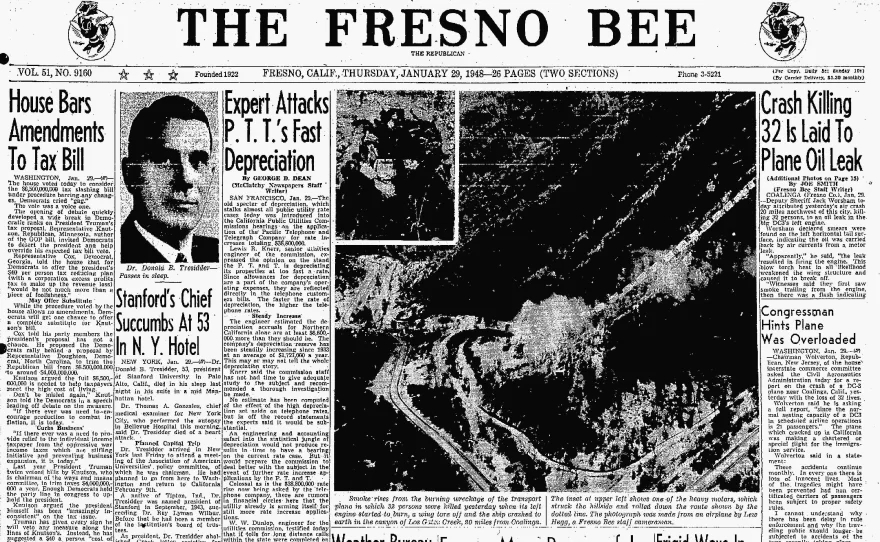
On January 28, 1948, a plane chartered by the US Immigration and Naturalization Service caught fire, broke apart in midair, and crashed into California’s Los Gatos Canyon. The disaster—78 years ago today—killed everyone on board: four white US citizen crew members and the 28 Mexican nationals who were being deported from the United States. An AP newspaper account identified the crew members—two pilots, a flight attendant, and an immigration officer—but referred to their incarcerated passengers only as “deportees.” Woody Guthrie distilled his outrage about the dehumanization of this anonymizing journalistic practice in the chorus of a new song. “I don’t have a name when I ride this big airplane,” mused Guthrie after reading the paper’s dehumanizing anonymization, “They just call me one more deportee.” Yet Guthrie, a folk music icon and anti-fascist activist, probably only knew the half of it. Three days after the crash, the 28 Mexican victims were buried in separate coffins in a mass grave in a Fresno cemetery. Their families were not notified about the burial. There would be no marker for years. When a simple plaque finally appeared, it did not even list the victims’ names.
Although Guthrie wrote these lyrics just days after the disaster, it was long thought that other performers first put his words to music.1 Now, this folk standard has been definitively restored to Guthrie’s catalog. “Deportee (Woody’s Home Tape)” is one of 20 songs released in the summer of 2025 on Woody at Home—Vol 1 + 2 (Shamus Records). Guthrie recorded these previously unavailable songs on a borrowed two-channel tape recorder in his family’s Brooklyn apartment in 1951 and 1952; he laid down the songs on tape—old and new, fully realized and in flux—to give his new music publisher a better sense of his work as he tried to maintain his creative relevance and political commitments in the face of early Cold War repression and as Huntington’s disease, his yet-undiagnosed neurological condition, took its toll on his mind, body, musicianship, and family life.
Although some have long known about these home recordings, advances in digital editing and restoration software made their exposure to a wider audience possible in 2025. Now, Guthrie’s recording of “Deportee” calls out for thinking about its continuing relevance. As poet and author Tim Z. Hernandez, who has written two books engaging with the Los Gatos plane wreck, puts it: “To finally hear these words in Woody’s own haunting voice, is to hear a prophetic voice from the grave, warning us about where we’ve been, who we’ve become, and where we are headed.”
Activism focused on deportation flights is indeed a necessary, specific response to a violent, dehumanizing political technology.
“Where we’ve been”—i.e., January 1948—coincided with a pause in the Bracero Program. From 1942 to 1964, this federal initiative brought Mexican guest workers into the United States to address labor shortages. It developed alongside efforts by employers to hire similarly low-paid and tractable undocumented workers. And so, when the Bracero Program was temporarily discontinued in late 1947, the US government ramped up its deportation efforts. The INS deported Mexican workers, former Braceros, and undocumented workers alike, all of whom continued to find work in industries that depended upon Mexican illegality to create surplus value while reinforcing it as a social problem in the eyes of the public.
These migrant workers were subject to what Adam Goodman and others have called the “deportation machine.” This system has, since the 19th century, relied on public transportation—ships, trains, buses, trucks, and, most recently, planes—to regulate migration and labor in a constantly morphing, increasingly networked, racial capitalist economy. Ethan Blue describes late 19th- and early 20th-century deportation trains as a “politico-technical assemblage” that connected state and corporate power, while it “enabled and extended the will and desire for an expansive understanding of national protection.” Writing about recent deportation flights in Europe, William Walters builds on Blue’s conceptualization, emphasizing how the deportation machine has been intricately conjoined with the “heterogenous domain [of commercial aviation] that encompasses air routes and other spaces, forms of law and other regulation, forms and norms of culture, aeronautical and navigational technologies, and much else.”
Walters’s approach works well for analyzing earlier deportation flights operating in the United States. Commercial aviation in the United States developed hand-in-glove with the growth of the bureaucratic and regulatory state, as well as with US imperial operations overseas. Government grants for airport construction projects and contracts for things like transporting airmail, building military planes, and charting flight routes served powerful governmental and private interests alike, going back to the very beginnings of commercial aviation in the 1910s. The industry expanded rapidly in the decades following World War II, thanks, in part, to massive federal and local funding for airport expansion projects and the reconversion and redesign for civilian use of military aircraft. After the passage of the Immigration and Nationality Act of 1952, airports were increasingly transformed into borders amid growing international travel and immigration by air.
Since the 1920s, Mexican deportees had regularly been transported to and across the border by train and bus companies, as well as to Mexican ports by shipping lines. Then, in 1946, after running a few deportation flights using military aircraft, the US government began contracting with US airlines for deportations to Mexico. The ill-fated January 1948 flight was operated by Airline Transport Carriers. It took off from Oakland with passengers who had been transported from the INS detention facility across the bay in San Francisco. They were flying to El Centro, California, from where they would be forced to cross the border.


Because “Some days I’m not legal / Some days I’m not wanted,” the INS and other state agents would “chase me towards that border.” Singing from the perspective of a migrant, Guthrie links the symbolic dehumanization and material obliteration of the Mexican national crash victims to the more mundane dehumanization of migrants in a labor system that reduced them to disposable commodities. The plane’s “fireball of lightning” that caused “my good friends” to “blow here just like dry leaves” is part and parcel of a broader, long-developing system through which migrants “fell dead” and were “killed” across geographies. Thus, Guthrie connects the spectacular violence of the Los Gatos Canyon plane wreck to a broader array of harms that accompanied the institutionalized exploitation of migrant workers and dangerous border crossings.
The song also implicates listeners in this transnational system of exploitation. It addresses them directly with the second person “you” at key junctures, in ways that are more pointed than in the revised lyrics popularized by later performers. The first verse describes the migrant workers being deported to “your ol’ Mexican border” after “your crops are all in.” The final verse questions the legitimacy of an agricultural economy that depends on precarious contracted and undocumented labor, asking whether it is “the best system to grow some good fruit.” Producer and consumer, in other words, are called out as having a stake in this violent economic arrangement with its supporting system of ideological denigration and deportation infrastructure.
Since the Obama administration, Tim Z. Hernandez has been wrestling with the “who we’ve become, and where we are headed” questions raised by Guthrie’s song. His 2017 book All They Will Call You reconstructs that harrowing 1948 flight and more: the circumstances that led those particular passengers and crew to be on it, the crash and responses to it, and how the event has lived on in the memories of the victim’s families. Hernandez’s book counters the dehumanization of the deported passengers by reconstructing several of their personal histories alongside those of citizen crew members. These stories show how migrants and immigrants in the past and present have sustained themselves and family (or at least have tried to) within an often-cruel system of managing low-wage labor and policing citizenship.
Hernandez extends this project in They Call You Back, published in 2024. He documents his search for additional members of the Mexican crash victims’ families. But he also explores the work he and others did to honor the crash victims publicly in the years after his 2017 book brought renewed attention to their plight, including placing a memorial at the crash site and participating—along with Joan Baez and his own and victim family members—in a California State Senate session recognizing the ill-fated passengers. He even collaborated with Chicano Indigenous singer Lance Canales on a version of “Deportee” that includes Hernandez reading the Mexican crash victims’ names.
Hernandez’s They Call You Back also addresses the social effects of accumulated trauma. Hernandez explores how his own desire to exchange information with victim families—and, ideally, bring them relief from their post-wreck, accumulated grief—was connected to his need to address his own inherited traumas. One of these traumas stemmed directly from an instance of lethal state violence deployed against a family member. Others were legacies of the common, everyday hardships borne by members of his and other working-class immigrant families.
Like Guthrie’s “Deportee,” then, Hernandez’s They Call You Back wrestles with how such spectacular and horrific violent acts reveal the broader systems of dehumanizing exploitation that are more consistently defined by prosaic harms. And, like Guthrie, Hernandez struggles across the book to come to terms with how individual healing and solidaristic purpose might build from the common ground of being implicated in and harmed by these systems.
If one flies, one is, to some degree, implicated as a willing participant in a security apparatus that includes deportation flights.
Thus, both Guthrie and Hernandez offer guidance for thinking about and perhaps responding to deportation flights today. Deportation flights since 2010 have been largely carried out by US Immigration and Customs Enforcement Air Operations, commonly known as ICE Air. ICE Air flights transport detainees to and from ICE-managed detention facilities to locations near the border prior to being transported by ground transport across it, and directly to destinations in other countries.
Currently based in Mesa, Arizona, ICE Air maintains additional operational bases and staging grounds for deportations in Miami, Florida; Alexandria, Louisiana; and Brownsville and San Antonio, Texas. Although ICE Air uses some military planes for deportations and has transported individual and small groups of deportees on regularly scheduled commercial flights via its Commercial Air Operations, it relies primarily on charter flights overseen by its Air Charter Operations.
ICE contracts its charter flights through air brokers, which in turn hire subcontractors to do the actual flying. Classic Air Charter was the air broker from 2017 to 2023, at which point the contract was taken over by CSI Aviation, led by Allen Weh, a major Republican Party donor and former New Mexico state party chair. Current subcontractors include GlobalX, Eastern Air Express, and Omni Air International—the latter a provider of “special high-risk charter” flights—as well as Avelo Airlines, a small passenger carrier. Avelo’s entry into this business earlier this year, undertaken to improve the struggling airline’s finances, was met with a good deal of controversy and calls for a boycott.
The number of ICE deportation flights—as documented by Thomas Cartwright’s flight-tracking research—ramped up considerably just seven months into the Biden presidency. The number jumped again dramatically as the second Trump presidency realized its often racist, xenophobic, and politically repressive anti-immigrant agenda, with inconsistent regard for established law and recent court orders. There have been 62 percent more deportation-related flights between January and September 2025 than during the same period the year before, with the monthly totals rising rapidly since May. The 1,464 flights in September 2025 dwarfed the 580 in September 2024 by an order of 2.5. These flights will no doubt increase, given the $75 billion of supplemental funding recently provided to ICE by the so-called One Big Beautiful Bill Act, with $14.4 billion dedicated to “transportation and removal.”
Thankfully, there hasn’t been a major wreck involving a deportation-related flight in the current day. Nevertheless, as journalists, academics, activists, flight attendants, and others have documented, recent deportees have been subjected to various forms of violence: inadequate inflight medical treatment, shackling and full-body restraints, limited food and water, and other punitive measures. Most have already had some experience of violence in the form of arrest, detention, and separation from family and friends, and many have faced dangerous conditions when renditioned and imprisoned elsewhere or upon their return to their countries of origin. Prominent examples include the March 2025 deportation of Kilmar Abrego Garcia and hundreds of Venezuelans, who were subsequently imprisoned in the notorious Salvadoran Terrorism Confinement Center (CECOT) without trial, and the September and December 2025 repatriations of about 100 Iranian political dissidents and others who had sought asylum in the United States.


Guthrie’s lyrics and Hernandez’s prose illuminate today’s complicity in trauma-producing violence of deportation by air. Clearly the Trump administration owns the biggest share. Its spectacular disdain for the health, welfare, and survival of deportees—primarily Black and brown—demonstrates its exuberant racism and xenophobia, as well as a calculus of the political expediency of manufacturing enemies and seeking retribution against them. But one can’t forget that ICE Air’s dehumanizing practice had foundations in longer history, and that it increased dramatically during the Obama and Biden administrations.
Commercial aviation is implicated as well. Avelo’s recent decision to begin running deportation flights—despite knowing the decision would alienate some of its customers, employees, and shareholders—shows that business is better than ever. CSI Aviation’s 2024 five-year air broker contract was worth $3.6 billion.
And yet, when thinking about current and possible future political responses to the deportation machine, commercial aviation is a site of contestation. Some of us who write about aviation more generally, like Blue and Walters, use concepts like networks and assemblages to address how airports and air travel are spaces where people of varying status are drawn together and compelled to relate to one another. They do this as workers, travelers, tourists, airport neighbors, and so on in terminal waiting areas and restaurants, at security gates and immigration and customs areas, on flights, in communities surrounding airports, and elsewhere. All the while they negotiate municipal, state, and federal laws and regulations; economic flows of different scales; environments; and often the time-compression of travel. In other words, hierarchical relationships are produced and reproduced in aviation spaces as people live out their differing aspirations and opportunities.
Yet, the existence of these relationships—sometimes hidden, sometimes quite visible—has made aviation spaces important sites of activism. This is evident in decades of anti-jet noise activism, living wage and anti-employment discrimination struggles, and immigrant rights protests at or near airports.
We can add opposition to deportation flights to the list. As noted, flight trackers and watchdog organizations have called attention to the proliferation of these flights, the growing number of deportees on them, and, at times, the abuses that have occurred on them. Local politicians, researchers, and activist groups have pressured municipal operators to scale back or stop deportation flights at their airports. Such was the case when political pressure following a 2019 University of Washington report series on ICE operations and subsequent advocacy led to a four-year pause in deportation flights at King County International Airport / Boeing Field. The Avelo boycott, although unsuccessful in terms of ending the airline’s ICE contract, directed significant scrutiny to ICE Air operations while providing a model for future actions against carriers who choose to get into the deportation game.
Despite the ramped-up deportation numbers, the blatant racism and xenophobia, the performative cruelty, and all the rest of it, the Trump administration will likely not deport so many people as to jeopardize the long-term profitability of low-wage immigrant- and migrant-dependent businesses in the agricultural, hospitality, health care, construction, and other sectors. And so, those with less power—whose politics and financial interests diverge from those of the US government and air carriers—must take a hard look at the everyday ways their lives are shaped by the presence, precarity, and deportability of immigrant labor. If one flies, one is, to some degree, implicated as a willing participant in a security apparatus that includes deportation flights. The fact of inclusion in these overlapping assemblages compels us to ask more generally how we, as producers, consumers, citizens, even noncitizens, are supported by the labor of those who are most at risk from today’s aviation-based deportation machine.
Activism focused on deportation flights is indeed a necessary, specific response to a violent, dehumanizing political technology. All the better if it can lead to an analysis of and political response to the more fundamental dehumanizing and violent system that it serves. Guthrie, Hernandez, and common experiences with aviation ultimately might help to inform a broader politics—once we are beyond the current emergency—that addresses the prosaically violent norm of exploitable migrant and immigrant labor. 
This article was commissioned by A. Naomi Paik.
- Guthrie’s early 1950s version of “Deportee” is remarkable, in part, because it was widely assumed he never recorded what eventually became the folk standard “Deportee (Plane Wreck at Los Gatos),” aka “Plane Wreck at Los Gatos (Deportee).” This piece, the story goes, started off as a poem written by Guthrie. It only became a song about a decade later when Martin Hoffman, a young, Colorado-based folk singer, set the widely shared verse to music. “Deportee” became a standard, as well as a political anthem about deportation as a civil rights issue, after Hoffman taught the song to Pete Seeger at a gathering following Seeger’s 1958 concert in Ft. Collins, and then Seeger went on to record it and make it a part of his repertoire. The song was later performed and recorded by prominent artists such as Joan Baez, Odetta, Dolly Parton, Arlo Guthrie, Sweet Honey in the Rock, Ani DiFranco, Bruce Springsteen, the Highwaymen, and Los Super Seven. ↩︎