

Advertisement

Most of the films that Soviet filmmaker Sergei Eisenstein planned never came to fruition. Take the ironically titled Prestige of the Empire. Conceptualized in the 1940s—well into the Stalinist purges that turned so many of the artist’s former supporters against him—the film was to be based on a play of the same name by the Soviet trial investigator Lev Sheinin, which dramatized the 1913 trial of Menahem Mendel Beilis in Kyiv. Beilis, a Russian Jew, was accused of ritually killing a Christian boy. His trial was sensationalized in the Russian empire, and news of it spread globally. The play intrigued Eisenstein, and he began drafting a screenplay. The director was not oblivious to the conspicuous themes of Russian nationalism, racism, and Jewish persecution; still, because the film was to end with the acquittal of Beilis, Eisenstein believed he was crafting a screenplay about the internationalism of “the great Russian people.” He used the idea of the Russian people to refer to a sense of a unifying cultural identity rather than an ethnonationalistic idea. Internationalism was plural and contested from its very beginnings, and it was for Eisenstein too as he challenged himself in film theory and in his creative work.
Yet he ultimately planned to depict state-sponsored pogroms, the empire’s antisemitic policies, and an unjust trial led by politically motivated officials readily persecuting citizens. Given the nationalist and imperialist trends that had solidified in the Soviet Union by 1940, Eisenstein’s proposal to make the film was quietly denied by the head of cultural policy.
The films that Eisenstein never got a chance to make remain in a third space between theory and cinema. This ghostlike figuration resounds and leaves very real traces of its existence—a script here, a letter of intent there. Their delicate murmurings can be nurtured and coaxed out to reveal easily overlooked, yet lasting commitments and dedicated labor. The material traces of an artist’s imagination bring to life ideas that a lack of state support deterred from flourishing.
Eisenstein’s oeuvre consists in large part of unfinished projects, films, books, plays, and more, more numerous than the works he was ultimately able to complete. Known primarily for films like Battleship Potemkin (1925), October (1928), and Alexander Nevsky (1938), the filmmaker also spent years traveling around Soviet republics and internationally, where he was inspired to make films in Mexico, the American South, Argentina, Haiti, France, Kazakhstan, and other locations. The unrealized film constituted a site where Eisenstein’s ideological and aesthetic position and worldview could be articulated, and he could even begin to tease out a new conception of what we now call world cinema. Eisenstein wrote prolifically alongside his filmmaking practice, describing and theorizing his reasons for making films about the history and working-class struggles of people globally. The Odesa film, or even the Ukrainian port city film, can be read as a unique thread of Eisenstein’s creative and theoretical work. He died, suddenly, in 1948 at age 50, from heart failure, leaving behind an expansive catalog of artistic material and a legacy that continues to influence filmmaking and theory today.
Recent approaches to world cinema reveal the ways audiovisual media were fundamental to socialist internationalism throughout the 20th century. Looking closely at Eisenstein’s unrealized films acknowledges this internationalist project’s resonance in the present day. How can an unmade film speak to the possibility of an alternative social system? Is it possible to read this film, to comprehend its missing images as able to make meaning and inspire for modes of political and social organization? How can a potential project activate a new way of imagining the past, the present, and the future?
In the 1920s, Eisenstein was a key figure in the transnational avant-garde movement. His film philosophy, writings, and other creative works were sophisticated and cosmopolitan, although the intellectual complexity may be difficult to see under the shadow of the pressure to conform to the Soviet nationalism under Stalin in the 1930s. His films made in the 1920s reveal his internationalism and iconoclasm. More importantly, by looking at the films he was not able to bring to fruition, those left unfinished and preserved in a realm of imagination, we are able to learn about his commitments and ambitions that couldn’t meet the party’s standards and expectations.
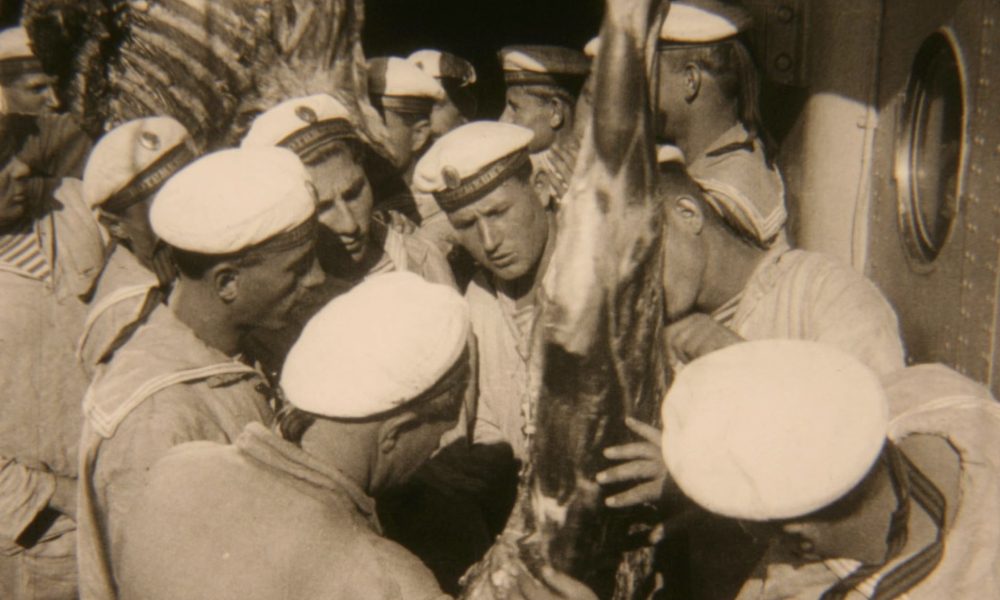
“I knew the Sevastopol port inside out,” reflects Eisenstein in 1945 as he describes himself scanning the waterfront for inspiration during the shooting of Battleship Potemkin. “I was sick of the actors’ faces, too,” he adds, and this boredom with seeing the same landscape and the same actors and film crew draws his attention to the other people sharing space at the Crimean port.1 Eisenstein switches his attention from judging the physical strengths of the men around him (in case he was to hire them onto the film crew) to address their expressive properties. In this way, he begins to sketch out a scene of the Ukrainian everyday people who play major roles in one of his seminal films. The stove heater of his shabby Sevastopol hotel becomes the battleship Potemkin’s surgeon, an old gardener tending to orchards on the outer edges of the city dons a wig and becomes the priest, and a park watchman at the Alupka Palace in Crimea serves as a background extra.
Eisenstein gives seemingly frivolous reasons for choosing to shoot Battleship Potemkin in Odesa and Sevastopol. “It was the sun that made us pack up and leave Leningrad in 1925, when we launched somewhat belatedly to shoot 1905. It made us chase for its last beams in Odesa and Sevastopol and compelled us to choose from the scenario the only episode that could be filmed in the south.”2 Seeking warmer shores, Eisenstein describes these Ukrainian port cities with their stereotypical Soviet images of leisure and escape. In this casual aside, he leaves out that he had also been planning many other projects to be filmed around the Soviet Union and internationally. However, when he presented his early scripts to the Goskino (the Soviet State Committee for Cinematography), the committee estimated that making the films would cost an exorbitant amount of money and labor. Studio leaders demanded he go to Odesa as a cost-saving strategy, and there he ended up filming some of the masterpieces of his oeuvre. Although it might seem that Eisenstein found himself in Odesa and Sevastopol nearly on a whim, or even due to pressure by studio leaders, the director had a personal and independent relationship with Ukraine and its culture that lasted throughout his lifetime.
How can a potential project activate a new way of imagining the past, the present, and the future?
What may initially seem like trivial asides to the production of one of Eisenstein’s lasting films reveals the overlooked details that imbue his works with more meaning than the obvious elements on the surface. Even more, the details that did not even make it to the screen reveal the intricacies of Eisenstein’s political and aesthetic drives, which might otherwise easily slip away into myth.
Battleship Potemkin was not the only project that Eisenstein intended to make in Odesa. In 1925, he was also working on a collaboration with his close friend Isaac Babel. Eisenstein longed to bring to the screen an adaptation of one of Babel’s stories that would later become a part of the author’s Odessa Stories collection.3 The script revolved around Babel’s character Benia Krik, a Jewish gangster running the scene in the Moldavanka section of Odesa. Eisenstein’s plan was to film both the Odesa portions of Battleship Potemkin and this Babel script at the same time, but the former project eclipsed the latter. Filming the Odesa sequences of Potemkin weighed heavily on production, requiring more of Eisenstein’s and his crew’s attention. In the end, he passed his script based on Babel’s story to the director Vladimir Vil’ner, who released his version, entitled Benia Krik, soon after Potemkin premiered. Eisenstein was never credited for his involvement in this script, nearly erasing his commitment to bringing this story to the screen.
By the 1930s, it had become much more common for nationalist and imperialist trends to commingle with cosmopolitanism. Eisenstein had a lifelong fascination with the idea of the Russian people, although this wasn’t the Russian nationalism we know in today’s parlance.
In the early ’30s, Eisenstein envisioned a number of films that would dramatize narratives of greed outside of the Soviet Union. These included Sutter’s Gold and An American Tragedy about the US, and Black Majesty about the Haitian revolution (not his only attempt at making a film on the subject).
In 1930, Eisenstein had signed a contract with Paramount Pictures and submitted the first full script adapting Blaise Cendrars’s 1925 novel L’Or, about the Swiss pioneer John Sutter as he traveled from Europe to California during the Gold Rush. Sutter’s Gold was Eisenstein’s first fully prepared screenplay to trace a traditional epic narrative and focus on one central character, and even more important, his first script composed with the full incorporation of an imagined audio soundtrack. Although the screenplay was praised by the studio, budgetary concerns thwarted Eisenstein’s efforts to bring the film to fruition.
In the aftermath, the studio gave him another project, based on Theodore Dreiser’s 1925 novel An American Tragedy. In this film, the director aimed to develop a sound montage technique that he had invented in reference to the literary monologues in James Joyce’s Ulysses. Eisenstein planned for the film to focus on key moments from the life of the protagonist, told through his interior monologue to emphasize the narrative’s tragic structure. In this way, Eisenstein hoped to accentuate the film’s criticism of the socioeconomic system that produces murderous individuals. Again, although the studio seemed to praise the script, executives cited apprehension about how to advertise the film to broader audiences. Marketability aside, both of these American projects by Eisenstein reveal an ambition to shift his political orientation from celebrating Soviet achievements to complex thoughts on other national contexts.
Eisenstein brought this sense of nuance and a desire for international collaborations to his project Black Majesty. He was never able to develop it into a script, but notes and drawings point to the director’s strong impulse to make a film about the 18th-century Haitian revolution and indict the self-fashioning of one of its leaders, Henry Christophe, into a despot. Eisenstein did not expect to attract any American film studios’ attention for funding the project, but he exhibited some hope of completing it on his return to the Soviet Union. He had even aspired to have Paul Robeson, whom he invited to visit the Soviet Union in 1934, star. It’s unclear exactly why Black Majesty was not made—whether developmental issues barred production or Eisenstein realized he would have to move on to state-favored topics centered on the subject of the strength of the common Russian people.


By the 1940s, Eisenstein’s peers, who either believed in or capitulated to the new Stalinist order, rejected him from the collective social fabric. Contrary to how we might view his films and writing, Eisenstein’s works resemble a constellation of disparate parts rather than a unified system. His mind contained the constant chatter of films he hoped to make, often motivated by his internationalist beliefs.
This chaotic, unfinished space, often prevented from coming to fruition by the official state cultural committee, mirrors the lives of artists and writers working today. Museums close their doors and funding for the arts vanishes overnight. Curators and artists lose their jobs for not falling in line with official state ideology. Some projects must remain in the draft stages, germinating. The work of the artist is to make art, that is, to continue the work of imagining what is possible now. When we look back on these years, will we be able to understand what was spoken through the countless unrealized projects? 
- Sergei Eisenstein, Notes of a Film Director (Dover, 1970), 24. ↩
- Eisenstein, Notes of a Film Director, 28. ↩
- Dustin Condren’s book, An Imaginary Cinema: Sergei Eisenstein and the Unrealized Film (Cornell University Press, 2024), reveals valuable insights into Eisenstein’s unrealized film oeuvre, along with a necessary list of these projects, previously uncollected. ↩