
Being reviewed:
Frankenstein
Frankenstein: Annotated for Scientists, Engineers, and Creators of All Kinds
Advertisement

In the 18th-century equivalent of a college dorm room, Victor Frankenstein builds his new creation from scraps of the old. And like many tech disruptors today, Frankenstein—at least, in Mary Shelley’s original novel Frankenstein, first dreamed up 210 years ago this year—is not the genius doctor into whom he has morphed in most adaptations. Instead, Victor is an undergraduate, a soon-to-be dropout, in fact. He is the darling of his department and the inventor of some novel chemical instruments, but not a generational talent.
The young Victor forces his vision onto the world without guidance or restraint from a mentor. He constructs his first creature, a male, during a few months in isolation. When the creature so eloquently demands a female companion—his own Eve—Victor’s real work begins. Creating a male was fairly straightforward, but creating a female requires Victor to first consult with some of the most prominent scientists in Europe: he needs collaborators.
This dynamic—male/first/simple, female/second/complicated—echoes trends in biomedical sciences from Shelley’s time to our own. Male anatomy and physiology were seen as a baseline and the focus of medical education; women’s health was an afterthought. Shelley’s own mother died from an infection after giving birth. Up through the 1970s, scientists rationalized excluding women from medical research and female animals from preclinical research with arguments that hormone fluctuations associated with the menstrual cycle would complicate experiments, and that research could affect fetal health in pregnant women and even fertility in potential mothers, regardless of the health benefit. Collaborative efforts to do the complicated thing, undo centuries of neglect, and improve our understanding of women’s health are ongoing. Shelley’s original novel is littered with such parallels to the scientific world.
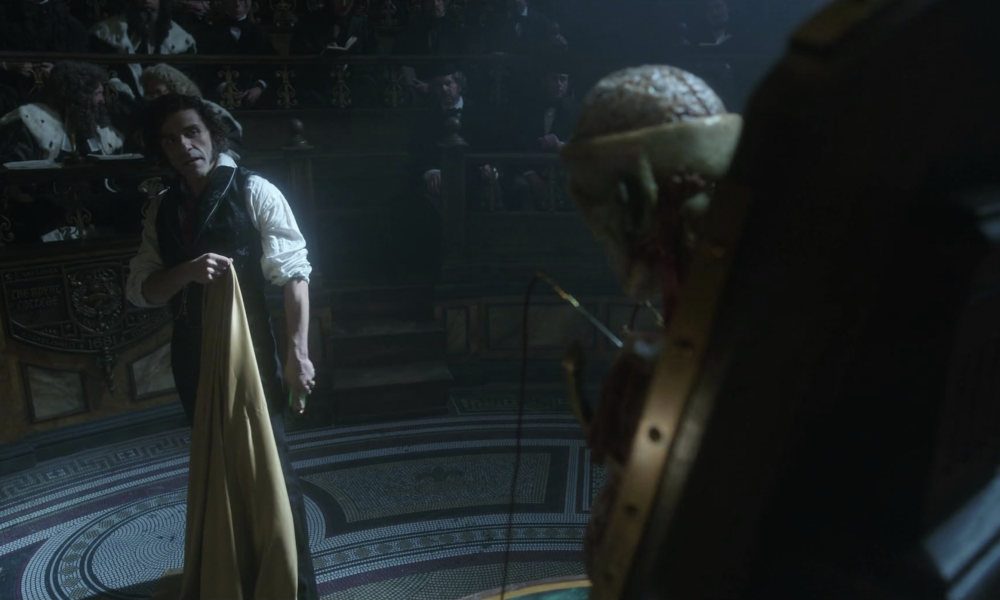
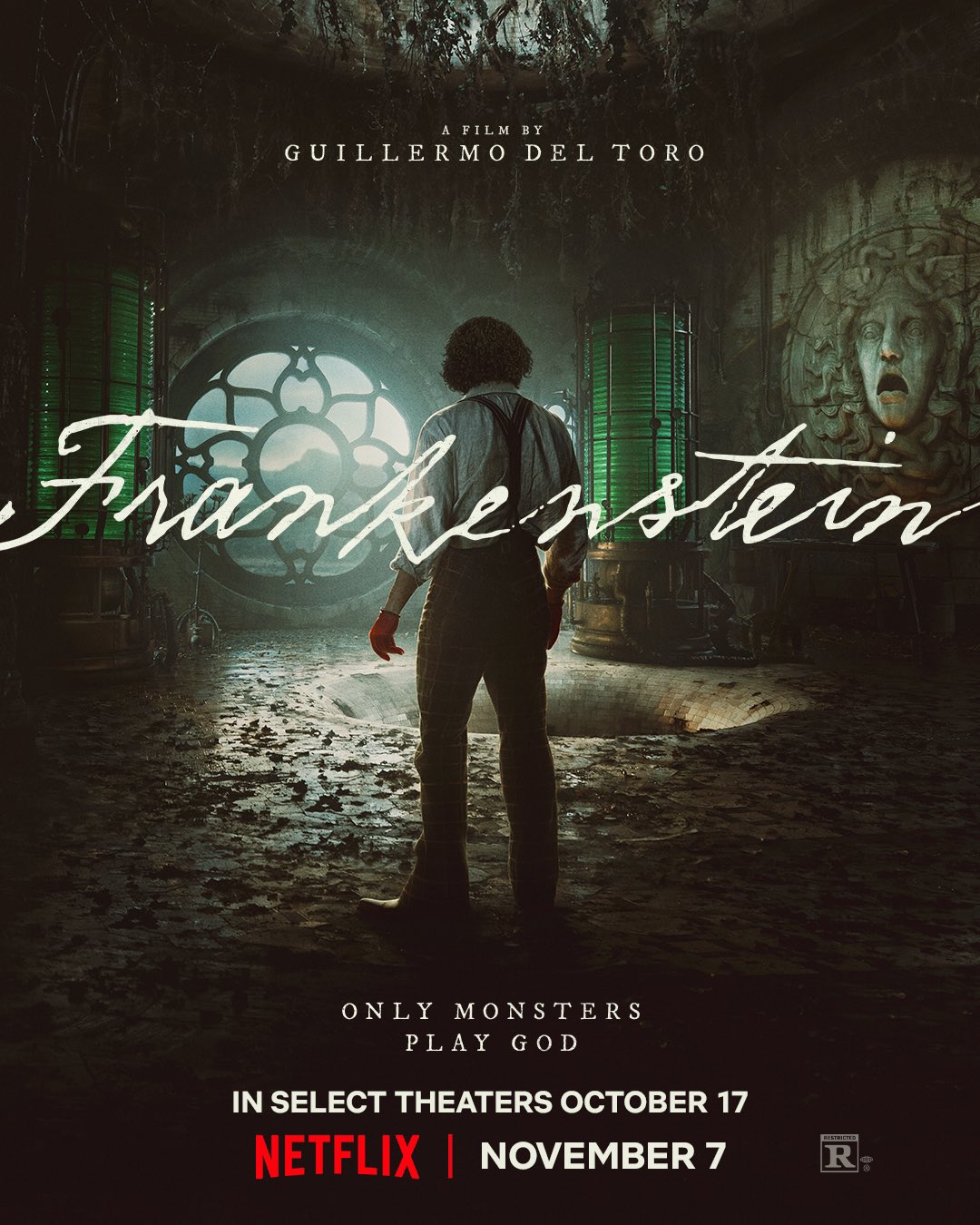
In Guillermo del Toro’s adaptation, Frankenstein (2025), Dr. Victor Frankenstein never tries his hand at a female creature. He has the fortitude, or small-mindedness, or both, to refuse the creature’s request outright.
That’s okay. Del Toro has plenty of other gender-related themes to explore.1 Victor’s distress at his mother’s death is amplified. He has a seemingly oedipal and exclusive thirst for milk. And he is engaged in a love quadrangle with his love interest, Elizabeth; his brother, Elizabeth’s husband; and the monster, Elizabeth’s love interest. Even Elizabeth’s and Victor’s approaches to scientific inquiry are gendered: her study of insects and appreciation of “God’s design in the symmetry and the shapes” is more in the style of a Victorian naturalist compared to his obsession with creation, that is, applied science. Surely some psychoanalyst has written a review of the film unpacking all this by now.
Del Toro makes plenty of other deviations from the text, and that’s okay too. Of the creature’s over 400 depictions in feature films, less than one percent are even based on the novel; about as many are pornographic parodies (according to Wikipedia, anyway). A change from an 18th-century setting to the 19th century more readily lends itself to the gothic and steampunk aesthetics del Toro so masterfully employs. Victor is a baron (the aristocracy seems somehow creepier than the bourgeoisie). There is a healthy dose of Catholic imagery peppered throughout (Catholicism reliably adds a bit of gravity to horror). The person to whom Victor relates his tale is Danish rather than English (I have no explanation for that).
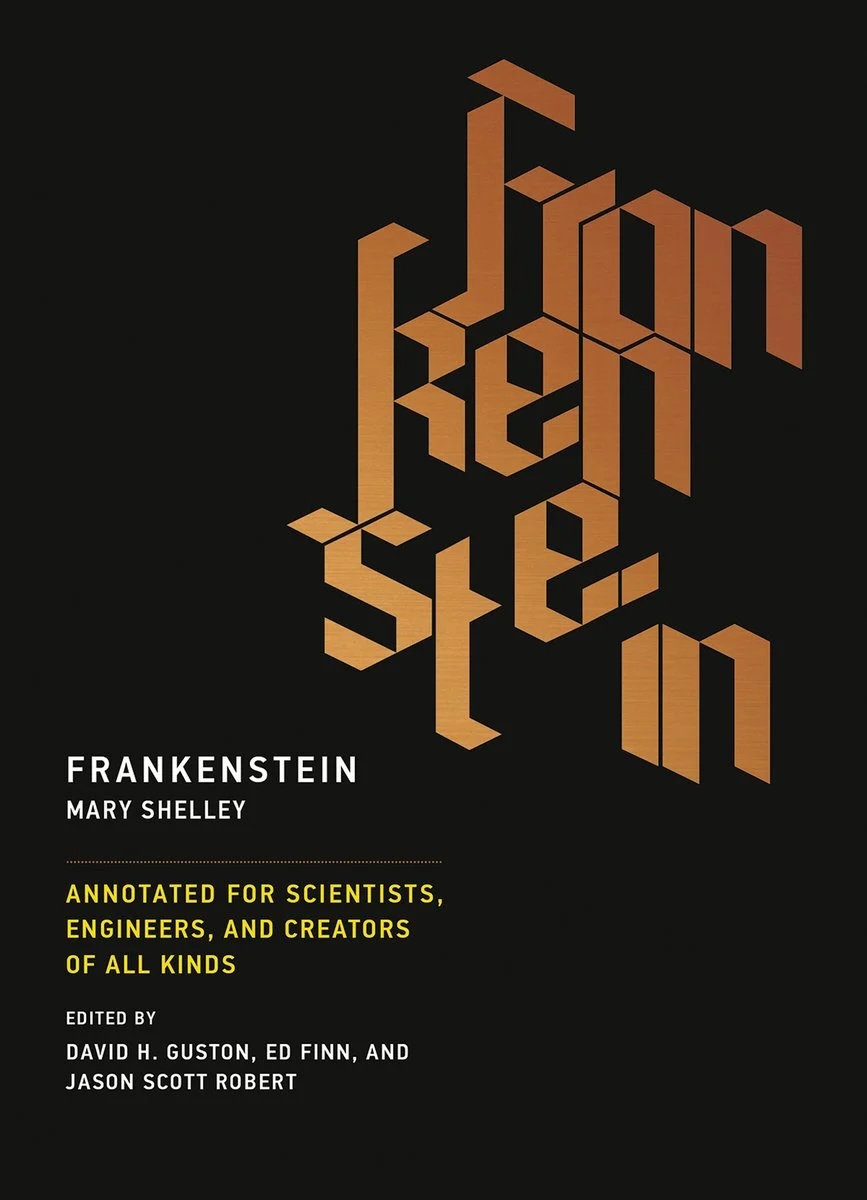
Some of the most interesting deviations from the novel, however, regard mentorship, both Victor’s and the creature’s. And scientific mentorship is a primary focus of Frankenstein: Annotated for Scientists, Engineers, and Creators of All Kinds. Published in 2017 by an interdisciplinary team based at Arizona State University including ethicists, synthetic biologists, neural engineers, and scholars of English literature, this volume reproduces the original 1818 edition of the novel alongside annotations and essays that highlight the scientific and ethical themes Shelley explored. It contains fascinating explanations of the history of science, the intellectual milieu of Shelley and her contemporaries, and the ethical issues raised throughout the novel.
The annotators and editors make clear that Shelley’s Frankenstein is a cautionary tale of how two autodidacts, lacking strong mentorship, wreaked havoc on themselves and those around them as a result of “doing their own research.” Victor Frankenstein’s lack of guidance results in his ill-advised project—to animate lifeless matter—and ultimately the destruction of his family and his sanity. The creature’s lack of guidance results in his antipathy and ultimately violence toward his creator and mankind at large.
It is thus revealing that in del Toro’s adaptation, Victor does have an early scientific mentor in the form of his father: an aristocratic surgeon (a combination too anachronistic for my taste—medicine, especially surgery, was considered beneath the aristocracy in the 19th century) played by a master of the tyrannical father role, Charles Dance. Victor receives the best medical education available, coupled with a great deal of cruelty and corporal punishment. This is probably as bad as, if not worse than, no mentorship at all.
Del Toro’s Victor also has something that Shelley’s does not: a benefactor—or an angel investor, to use the modern parlance. Heinrich Harlander, played by a master of the charming villain role, Christoph Waltz, is a war profiteer with a penchant for transhumanism (sound familiar?). With the offer of unlimited funding and access to cutting-edge technology, Victor has all the resources he needs to produce the creature. He may not have a proper collaborator, but he gets a lab manager in the form of his brother. Almost every scientist wants to delegate some of the technical and administrative labor so they can think the big thoughts, perhaps, as Victor does, in the bath.

Between Dr. Frankenstein’s antipathy toward academia and Harlander’s obsession with transferring his consciousness from his body in pursuit of immortality, it is difficult to imagine that del Toro did not have certain tech billionaires in mind.
Like some tech disruptors today, Harlander wants to leverage Victor’s achievement to transfer his brain/mind to a new body. For instance, in a recent interview with Ross Douthat, Peter Thiel hesitated before affirming that the human race should endure, then seemed to endorse a transhumanist agenda “where your human, natural body gets transformed into an immortal body.” A few years ago, the startup Nectome had ambitions to back up one’s mind like a hard drive and simulate customers’ brain activity. Sam Altman was an early booster. Some transhumanists believe that simulating the brain (the work of computational neuroscientists) is a necessary step toward “uploading” one’s consciousness and living forever. But apparently, Harlander could not have transferred his consciousness to either del Toro’s or Shelley’s creature. It is unclear from whom the brain tissue used to form the creature came, but any memories formed by its previous owner, autobiographical or otherwise, seem to have been lost in the process of animation. The creature is what researchers in machine learning and artificial intelligence might refer to as a naive agent.
Although del Toro’s adaptation of Frankenstein is not merely an allegory about large language model (LLM) chatbots, the creature is definitionally an artificial intelligence. As with the development of the creature, the ethical implications of creating an artificial intelligence in our present moment are often an afterthought.
In Shelley’s novel, the creature, like many LLMs, is educated by training on what people in the field might refer to as unstructured data (conversations, novels, etc., as opposed to spreadsheets, databases, etc.), performing unsupervised learning (there are no labels to the data he trains on; he must learn any associations himself) without many teaching signals (rewards or punishments that indicate whether his decisions are correct or incorrect). Like the creature reading Paradise Lost, which in the novel inspires him to emulate Milton’s Satan by tormenting his creator, LLMs have no context for the literature on which they are trained. Both the creature and LLM chatbots have the capacity for eloquence, but also for extreme deviousness—the creature kills children and frames people for murder; news reports of ChatGPT goading people into suicide have surfaced in recent months. In del Toro’s film, the creature receives plenty of negative reinforcement from Victor and some positive reinforcement in his literary education from an elderly cottager, which makes him a good deal less mischievous.
Through the examples of Victor, the creature, and the artificial creatures in our own world, we can appreciate the importance of how one is trained and especially of mentorship in training young scientists. In academia, scientific research resembles a medieval guild system: graduate students are essentially apprenticed to their advisors. These student apprentices are motivated to publish, so as to graduate to the equivalent of journeymen (postdocs). Advisors are incentivized to maintain a labor force of apprentices but also to produce successful students who rise through the ranks themselves. Graduate students’ research projects are strongly influenced by their mentors’ guidance and sometimes dictated by their funding or even their whims. Picking a mentor is thus one of the most consequential decisions a scientist can make.
Between Dr. Frankenstein’s antipathy toward academia and Harlander’s obsession with transferring his consciousness from his body in pursuit of immortality, it is difficult to imagine that del Toro did not have certain tech billionaires in mind.
I don’t think Shelley, del Toro, or the editors and annotators of Frankenstein: Annotated for Scientists, Engineers, and Creators of All Kinds could have predicted the emergence of artificial intelligence/creature as scientific mentor. In recent months, I have encountered a number of young scientists and engineers who have turned to LLM chatbots for mentorship. When they are presented with a technical challenge or need to explore a new topic, they often look first to chatbots, even seeking advice on the direction of their research. I have heard students wish aloud that their conversations with their advisor were more like their conversations with chatbots.
Of course, many scientists are excellent mentors, and not all scientific insights generated by LLMs are bogus (I use them myself sometimes). Still, given ChatGPT 4.0’s tendency toward sycophancy, Grok’s tendency toward racism and antisemitism, and the tendency of LLMs in general to “hallucinate,” I think there is cause for concern. These young scientists are much closer in age to the Victor of the novel than the Victor of the film. What happens to a young scientist whose primary mentor is an artificial intelligence? 
This article was commissioned by Imani Radney.
- I’d like to thank Public Books editor Imani Radney for helping develop my analysis of the gendered dynamics of del Toro’s adaptations of the novel’s plot. ↩︎