
Being reviewed:
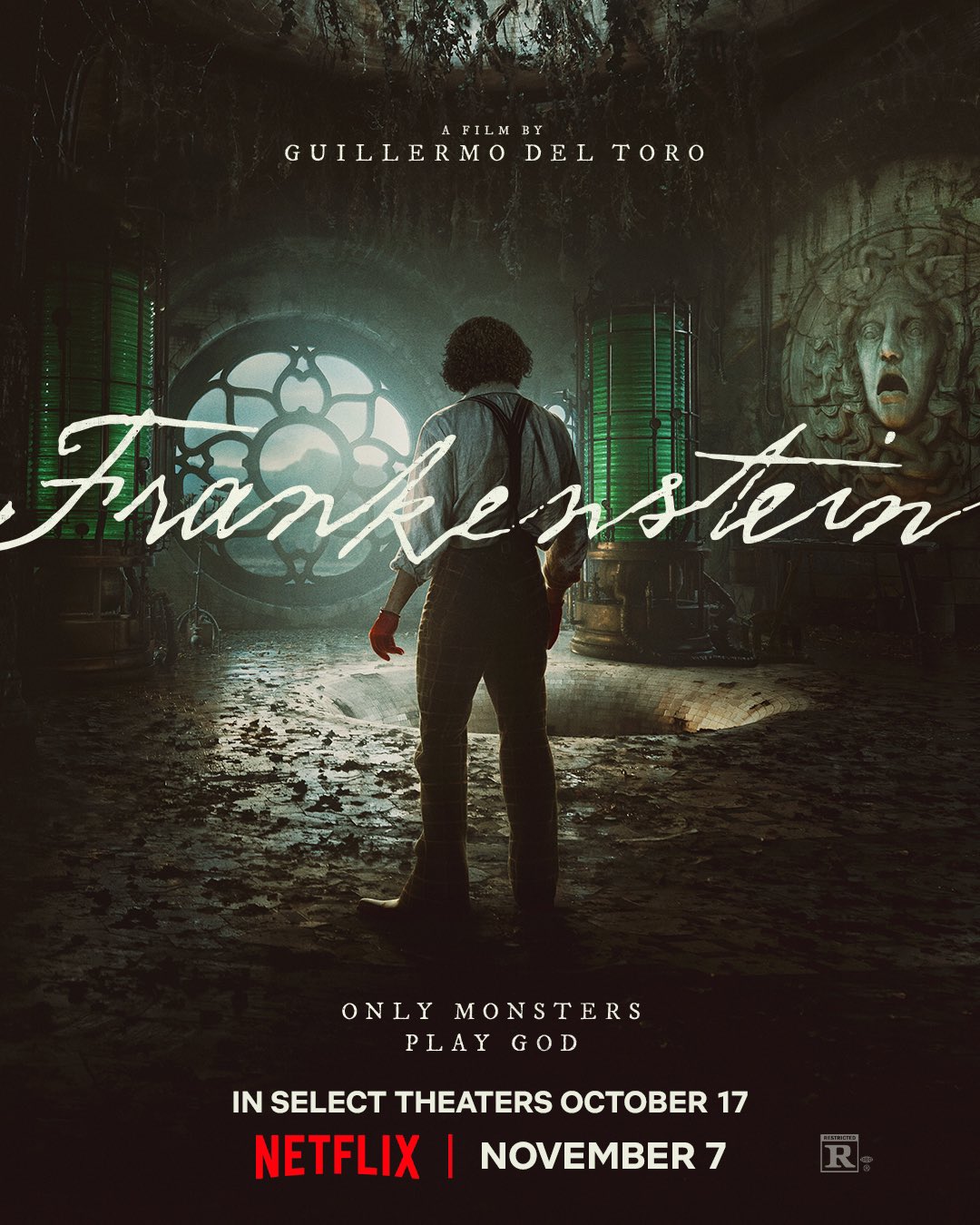
Frankenstein
Advertisement
Dr. Victor Frankenstein is dying, while his monstrous creation looks on. Lobbing the last of many insults at Mary Shelley’s 1818 novel, director Guillermo del Toro invents a deathbed rapprochement for his new film, Frankenstein (2025). “Forgive me, my son,” implores Victor. And the creature, weeping, absolves his father: “Perhaps now, we can both be human.” Nothing resembling this scene occurs in Shelley’s Frankenstein, where the bitter enmity dividing the main characters remains chillingly unresolved.
There’s a good reason for that: in the novel, both Victor and his creature have committed unforgivable acts. The creature has killed Victor’s very young brother, William; his dearest friend, Henry Clerval; and his bride, Elizabeth Lavenza (which causes Victor’s father, Alphonse, to die of a broken heart). And Victor set all of this carnage in motion by abandoning his creature on the very day he brought it to life, and then, three years later, reneging on his agreement to build a female mate for it—breaking a promise made in response to the creature’s heartrending plea: “Oh! my creator, make me happy; let me feel gratitude towards you for one benefit! Let me see that I excite the sympathy of some existing thing; do not deny me my request!”
Bafflingly, not one of these plot points appears in del Toro’s adaptation of Frankenstein, a film that never attempts to address the novel’s most wrenching question: What does it mean to abandon a sentient human that you have brought into the world, from whom all other humans flee in terror and disgust? That question then opens onto the agonizing philosophical dilemma that torments creator and creature alike: Does Victor have a moral obligation to atone for his abandonment?
“My vices,” the creature tells Victor, “are the children of a forced solitude that I abhor; and my virtues will necessarily arise when I live in communion with an equal.” At first, Victor sympathizes, deciding that “the justice due both to him and my fellow-creatures demanded of me that I should comply with his request.” But as he works on the second creature, he wonders: Does he instead have a moral obligation to refuse the creature’s demand, on the grounds that a second creature “might become ten thousand times more malignant than her mate, and delight, for its own sake, in murder and wretchedness”? Victor’s uncertainty yields the novel’s terrifying insight: procreation has no guarantees—and in that respect the creature is no different from any child born on Earth.
Del Toro is, of course, not the first to excise these questions from the novel. Of the major adaptations of Frankenstein—by James Whale, Mel Brooks, Kenneth Branagh—only Branagh’s attempts to address the second creature conundrum. (Whale offloads it onto a second film that bears no relation to anything Mary Shelley wrote.) But omitting the female creature plot is but the most visible instance of the violence del Toro wreaks on Shelley’s writing, very little of which survives in the screenplay. Beyond modifications to the novel’s plot, del Toro overwrites Shelley’s language with Lord Byron’s and concludes the film with a line from “Childe Harold’s Pilgrimage,” decontextualized and turned Celine Dion–saccharine: “And thus the heart will break, yet brokenly live on.” It is an infuriating reenactment of literary history: Shelley published Frankenstein anonymously, and the novel was widely presumed to have been written by her husband, Percy Bysshe Shelley, its story too shocking to have come from a woman’s pen. The author’s name did not appear on the cover until the publication of the second edition in 1823, and Shelley would be excluded from Romantic literature’s all-male canons until late in the 20th century.
“A text is like a house; you have to move in,” del Toro told Parul Sehgal of the New York Times Magazine. Now del Toro has moved into the house Shelley built—so long believed to be one she, as a woman, couldn’t have built—and has proceeded to demolish the entire East Wing.

Let us offer an analogy for this version of Frankenstein. Imagine an adaptation of The Lord of the Rings that includes neither Aragorn nor Saruman. Also, in this version Boromir lives and winds up marrying Galadriel after her husband, Celeborn, dies in battle. The film ends with Elrond and Gandalf forgiving a repentant and reformed Sauron, and introduces a new character, a syphilitic arms dealer who wants his brain to be downloaded into a palantir. Oh, and the eagles fly the ring to Mount Doom, thereby putting that perennial question to rest.
We suspect that most LOTR fans would consider this an adaptation that mangles Tolkien’s work beyond all recognition. “These aren’t adaptations,” people would say. “They’re travesties.” And that’s what we think of del Toro’s many deviations from his source material. We could enumerate all the aspects of his travesty, in the spirit of Mark Twain’s account of the literary offenses of James Fenimore Cooper. But we’ll confine ourselves to the ones suggesting that del Toro, for all his long-professed love of the novel, is either indifferent to or unaware of a great deal of what Mary Shelley accomplished—and invited her readers to imagine.
Besides, del Toro’s adaptation raises a larger question, about all the many, many adaptations of Frankenstein over more than two centuries. The novel wasn’t even taken seriously as “literature” until the 1970s. Why, we wonder, has this novel been, for so long, the most widely and wildly and (usually) mistakenly adapted work of fiction in the history of literature since the first draft of Gilgamesh?
Most of del Toro’s deviations are attempts to streamline the plot and to impart a sumptuous visuality to Victor’s tortured ambitions. Set principally in Edinburgh and Vaduz, del Toro’s Frankenstein relocates Shelley’s 1818 novel from the late 1790s to 1857, a post-Enlightenment moment that allows the director to feature the Crimean War’s corpse-rich battlefields and to obliquely reference “two revolts and a fire” on a faraway plantation that destroys Victor’s maternal family’s fortune. It also takes the audience on a whirlwind tour of mid-19th-century innovations, from daguerreotypes and ambrotypes to a French porcelain urinal that “chimes to a man’s stream” to anachronistic blasts of dynamite (invented in 1867). A North Pole-bound Danish Captain Anderson stands in for Shelley’s English Captain Walton; and an angel investor named Heinrich Harlander—that syphilitic arms dealer mentioned earlier—takes the place of Victor’s optimistic, loyal friend, Henry Clerval. Harlander’s extravagantly gowned niece Elizabeth modernizes Victor’s doomed fiancée, Elizabeth; del Toro imagines her as a spirited scientist preposterously enamored of the creature despite her engagement to Victor’s brother, William. A state-of-the-art cadaver laboratory updates the “workshop of filthy creation” where Shelley’s Frankenstein assembles his creature. Victor’s father, a surgeon rather than a Swiss syndic, dies soon after Victor’s mother’s death instead of perishing from grief after the creature murders Elizabeth—a murder, incidentally, that the film attributes to Victor himself.
Del Toro’s changes afford considerable entertainment. They are also far less thought-provoking than the source material the movie pretends to honor. Del Toro obscures Shelley’s knowledge of prevailing Romanticist aesthetic theories of the sublime and the beautiful; he sidelines her knowledge of political theory and medical and scientific debates—most importantly, her familiarity with the debate between vitalists (who believed that life entails a divine spark or élan vital) and materialists (who believed that no such things exist, and that we are simply highly organized matter). Short-circuiting the questions about knowledge and responsibility that electrify Shelley’s novel, del Toro decidedly does not offer his audience a film of ideas.
Instead, the director provides a glorious jumble of medico-surgical spectacles that lay bare the intricacies of human physiology. In spirited but empty scenes, Victor battles his detractors in the Royal College of Medicine; the creature, meanwhile, discusses theology and free will with the blind man who teaches him to read the Bible and Paradise Lost. In a nod to Rousseau, Victor chains the creature’s wrists mere hours after his birth. Herr Harlander dubs Victor “Prometheus” and the creature-in-progress “our new Adam,” gesturing toward the venerable creation stories that were Shelley’s touchstones in the work she titled Frankenstein: or, the Modern Prometheus, whose epigraph she drew from Milton’s Paradise Lost.
But in the end, these are all empty signifiers: del Toro, despite his evident love for the creature, erases precisely the traits that have made him an object of fascination for two centuries of readers. The film’s tagline, which is also a line of its dialogue, is “only monsters play God,” but the novel doesn’t allow for such moral simplicity—and the creature knows it. “Remember,” he tells Victor, “that I am thy creature; I ought to be thy Adam; but I am rather the fallen angel, whom thou drivest from joy for no misdeed.” Shelley’s creature has in fact read Paradise Lost and sees himself as an adaptation of it, a mashup of Adam and Satan. It is an excruciating form of self-knowledge, and the creature knows that too, and tells Victor his “sorrow only increased with knowledge.” This film simply abandons the very specific humanity—and the complex morality—of Shelley’s original creature. It is as if del Toro has duplicated Victor’s abandonment of his new-made being.
Del Toro’s changes afford considerable entertainment. They are also far less thought-provoking than the source material the movie pretends to honor.
“I saw the dull yellow eye of the creature open,” wrote Shelley in the chilling description of the creature’s birth, “it breathed hard, and a convulsive motion agitated its limbs.” Yet this horrifying human birth is obliterated by del Toro’s cinematic visuals. “It is finished,” declaims Victor as he mounts his inanimate creation on a massive cruciform platform, its posture reminiscent of Cristo Redentor in Rio de Janeiro, arms outstretched as Victor awaits a life-giving strike of lightning.
More worrisome than this scene’s departure from Shelley’s text is that del Toro styles his creature as a Christlike martyr. Jacob Elordi’s ghostly blue loincloth-swathed figure may evoke a canon of perfect and imperfect male bodies in art—from Leonardo’s Vitruvian Man and Blake’s Nebuchadnezzar to Tarzan and the Terminator—but foremost the body of Christ. Palms bloodied as though by stigmata and side gashed by a wound into which Elizabeth places her hand, del Toro’s creature even battles wolves preying on innocent sheep. He is immortal, secure in a divinely ordained fate and shielded from the bitter lessons Shelley’s creature learns about human cruelty. Opting for heavily foreshadowed martyrdom, del Toro thus abandons the chance to dramatize how “the fallen angel becomes a malignant devil” or to explore the profound implications of Shelley’s creature’s utterance, “I am malicious because I am miserable.”
But del Toro’s creature isn’t even malicious. He is born, startlingly, with the power of speech, and expresses himself in mostly bellows, screams, and unsubtle sentences (“Not something. Someone. You made someone,” he admonishes Victor). But Shelley imagined her creature as an autodidact whose miraculous acquisition of the liberal arts endows him with heartrending eloquence that fails to stir the sympathies of his negligent parent. Victor, himself the beneficiary of an Edenic childhood, has no excuse for abandoning or failing to empathize with his creature. In contrast, del Toro positions Victor as the victim of an ill-tempered father’s abuse, providing a bog-standard intergenerational-trauma justification for Victor’s violent behavior toward his own offspring. The movie creature then adopts that justification for himself: “You thought me a monster. Now I return the favor. … Victor, you only listen when I hurt you,” he growls, breaking Victor’s nose as though justice could be found in physical disfigurement. Like Christ on the cross, del Toro’s creature cries out to a father who has forsaken him, and, following two quasi-resurrections (“How long did I die for?” he wonders, rising after receiving would-be fatal gunshot wounds), travels along a path of sin, atonement, forgiveness, and redemption. New Testament thus overwrites Old.
As a result, the film lacks the moral complexity with which Shelley challenges readers. In the novel, after the creature kills young William, he frames the maidservant Justine Moritz for William’s murder on the grounds that she is “one of those whose smiles are bestowed on all but me.” Victor knows the creature is the murderer but passively and appallingly acquiesces. Shelley’s deeply sympathetic creature is also, unnervingly, an incel. A reader might—just might—excuse the creature’s murder of William as a form of revenge against Victor for his abandonment, but his decision to frame Justine is indefensible. When Victor considers that a second, female creature might delight in murder and wretchedness, he is not wrong.
All that said, we offer two caveats. Caveat one: We’re literature professors, but not the kind who go around saying “The book was so much better than the movie” or “They didn’t even get this one thing right.” Okay, we’re saying that now, but we don’t say it all the time. Adaptations are gonna adapt, in culture as in nature.
For example, both Peter Jackson’s and Ralph Bakshi’s (half-realized) adaptations of LOTR wisely dropped the Tom Bombadil interlude from Tolkien’s original. And there are brilliant adaptations whose variations from the source material manage not merely to remain true to the spirit of the text but even to enrich it: for example, Denis Villeneuve’s Arrival (by changing the daughter’s cause of death from a climbing accident to a degenerative disease, thereby complicating the protagonist’s—and the film’s—convoluted sense of temporality) and Alex Garland’s Annihilation (by doubling its doppelgängers and leaning into the novel’s treatment of biological adaptation and mutation). Perhaps it is important that these texts’ authors, Ted Chiang and Jeff VanderMeer, respectively, worked on those scripts, whereas Mary Shelley cannot be consulted except by Ouija?
One of us (Michael) has a brilliant graduate student, Morgan Hamill, whose dissertation chapter on adaptation argues that Annihilation is effectively a metameditation on textual adaptation, and that the best kinds of adaptations can be thought of as doppelgängers. So we’re okay with people taking liberties with texts.
But there are liberties, and then there are liberties. Del Toro’s Victor involves himself with the creature as soon as he comes to life, enduring postpartum fatigue from devoting countless hours to his care and education; and the creature has companions and a love interest who engage him in conversation. These elements alone make the film a landmark in the history of adaptations that totally miss the point of their source material. Indeed, since Shelley’s creature is in many ways a doppelgänger of Victor, del Toro’s adaptation even manages to evade the novel’s exploration of doppelgängers.
Caveat two: To return to the broader question, what compels artists to take egregious liberties with a text that—in our professional opinion—offers a perfectly good backstory for Victor Frankenstein, and fascinating subplots that explore extraordinary human depravity and corruption alongside extraordinary human love and generosity?
Almost every adaptation of Frankenstein—from the first stage version in 1823 through James Whale’s iconic 1931 film and its numerous cinematic progeny—renders the creature as intellectually disabled, unable to appeal eloquently to Victor for some measure of justice. And most versions cut out Captain Robert Walton altogether, declining Shelley’s invitation to compare a legitimate form of human ambition (polar exploration and the search for a Northwest Passage) with something far more dangerous: Victor’s discovery of how to “endue inanimate matter with life,” a breathtaking feat that we have yet to achieve, two hundred years after Shelley penned her novel.
Even the film (rightly) hailed as the most faithful of the adaptations, Branagh’s 1994 version, takes indefensible liberties with Justine’s story and (more importantly) with the building of the female creature. The creature frames Justine for William’s murder, but then she is hanged by a mob. In the novel, by contrast, she is tried and convicted in a court of law—on the basis of her false confession, coerced from her by a priest who threatens her with damnation. Shelley’s depiction of an orphaned, innocent young woman sentenced to death by the representatives of law and religion … gone. And then, the film adds insult to injury: Victor grafts her head onto the body of his murdered fiancée, Elizabeth, and the creature demands that this atrocity become his wife. Why? Would anyone perform comparable surgery on Pride and Prejudice?
We appreciate del Toro’s epic ambitions for a film composed of undeniably beautiful spectacles. Adaptations are mutations, and sometimes they don’t have much of the DNA of their parents. But all the same, we are hoping that someday a film will do justice to Frankenstein—to its treatment of science, of friendship, of generosity, of depravity and corruption, and, perhaps most of all, to its complex sense of justice.