Being reviewed:
Advertisement
There’s nothing notable about a boy playing war games in his backyard. Unless, that is, he grows up to become the very avatar of revolution.
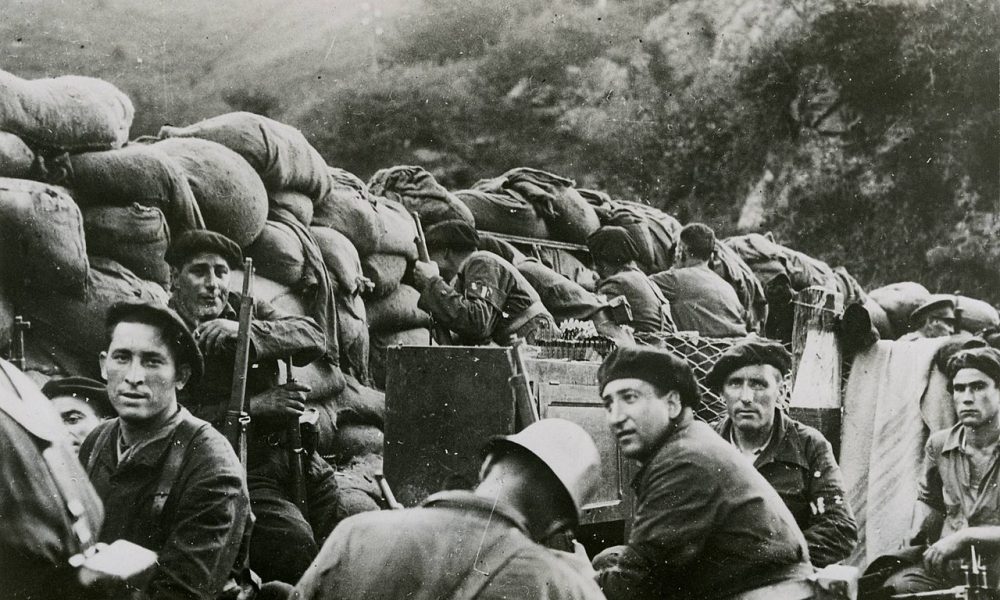
In July 1936, Ernesto “Che” Guevara was eight years old, living in the small Argentine city of Alta Gracia. An ocean away, far-right army officers—assisted by Hitler and Mussolini—launched a coup against the democratically elected leftist government of the Second Spanish Republic. Republican resistance proved fiercer than the rebels anticipated; so ensued the Spanish Civil War, transfixing the world.
And young Che turned his yard into a scale model of a Madrid besieged by Falangist insurgents: here the Modelo prison with its cells full of fifth columnists; there the firefights of the Ciudad Universitaria; everywhere the bravery of the Republic’s militias. The cause was a family affair. Che named his dog, Negrina, after Juan Negrín, the Republic’s last prime minister. His father coordinated local solidarity efforts, and exiled Republicans became household friends. His uncle, the Communist intellectual Cayetano Córdova Iturburu, traveled to Spain as a war correspondent, and the boy sat rapt at his aunt’s knee as she read aloud tío Cayetano’s reports of Nationalist atrocities, heroic factory workers, and the great groundswell of global antifascism.
Several thousand miles north, another boy was also thinking about Spain. Fidel Castro’s earliest major political memory, as he told interviewer Ignacio Ramonet, was of the war dividing his hometown of Birán. At the time, Spaniards made up a fifth of Cuba’s population; many, like Castro’s father, Don Ángel, were Galicians, who had migrated by the hundreds of thousands at the turn of the century. Spanish Civil War partisanship in immigrant-dense Birán was, Fidel recalled, channeled into hotly contested games of dominoes. His father, like all the teachers at his Santiago de Cuba boarding school and most of the other gallegos on Don Ángel’s farm, was an avowed Francoist. In the minority was the cook, Manuel García, “a fire-breathing Republican” who was illiterate yet desperate to follow the Republic’s fortunes. So Don Ángel’s nine-year-old son, home from school for the summer of 1936, gamely read aloud to García all the available newspaper coverage, every day, for hours on end. It was the first time Castro analyzed the nuts and bolts of a military campaign—although of course, it would not be the last.
Nearly two decades later, Guevara and Castro met in Mexico City. The Argentine medic had been doing public health work with Guatemala’s “Revolutionary Spring,” the Árbenz government’s landmark democratizing project, and barely escaped the 1954 counterrevolution that destroyed it. The Cuban lawyer, meanwhile, was keen to regroup after leading the failed 1953 Moncada Barracks assault against Batista’s dictatorship. Joining forces in the 26th of July Movement, the world-historical pair and their comrades needed military training. They found it at the unlikely address of 67 Country Club Avenue in Coyoacán, courtesy of a one-eyed Spaniard named Alberto Bayo, a Republican Army combat veteran. Banished to the Americas following Franco’s victory, Bayo helped train the Caribbean Legion, a motley crew of antifascists trying to overthrow local tyrants like Somoza and Trujillo, and authored a manual for waging irregular warfare. He spent six months preparing the members of the Granma expeditionary force—including Guevara and Castro—and when the Cuban Revolution triumphed on January 1, 1959, Bayo surely must have felt that his prior ventures, most of them failures, had found some vindication.
In the Anglo-American world, the Spanish Civil War is usually framed as a bungled dress rehearsal for World War II. (When David Simon, creator of The Wire, announced a new series about US volunteers in the International Brigades, he titled it A Dry Run.) This misapprehension owed to the politics of the Cold War, which made it more convenient to remember the whole affair in a tragic register à la Hemingway and Orwell: the Republic as the “last great cause,” undermined by Soviet chicanery, undone by leftist infighting, superseded by more urgent matters in the heart of Europe. Better to forget how the Western powers hung the Republic out to dry, then let a Nazi-installed dictatorship stay on to kill and imprison dissidents for the following 30 years. The belief that 1945 was the definitive rout of fascism is increasingly difficult to sustain these days. But even at the time, that contention required memory-holing the destruction of democratic Spain.
In Latin America, however, forgetting the Spanish Civil War was never an option. The ties of kin, faith, culture, and commerce connecting the Hispanophone world meant Latin Americans—from national political leaders down to children in the provincial towns of central Argentina or eastern Cuba—experienced the war more intimately in the first place. And its relevance to their own conflicts over land, church, labor, and democratization—the legacies of the feudal socioeconomic structures established, there as across the Atlantic, under imperial Spain—long outlasted the Republic’s fall.
The war, according to one Guevara biographer, the Spanish-Mexican noir novelist Paco Ignacio Taibo, was la gran herida: the great wound. That description suggests—as does Retrospective, the latest novel by Colombian writer Juan Gabriel Vásquez—that we should see the Spanish Civil War not as the end of one story but as the beginning of another. Still, there’s plenty of room for disagreement about where it led.
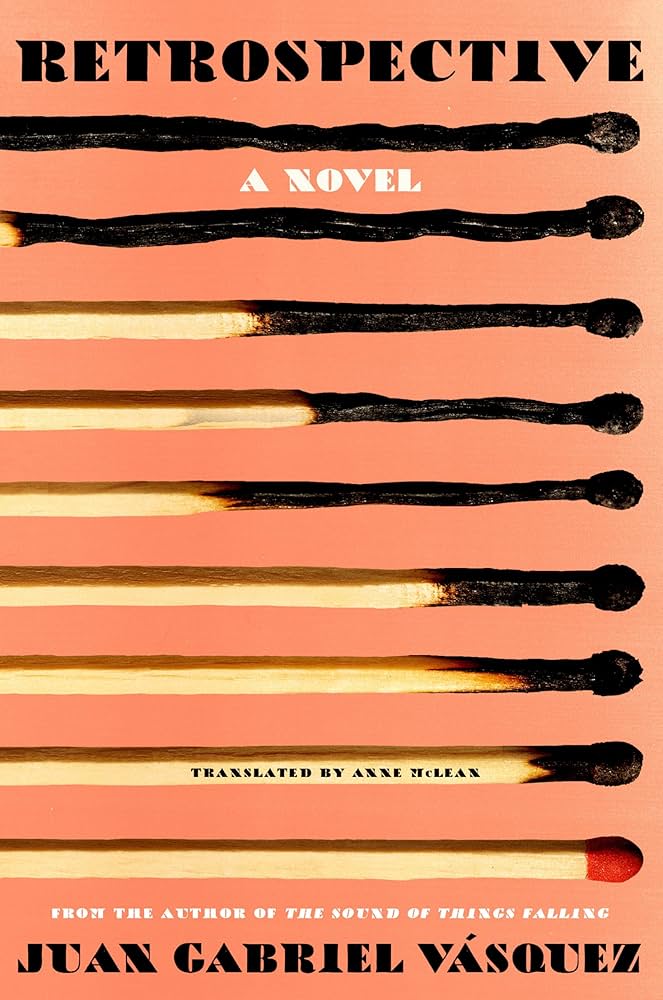
Retrospective portrays the 20th century’s utopias and agonies through the life of a singular individual: Sergio Cabrera Cárdenas, born in Medellín in 1950 to a Spanish father and a Colombian mother. Sergio and his sister, Marianella, share the “special loyalty” of “those who know that their life is incomprehensible to others and that the only way to be happy is to accept it without getting incensed.” By the time Sergio turns 22 and Marianella 19, the trials they have endured include being abandoned in Mao’s China by their parents, Fausto and Luz Elena, and becoming Red Guards during the Cultural Revolution. They also include being summoned back to Colombia to wage guerrilla warfare in the jungle and risking their lives to leave it all behind.1 Sergio despairs at being a victim of his circumstances but seizes his destiny by becoming a director. His movies include classics like The Strategy of the Snail (1993), about Bogotá tenants fighting their landlord with the help of a Spanish anarchist played by his father, Fausto, and Time Out (1998), in which Colombian guerrillas and police cease fire to watch the World Cup.
The novel’s protagonist is a real, living person—in 2022, he was appointed Colombia’s ambassador to China—and all this did indeed take place. An author’s note explains that Vásquez recorded 30 hours of conversations over seven years and exchanged innumerable emails and texts with Sergio and his circle, incorporating their photographs, artifacts, and diary entries. “The act of fiction,” he writes, “has been to extract the figure of this novel from the huge mountain of Sergio Cabrera’s experience.” Whether readers should attribute its interpretations of that experience to Vásquez or Cabrera is a question muddied, perhaps intentionally, by the form. Either way, the book ultimately treats the unusual lives of Sergio and Marianella not as edge cases, but as exemplars of what it takes to be the misadventures of the Latin American left.
The ties of kin, faith, culture, and commerce connecting the Hispanophone world meant Latin Americans experienced the Spanish Civil War more intimately in the first place.
Retrospective begins in 2016, with Sergio headed to Barcelona for a film festival honoring his life’s work. (On the side, he aims to spend some time working on his troubled marriage—this transpires largely via WhatsApp—and reconciling with an estranged son from a prior marriage.) It is a natural opportunity to volver la vista atrás, as Antonio Machado’s poem Caminante, no hay camino, a throughline of the book, has it: “As we walk we make our way / And turning our gaze to look back / We see the path that never / Again shall we tread.” But as Sergio arrives, Fausto suddenly dies, forcing the filmmaker to also reckon with his artistic and emotional debts to his charismatic ideologue of a father. The balance sheet of their relationship is, Sergio concludes, “not positive.” Yet he also knows, guiltily, that none of the experiences that made his life worth novelizing would have transpired absent the structuring force of Fausto’s passions: “had I not grown up in his world.”
That world’s crucible was the Spanish Civil War. Fausto—scarcely older than Castro and Guevara—is recruited by his beloved Uncle Felipe, a Republican, into battles against monarchy and fascism, making for a terrifying but thrilling adolescence spent bouncing from Madrid to Barcelona to Paris. Only later does Fausto learn that the Paris detour had been a rebuke to Felipe for confronting his superiors over their conduct of the war; we are told that “sometimes the Republicans’ worst enemies were other Republicans.” In the context of the novel, Fausto’s failure to internalize this axiom associated with the Republican cause is meant to establish his inability, or refusal, to temper his zealotry with evidence or doubt.
The Republic falls, and its partisans scatter before the Franco dictatorship’s murderous recriminations. Like tens of thousands of other families, the Cabreras flee into a precarious Latin American exile, winding up in Colombia. There, Fausto discovers his gift for acting and recitation, making his name as an interpreter of iconic Spanish Civil War poets like Miguel Hernández, León Felipe, and, of course, Federico García Lorca, a chance meeting with whom, years before Lorca’s execution by the Nationalists, Fausto spins into a tale of anointment. He frequents Bogotá’s Spanish Republican Cultural Center, where exiles eat tortilla and drink sherry, curse the Generalísimo, and discuss, anxiously, the guerrillas forming in Colombia’s east. “Everything is too similar, you see,” warns Uncle Felipe. “Something heavy is going to happen here.”
That “something heavy” was a political murder that would change the course of Colombian history. On April 9, 1948, the popular left-liberal presidential candidate Jorge Eliécer Gaitán—running on a platform of agrarian reform and economic redistribution not dissimilar to that of the lost Spanish Republic—was assassinated. (Fidel Castro happened to be in Bogotá, with an appointment to meet Gaitán, when the murder took place; he joined the protests after.) Gaitán’s killing, a subject Vásquez has explored at length in other novels, unleashes “La Violencia,” a decade of partisan brutality that claims hundreds of thousands of lives. In 1950, just as Laureano Gómez, a clericofascist Franco acolyte, ascends unopposed to the presidency, Fausto and Luz Elena welcome their firstborn, Sergio: the novel’s protagonist.
Retrospective does not dwell on it, but this dynamic—the crushing of popular, ardently held postwar political expectations for democracy and economic justice—becomes all too familiar to Latin Americans in the ensuing years. Reformers aim to redress the inequality and oligarchic corruption that stunt their countries’ development and undermine their national sovereignty; they know from observing the Republic’s demise that they, likewise, will face vicious backlash from within and without. Another exemplary case, unmentioned in the novel, unfolded soon after in Guatemala, when homegrown Falangists joined with the United Fruit Company and the CIA to depose Jacobo Árbenz, yielding nearly 40 years of dictatorship. The survivors, observers, and inheritors of these dashed aspirations were polarized and radicalized. Their enemies were emboldened.
Enter the Cuban Revolution of 1959. It is what Fausto “had dreamed of for his republican Spain, his defeated Spain, the Spain that seemed unable to do with Franco what Castro and Guevara had done with Batista.” Leftists around the continent try to replicate it; the Cubans know a hard line is needed to defend it. “Cuba will not be another Guatemala,” Che vows as the revolution turns, like the Republic before it, toward the USSR. As the old left gives way to the new, however, Retrospective seldom asks readers to think about why people felt impelled to use radical means to change their worlds, or about what they were up against. Instead, it invites them to observe the moral errors, as crystallized in Sergio and Marianella’s decidedly unusual collection of experiences, that are committed in the process. The novel’s central emotional problem is the entanglement of politics and parental abandonment, and its historical and political analysis is clouded by its main character’s ambivalence and pain.
Fausto, seeing a world on the march toward liberation, relocates the family to China, arriving just after the Great Leap Forward’s mass starvation and chaos. They move into the “Friendship Hotel,” a state-run housing unit for solidaristic fellow travelers from all over the world. Sergio and Marianella dutifully adopt Maoism, working in communes and factories, eager to please their parents with the strength of their devotion. Then, abruptly, Fausto and Luz Elena announce that they are returning to Colombia to join a Maoist armed wing of the Communist Party. The children, 16 and 14, are informed that they will stay behind. In her diary, Marianella rationalizes furiously, writing, “Chairman Mao, I love you most! I can do without my father and mother, but I cannot do without your great ideology!” Sergio, however, longs to ask Luz Elena: “At what point do parents reach the conviction that the revolution can educate their children better than they can themselves?”
Alone in Beijing when the Cultural Revolution begins, Sergio and Marianella become Red Guards, then imperiled shut-ins as antiforeigner sentiment mounts. They begin to perceive the hypocrisies, the violence, the sterility of the social cataclysm unfolding around them. And before the children have a chance to work through the implications of it all, their parents summon them back to Colombia to join yet another revolution, the idea being for the whole Cabrera family to share its firsthand knowledge of China’s revolutionary processes to advance their country’s own armed struggle. “What greater happiness,” Fausto writes, “could a father feel?”
Three grim years with the Ejército Popular de Liberación, a small Maoist guerrilla organization born in the context of the Sino-Soviet split and dedicated to the concept of a protracted people’s war, follow. Reborn as Comrades Raúl and Sol, Sergio and Marianella are better versed in Maoist theory than the other cadres. But the distance between Yun’an and the Río Cauca is unbridgeable, the Chinese experience meaningless to the Colombian peasants the EPL is supposedly liberating, Mao in the Andes no more than “a figure made of words.” Raúl/Sergio considers deserting, then dismisses the thought for fear of disappointing his mother, who by now is in prison, and his father, to whom he aches to prove his revolutionary worth. But the EPL’s abuses and moral transgressions pile up: sectarianism, sexual violence, pointless missions, lives squandered. All four Cabreras are betrayed by EPL leadership in devastating ways, leading them to make their first-ever fully collective family decision: to leave.
The belief that 1945 was the definitive rout of fascism is increasingly difficult to sustain these days. But even at the time, that contention required memory-holing the destruction of democratic Spain.
Decades later, Sergio strolls through Barcelona with the estranged son, Raúl, upon whom he bestowed his EPL nom de guerre. Pondering the tangled relationship of his early life to his later artistic choices, he recalls the 2014 premiere of his film Everybody Leaves, about a Cuban custody fight that reveals itself to be a battle over ideology and ends with “a handful of destroyed lives,” including that of the child’s father, who perishes in the Mariel boatlift. The screening, in Havana, coincides with the Colombian peace negotiations, hosted by Castro; there to conclude a half-century of bloodshed, guerrilla commanders and government negotiators alike attend Sergio’s premiere. Sergio tells the commanders they belong in jail for the pain they have brought to ordinary Colombians. “Well, let’s go to jail,” one replies. “But then we should all go. Because a war is not fought from only one side.” Sergio is frustrated: he “knew that, of course.” But he laments “how difficult it was to explain to someone who’d suffered violence from only one of the sides.” The point rings true—not least because it constitutes the novel’s perspectival blind spot.
Sergio’s need to transmute his childhood psychological wounds into political critique ends up undermining the place of his stated values in his art. Confidants try to talk him out of making the film, knowing it will be used to undermine an already threadbare Cuban Revolution, and because “we”—leftists—“don’t wash our dirty linen in public.” Sergio retorts, “And what happens if nobody does the laundry at home?” When Fausto calls Everybody Leaves “a slap in the face, Sergio Fausto, of everything you and I did in this life,” his son struggles to express that the film is simply “the story of a little girl, Nieve, whose life goes off the rails due to a state interfering in the lives of its citizens; it resembled what he’d been through too closely to let it pass. Nieve in Cuba was what he’d been in China: a child at the mercy. … But of what? He couldn’t explain any of that.”
Throughout his youth, Sergio is tormented by his perception of being carried on currents he neither sees nor shapes, his life’s narrative “written by someone else.” Given his unique circumstances, this makes sense. But in projecting those feelings, and the particularities of the Chinese and Colombian contexts, onto an entire continent, he denies a vast swath of people from an enormous and varied array of social movements the dignity and integrity of the choices they made as they fought for democracy and citizenship within profoundly unequal societies. “A whole generation of Latin Americans whose lives were pawned for an enormous cause,” Sergio muses. The word “pawned” reveals the extent to which he reasons outward from his own experience. Showing Raúl some of his old photos from China, he points out a family of visiting Uruguayans who later joined the Tupamaros; their revolution was defeated and their people killed. Didn’t they also feel, Sergio wonders—or, better said, needs to believe—that “someone had stolen years of their lives?”
Retrospective has a theory of history, perhaps Vásquez’s or perhaps Cabrera’s. It emerges in Sergio’s characterization of his film Everybody Leaves as a parable of
the meticulous way men and women were mercilessly crushed under the leveler of history: Cuban history, in this case, except that Cuban history was never just the history of Cuba; it was also the history of the United States, the history of the Soviet Union, the history of a war we call cold in spite of the fires it ignited all over the continent—in Cuba and Nicaragua, in Guatemala and Chile, and also in Colombia. … No, history was not a leveler in Latin America: it was a flamethrower, and it kept burning the continent as if the operator had gone mad and no one was brave enough to stop him.
But who operates the flamethrower? “History” is not an actor, and the only real agents in this novel are the revolutionaries, who are portrayed as misbegotten at best, malevolent at worst: the “men going into battle together,” who, per Vasily Grossman, the anti-Stalinist Soviet critic who is one of Sergio’s favorite writers, “hate each other more than they do their common enemy.” That is one possible takeaway from how Vásquez unfurls his tale, from Spain to Cuba to China to Colombia.
Still, it is a decidedly nondialectical story of revolution that has much to say about what happened and less to say about why. It echoes the classic Cold War interpretation of the Spanish Civil War as above all a fratricide of the left, relying upon a reading of Homage to Catalonia that, as the historian Paul Preston points out, even Orwell himself came to regret. In dwelling on the malign influence of the Comintern’s goons and the travails of left-wing sectarianism, Orwell’s famous but limited account, Preston writes, “makes it too easy to forget that the Spanish Republic was defeated by Franco, Hitler, Mussolini, and the self-interest and pusillanimity of the British, French and American governments.” Vásquez’s novel does something comparable for the postwar era—haunted, like the Cabrera family itself, by the ghosts of Spain.
Another takeaway would foreground fascism. Starting with the form it took under Franco, this particular right-wing ideological formation outlived World War II—with US support—and thereafter modeled, for generations of Latin American revanchists, how to crush demands for social change. Pinochet made the connection forthrightly in proclaiming his overthrow of Allende “a further stage of the same conflict which erupted into the Spanish Civil War.” As the historian Greg Grandin writes, noting Colombia’s FARC and Peru’s Shining Path as significant exceptions, “considering the repression it suffered throughout the twentieth century, the Latin American left on the whole responded with extraordinary restraint, almost in inverse proportion to the torment inflicted on it by the state, domestic elites, and the United States.”2
The point is not to exonerate leftists for the torments that they themselves inflicted. Instead, it should be to try to understand why they opted for such austere and often violently foreshortened lives of militancy in the first place. After all, as Vásquez illustrates, guerrilla warfare is often awful: in a memorable scene, Raúl cuts a dead capybara from the belly of a three-yard-long boa constrictor and boils it into a greasy soup to fend off starvation. Who wouldn’t prefer Allende’s genteel socialismo con sabor a empanada y vino tinto, socialism with the flavor of empanadas and red wine, if given the choice? Or the democratic reformism of Árbenz, or Gaitán? A continent today riddled with mass graves and still the most economically unequal region on earth attests to how powerfully that vision threatened the status quo.
A glimpse of this legacy appears as Retrospective draws to a close, when it describes the successful 2016 referendum campaign against the Colombian peace accords. Right-wing misinformation carries the day: that the accords were an attack on the Christian family, that they promoted an unholy “ideology of gender,” that their ratification would yield a communist dictatorship. By now, Fausto is an isolated and disillusioned old man, but in a family discussion of the referendum he breaks his now-characteristic silence. “They said the same thing when I was thirty,” he remarks. “And when I was fifteen as well, now that I think of it. That little trick seems so silly, but it has worked many times.” 
This article was commissioned by Bécquer Seguín.
- As in other works about childhoods subordinated to parents’ political journeys, the central character’s life feels less than entirely his own. Retrospective recalls Rebel Mother, Peter Andreas’s memoir about his mother abducting him to chase revolution in Chile and Peru, and Blame It on Fidel!, the film by Julie Gavras (Costa-Gavras’s daughter) about how a child experiences her parents’ May ’68 radicalization. ↩
- Greg Grandin, The Last Colonial Massacre: Latin America in the Cold War (University of Chicago Press, 2011), p. 176. ↩