
Being reviewed:
Advertisement

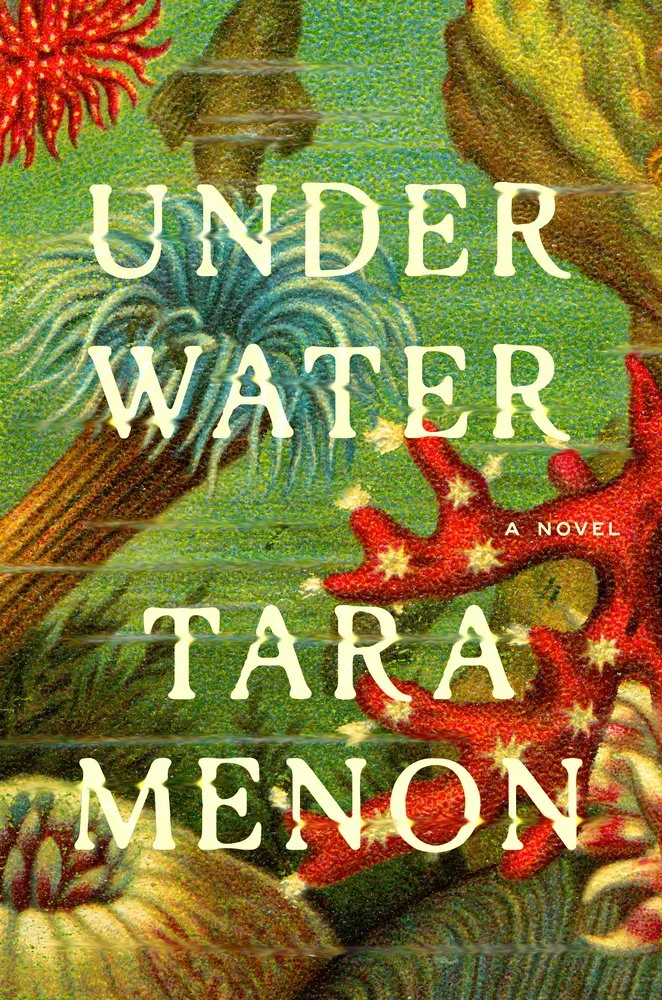
No natural disaster is like any other: each one is strangely particular in the manner of its arrival, the force of its damage, the texture of the human worlds it crushes. All natural disasters are alike: within them is the same ancient trouble opened, the total, impossible-to-conceive vulnerability of the built human world. That paradox, of ineffable distinctness arising out of a mythic similarity, is the terrain that Tara Menon’s debut novel, Under Water, occupies.
Under Water tells the story of a single life marked by two waterborne disasters. In December 2004, teenage Marissa lives with her father in Thailand, her days increasingly entwined with those of her friend Arielle and with the manta rays they swim among on weekends; it is an idyllic life, if marked already by the ephemerality of late childhood. In October 2012, the adult Marissa lives a solitary life in New York City, drifting through haunted days, now all too attuned to the fragility of everything that surrounds her. Menon writes of two moments in time about to be marked by catastrophe and loss, and in juxtaposing the two, explores temporalities that we all, in our own more vague ways, have started to know well: the haven of the not-quite-yet, the dread of the foretold aftermath.
Under Water is a fully realized, deeply worldly first novel about the unsteadiness of human dispensations in an age of accelerating climate change. Nothing about it feels like an academic’s novel; but it is, in fact, the product of scholarly immersion in the theory of the novel, and it comes from a writer who is both a literary scholar and a critic. Menon, currently assistant professor in the Department of English at Harvard University, is a specialist in 19th-century British literature and the theoretical terrain around the realist novel; her first scholarly book, Speaking Parts: Conversation, Character, and Social Worlds, will be published by Princeton University Press this coming fall. As a critic of contemporary fiction, she has written on novelists as different as Édouard Louis, Sally Rooney, Anuk Arudpragasam, and Sigrid Nunez. She has also written penetratingly about sports fandom, while herself being an athlete who has represented both Singapore and the United States in Touch Football World Cups. (Meanwhile, she serves Public Books as our co-editor for literary fiction.)
I’ve known Tara for the better part of two decades, and she is one of my most cherished interlocutors on the writing life and the state of the novel today. But when we sat down to talk this past December about Under Water, I had a fresh set of questions for her: I wanted to know how a scholar and critic approaches writing their first novel, how these separate enterprises inform each other, and how a novelist encounters, uses, or refuses some of the theory that informs the academic study of fiction.
Nicholas Dames (ND): This is a novel that exists in two components. One component leads up to the 2004 Indian Ocean tsunami hitting Thailand, and the other leads up to Hurricane Sandy making landfall in New York City in 2012. There is a single character undergoing both of these experiences, but these parts are also fairly compartmentalized. Did you have models, or inspirations, for how to construct a novel that falls into two halves like this?
Tara Menon (TM): As someone who teaches Victorian literature, it is difficult not to think about Bleak House when asked about the split structure of a novel. One of the many things I love about Bleak House is that the reader is put to work immediately and constantly—they have to figure out the connection between the two halves. How does one part relate to the other? How does this reference in this chapter relate to a similar reference in a different chapter of the novel? I take great pleasure in doing that kind of mental work as a reader, and I tried to write a novel that asked readers to do this type of work as they moved between two very different places in two different decades. But the truth is I didn’t consciously model my novel on Bleak House, or really on any other novel.
The structure of the novel—each chapter alternating between these two different places and times—came to me very early. What was most important to me was that the two halves felt very different tonally. I wanted the Thailand sections to feel light and beautiful, and the New York sections to feel dark and heavy. Day and night, dawn and dusk, literally and otherwise. I also wanted the two spectacular, catastrophic events to happen at the end of their respective timelines. Another motivation for splitting the book in this way was so that these two big events could both occur at the end and since neither is a surprise—we know very early on that they are coming—they both loom over the whole book.
ND: I want to go back to something you said there, which is that in both of those components, both of those two days, what you present is almost all lead up, or “looming.” An ominous feeling, about which the novel is extremely delicate, or reserved—the reader will know, obviously, what is about to happen in each strand, but there’s a lovely way in which you don’t insist upon the looming disaster. You allow the characters to occupy time in a way that isn’t yet fully colored by the catastrophe that is going to happen, that grants them the beauty of ignorance. The “looming” is wonderfully tacit, no?
TM: I’m really glad to hear you say that. That’s certainly what I was trying to do. When we think of environmental disaster or climate change, we often think of catastrophic events—the Californian or Australian wildfires, deadly floods in Bangladesh or Pakistan, a destructive typhoon or hurricane. When events like those becomes the point of focus, we stop thinking about other kinds of destruction and degradation. I wanted to find a way to reveal what Rob Nixon called slow violence. I didn’t want the major catastrophes to entirely dominate the novel; I wanted to bring slower instances of change to the foreground.
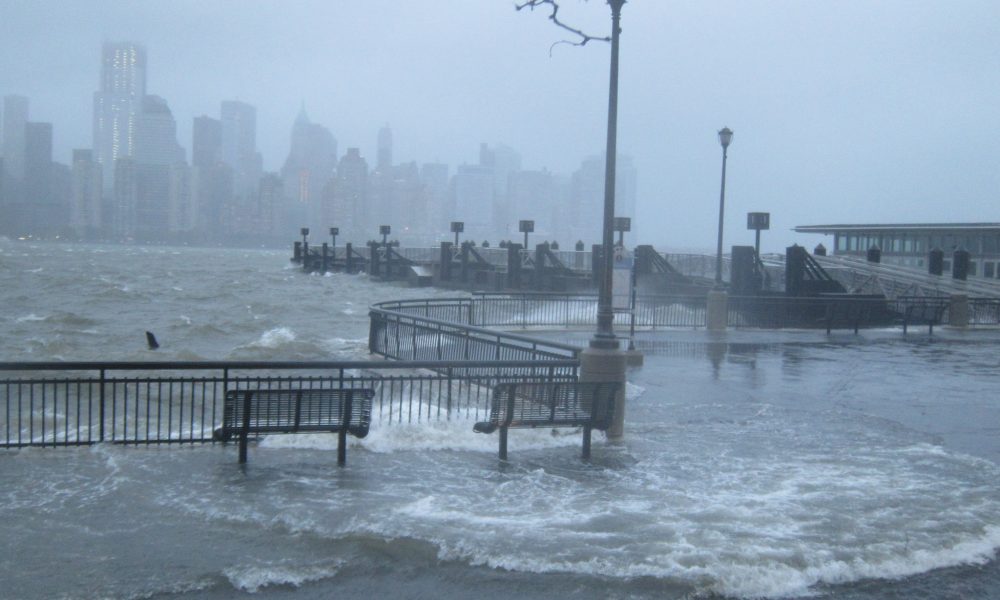
But I also hoped to draw another kind of distinction. In the tsunami narrative, no one knows what is going to happen. The tsunami can’t color the narrator’s vision because there’s no warning. As many survivors of the tsunami have said, Boxing Day 2004 was a perfect day—blue sea, blue skies—and then, out of nowhere, it became a total horror. In contrast, in the Hurricane Sandy narrative, the narrator is now attuned to this kind of disaster, partly because she has experienced something like it before. In fact, she’s hypervigilant about it, especially compared the blasé and negligent New Yorkers around her. I was in New York for Sandy and in my memory the overriding feeling in the city was, This is just going to be like Hurricane Irene! Everyone seemed to think it would be a nonevent. There was no sense that this hurricane would be the one to completely change life in the city for weeks, and months, to come.
ND: Am I remembering correctly that you were raised in Singapore?
TM: I was raised in Singapore.
ND: And lived for quite a while in New York.
TM: Yes, I lived in New York for a decade.
ND: If it sounds like I’m cross-examining you, I guess I wanted to establish that you’ve spent a lot of your life in what we might call large coastal or estuarine metropolises. Cities immediately connected to the sea.
I suspect you know where I’m going with this, right? I’m thinking here of Amitav Ghosh’s 2016 book, The Great Derangement, in which he argues that climate change is a dead end for the novel form—that the novel cannot depict disasters on the scale of the 2004 tsunami, which are going to occur with increasing frequency. Novels, for Ghosh, were born in a culture structured by regularity, or what he calls “uniformitarianism,” an idea of change occurring at an even rate, a world in which the borders of the plausible and implausible are fairly fixed and intuitive.
But then his argument makes an interesting shift. He points to how capitalism, starting in its colonial phase, essentially created a particular kind of conurbation, the global entrepôt—not just Singapore or New York, but Hong Kong, let’s say, or Mumbai. Commercial beachheads, clusters of low-lying islands, surrounded by water. And Ghosh points to the intense vulnerability of these cities, built, in a sense, despite nature. These spaces cannot last in their present form. They’re where the effects of climate change on populations will first be felt on a mass scale. So, this is two questions for you folded into one: Do you agree with Ghosh’s sense that the novel form cannot fully or satisfyingly depict change at this scale and pace? And did your experience of living in this kind of flat, oceanic metropolis, that are for Ghosh artifacts of the unheeding world of capital, make you more attuned to the question of rapid change or catastrophe?
TM: When I first read The Great Derangement, I just found it so compelling—mind-blowing, in fact. Partly because I love synoptic diagnoses of wide swathes of literary production, which is not my strength as a critic so I am always in awe of people who can do it well. In one respect, I agreed with Ghosh’s diagnosis completely: when climate change is depicted in contemporary fiction, it is usually in dystopian science fiction, what we now call cli-fi. In other words, in novels climate change happens in the future; it hasn’t yet penetrated into a realism of the present. Ghosh also argues that fiction that dealt with climate change was also dismissed by the literary critical establishment as somehow unserious. I thought Ghosh was right about this, and also right to suggest that what we would call “literary fiction” was failing in its responsibility to understand and represent the most pressing issue of our moment.
At the same time, I also thought he was totally wrong.
ND: Otherwise you wouldn’t have written Under Water, right?
TM: Exactly. In some ways I wrote this novel as a response, even riposte, to The Great Derangement. One of Ghosh’s chief complaints is that “the contemporary novel is ever more radically centered on the individual psyche while the collective—“men in the aggregate”—has receded, both in the cultural and fictional imagination.” While I thought Ghosh was right about the diagnosis, I thought he was wrong about the proposed cure. He suggests that we need to return to the type of novel that you and I both study and teach—multigenerational, multiplot, sweeping in scope—because this is the only type of novel that can effectively show mass change to complex systems, that can show climate change. I felt, instinctively at first, this was not true. Don’t get me wrong: I too think contemporary fiction would be greatly reinvigorated by a return to old-fashioned, sociological 19th-century style realism, but I also suspected that actually it was possible to write a literary novel that was focused on a single individual psyche that could also index climate change. In some ways, I wrote the novel as an experiment—to test this idea, to see what was possible within a certain form. Could I write a recognizably “literary” novel—centered on one bourgeois woman, walking around New York—that managed to keep climate change central?
Of course, to do this, the bourgeois individual I focused on had to be a very specific kind of person. Marissa is, to use an annoying phrase, a citizen of the world. She doesn’t really belong to one place, or any place; and because of her very particular upbringing, she occupies two very distinctive locations in two different decades. The novel is set in the recent past, in 2004 and 2012, to show that climate change is not future possibility, but instead past and present truth. Disaster is not coming; it has happened and is happening. And the split setting is to show that it’s not happening in one place, it’s happening across the globe. Marissa is also, again because of how she grew up and the kind of people who raised her, unusually attuned to change, both political and social, and also hyper attuned to the natural world. This might seem like cheating—she is not a “typical” bourgeois individual—but people like this exist in the world! In other words, just because much contemporary Western fiction centered on the individual doesn’t address climate change and often seems to willfully ignore it, doesn’t mean that the novel today, even one that centers on an individual rather than on the collective, is incapable of addressing climate change.
One consequence of the decision to really focus on Marissa is that this is a very lonely novel. There are other characters in it, but really, this is a novel about one person.
It is also, both literally and metaphorically, a novel about grief and loss. The grief that suffuses every page is, on the one hand, literally about one person, one friend, but I also wanted to propose grief as perhaps the most appropriate response we can have to what is happening to the natural world—the disappearance of coral reefs in the Andaman Sea and bird habitats in New York.
My novel is not apocalyptic in the common way we use that word, it’s not about the end of the world. It is, though, in a more precise, etymological sense: apocalypse as in “to reveal.”
ND: So on this question of grief: it comes into your novel through friendship. But two distinct kinds of friendship. One is for a human best friend, a close female friendship. The other is friendship with a species: the manta ray. But not just a species, right? Named distinctive individuals of that species, specific manta rays that Marissa and Arielle swim with in the Andaman Sea and come to know over their lifespan—which incidentally is a lot longer than I would have thought. What’s interesting about both forms of grief is that they are not primarily, or at all, produced by eros. You must have made the decision at some point that this would not be a novel that foregrounds erotic-object loss, but instead friendship, companionship, beneficent coexistence.
TM: I have so many answers to this question. If The Great Derangement was one big source of inspiration for me, there are at least two others. One is Tennyson’s In Memoriam, a poem that I first read when I was an undergraduate. I was overcome by its exquisite beauty and the way it evoked how grief for a friend can be all-consuming. But I was also really struck by some of my classmates’ responses to the poem, which was: well, Tennyson must have been in love with Hallam.
I found this fascinating. I was less interested in the facts of the matter—whether Tennyson was or was not in love with Hallam—and much more invested in the question the responses raised: Was it actually not feasible that a person could grieve a friend, in a way that could be completely destructive, even if there was no erotic relation between them? Was erotic, or romantic, loss really the only legitimate source of enduring grief? I also felt that Tennyson’s poem was so resoundingly male. I started dreaming, long before I started writing, of a novelistic version of In Memoriam that was about, and between, women.
The other, admittedly very different, inspiration was a research paper about manta rays. I’ve always been quite obsessed with coral reefs, and snorkeling, and swimming in the sea, and I knew that I wanted to write about marine life, but it was only after I stumbled across this paper by a researcher called Rob Perryman, which showed that female manta rays form social bonds, that I knew mantas would be at the center of this book. Perryman and the scientists he worked with tracked female manta rays across a long period of time and discovered that certain individuals regularly returned to certain cleaning sites (places they have their wounds cleaned by other fish) together and clustered in certain ways. I wanted to underscore the human friendship and interspecies relationships, with the close social relations that rays have with one another.
ND: Can I pick up on your mention of Tennyson? Because your novel is extremely literate. There are references throughout. Naturally, I was pleased to note how many of the references are from, or adjacent to, Columbia’s Core Curriculum, which of course you took and I teach in. But the novel references Aeschylus, and The Odyssey, and Aristotle on friendship; and in the novelistic tradition, Thomas Hardy, George Eliot, and Mary Shelley, among others. How aware were you of this dense network of allusion? Did you have concerns about it? Is it something that, given your training, you couldn’t not do?
TM: One of the downfalls of the day job? No, but seriously, the Core—all those texts you mention—had a profound influence on the way I read, write, and think. I can’t ever escape it. That’s the “me” answer, I suppose, but the Marissa answer, the more important answer, is that I wanted to create a sense of her deep loneliness. I did that by suggesting that her imagination was partly formed by the extremely solitary activity of reading books. The many literary references are a consequence of her own Core education. For many other people, and maybe even for Marissa if she hadn’t lost Arielle, the years of college would have been extraordinarily social. By making her imagination so literary, I wanted to suggest that Marissa spent a lot of her time at college actually just really reading these texts, quite obsessively.
But also, and this is really important to me, none of the references are superfluous. Every single one is there for a specific reason. Like, The Mill on the Floss—
ND: Right, among other things, you’ve constructed here a little archive of great texts about floods or water.
TM: Yes. And also, an archive of texts about friendship. Surrogates for her, someone who has spent a lot of time in books.

ND: There is this wonderful scene that of course, as a literary academic myself, I’m inclined to like, in which Marissa enters a bookstore you don’t name but that is—spoiler, I guess—obviously Three Lives in the West Village. She’s just browsing, and the first thing she picks up, a book that’s inevitably by the register in any bookstore in the city, is E. B. White’s This Is New York. And she reads its first sentence and thinks: “This is a man’s sentence.” And then she moves to another table, in which she reads first sentences by women: by Muriel Spark (a novel we read in a seminar together many years ago), by Sigrid Nunez, Toni Morrison, and Virginia Woolf, which seems to sate her hunger for a different kind of sentence. So I have an obvious question for you: can you tell me what it is for you to not write a man’s sentence?
TM: There is nothing auto-fictional about this novel, but I will confess that like Marissa, I have spent many, many hours in that glorious bookstore. But I’ll start to answer your question by saying there are also two other obvious intertexts for this novel: Teju Cole’s Open City, and Ben Lerner’s 10:04.
I admire these books very much—I teach Open City every year. I really love it. But something I felt when I first read both these novels is that the kinds of observations made by their central characters are particularly male. What I mean is that there’s a way in which Julius and Ben—the first-person protagonists—get to choose their interactions. They get to decide who they look at and who they talk to, and, more importantly, who they do not interact with. When I read them, I found myself thinking: if you’re a woman in your mid-20s walking through New York, you don’t really get to choose who you interact with. There’s an inevitable imposition of or by the world outside, you’re rarely the sole driver of an interaction. Marissa’s walk through New York is often imposed upon or interrupted by other people. This changes how her observations operate and how the sentences operate. Unlike writers like Virginia Woolf, I am not making a claim about gender at the level of style or syntax but in terms of what this protagonist pays attention to.
ND: It’s important to note that the E. B. White sentence that she reads as a “male sentence” is about how New York gives you what he calls “the gift of privacy.” And her response to this is, that’s bullshit. Quite the reverse, right? I’m forced to be hyper-visible, and also hyper-attuned to others.
TM: Exactly. As a woman, you’re never private in the city—you’re barely private in your own house in New York. This must, I think, change how observations are made, and therefore how consciousness is depicted.
ND: On the subject of collectivity, there’s a motif in the book about “venery nouns”: for instance, a murder of crows, a parliament of owls, and (a term I didn’t know) a fever of rays. Marissa and Arielle love to memorize them, they compete to remember them. As a linguistic quirk, they’re fascinating. But it seems more than this—as if you’re really interested in the ways we have for recognizing and naming collectivities.
TM: Before I answer that directly, I’ll tell you something I learned recently about venery nouns: they don’t exist in some languages. The novel is being translated and one of the translators said to me, we’re going to say that the two girls made up these words. I’m not sure that quite works but it was the best solution. These beautiful phrases are untranslatable.
But to your question: yes, other than simply being delightful terms—a conspiracy of lemurs, a bloat of hippopotamuses—what mattered to me was the idea that non-human creatures have their own collectivities, their own ways of connecting to one another, of belonging together. To repeat myself, the reason this motif recurs is that I wanted it to serve as a contrast to how completely alone and isolated Marissa is; they function as reminders that her solitude is deepened because she is surrounded by different kinds of collectivity.
And, more strictly psychologically: when Marissa and Arielle play this game with venery nouns, there’s something about it that doesn’t quite fit with their age. They’re 17, too old for it; it’s a holdover from an earlier stage in their friendship. This childlike game is juxtaposed with the ways they find themselves navigating their emerging sexuality. I wanted to capture the ways girls can hold on to younger versions of themselves when they’re alone with one another. I wanted to show how they can be silly, or childish, in a way that still feels genuine. This is not at all the way they would behave around boys, or adults. I wanted that moment at the novel’s beginning to set up an idyllic space, and that word game is a world unto itself for them.
ND: I see that. This is an end-of-childhood novel too. And it makes me think: their incipient entry into sexual life—particularly a fraught scene they share in a nightclub, right before the tsunami hits—gives you a sense of an imminent ending. Of a version of their friendship, right? Which is going to be impinged upon by their sexual experimentation, which is just about to start, but that doesn’t get a chance to happen because the natural disaster occurs. Is part of the grief in the novel a grief for the metamorphosis of the friendship that never can occur? A grief, let’s say, for a different, personal loss that never will happen?
TM: An end-of-childhood novel is a beautiful description of the book. Thank you. There’s a deep sadness to that other kind of ending to friendship too—the going away to different places, the forming of erotic ties and other friendships elsewhere, the growing up apart from each other. In some ways, Marissa gets to do what friends don’t usually get to—she gets to keep Arielle as she was, she never has to confront or go through that other, more typical but also very sad change. Their friendship is already running out of time—and then time stops in a different way.
There’s something remarkable about so many city novels, particularly novels about New York, which is that animals don’t appear. At all. But of course, there are animals everywhere in New York.
ND: Do you think of this as an apocalyptic novel? That’s a hard question to answer, I know—
TM: Do you mean in the etymological sense?
ND: Well, I guess I’m asking you, is there a sense in which this novel is apocalyptic?
TM: This might be too circuitous an answer, but I’ll try. I think that one thing Ghosh hadn’t quite calibrated in The Great Derangement is our increasing acceptance of improbability. The suggestion Ghosh makes is if you have two highly improbable events like the tsunami and the hurricane in a single novel, then that novel will stop feeling part of a realist tradition. But now that combination easily feels like part of a realist texture of the world we inhabit. We are increasingly accepting of the idea that these events will occur frequently—not as remarkable once-in-a-lifetime catastrophes, but as frequent events dotted throughout all of our lives. My novel is not apocalyptic in the common way we use that word, it’s not about the end of the world. It is, though, in a more precise, etymological sense: apocalypse as in “to reveal.”
This might be particularly true of the New York parts of the novel, which demand that we redirect our attention to aspects of city life that are often overlooked. For instance: there’s something remarkable about so many city novels, particularly novels about New York, which is that animals don’t appear. At all. But of course, there are animals everywhere in New York. I think, or hope, that the novel reveals what we don’t, or don’t want to, pay attention to.
ND: So, to play with this root meaning of “apocalypse” as that which reveals—and to cite one of your novel’s references: another place that root meaning occurs is in the Odyssey, with Calypso. She’s the reverse of apocalypse—her name, from the same root, means “hidden.” The invisible, that which is veiled. And of course that’s the threat she signifies in the epic: if you spend time with her, you might never be seen again. And in some way this struck me in relation to Marissa, who becomes increasingly ghostlike in the novel. She passes in and out of people’s lives, including erotically; at the same time that this major revelation of the storm is coming, she’s becoming increasingly opaque, hidden.
TM: I think of Marissa as a one-way glass—she is able to see out, but other people are completely unable to see in. No one who appears in the New York sections of the novel has any sense of what she is really like. In some ways, the only person who does know her is the reader. There’s a sort of Jane Eyre quality—the only intimate relationship she has, in the New York portions of the book, is the one with her reader.
ND: Yes, right.
TM: I haven’t spoken about this—I never took a creative writing workshop and, to be honest, I don’t think I know exactly how to speak about craft—but something I found technically difficult was to create a character who felt realistic even though she has very few meaningful relationships in the “present” of the novel. I had to figure out how to write a character who felt credibly isolated but had to not be so completely removed that she felt fake. I included occasional urban interactions—talking to a bartender, helping a mother carry a stroller down the subway steps—to show she isn’t a ghost, she is still embodied, still immersed in the world around her.
ND: I have a final question for you. You don’t live in either Singapore or New York now, but you’re in both with some frequency. Has writing this novel changed your relation to these spaces?
TM: I spent the first 18 years of my life in Singapore and the next 10—the formative adult years of my life—in New York. While writing this novel, I often felt acutely aware of their fragility.
The damage of Sandy to New York was both more thinkable to me than to some other people, but also maybe more shocking to me than to people who have lived in New York their whole lives. I think I felt more highly aware of the vulnerability of a small island in the middle—to be a little loose about “middle”—of the sea. But also, Singapore is such a strange and exceptional place in many ways—but two of those ways are that it’s very young for such a global metropolis and it’s resilient, for idiosyncratic natural reasons but also because of extraordinary urban planning. Singapore does not, for instance, have a subway system that is over 100 years old that would be shut down for weeks by a major storm. The extremity, and duration, of Sandy’s impact on New York was really startling to me.
I don’t know if writing the novel made me realize any of this, but it certainly made me think about it more intensely.
ND: For a reader of the novel, and as a New Yorker, one thing Under Water drives home—a thing that New Yorkers are very good at ignoring—is that we live in a coastal city. We have a bizarrely amnesiac relation to the thing we’re so proximate to. It’s an inward-turned city in so many ways. But this is a kind of forgetting. Which is likely very self-protective.
TM: Right. This is something, finally, that you can’t not know. That’s realism for you.