Advertisement

“On the wall of every cell, the prisoner tries to etch a ship or a bird,” wrote Palestinian poet Muin Bseiso in his own prison cell. “A ship in prison is a gift from the old prisoner to the newcomer. They won’t be able to kill you if you travel.”1 A Gazan and a Communist, Bseiso was imprisoned in Egypt in 1955 after demanding Palestinian refugees not be resettled except in Palestine itself. His actions, and his poetry, echo down into Gaza today.
And, indeed, metaphors abound in any attempt to encapsulate Israel’s totalizing control over Gaza: an open-air prison, a laboratory, a holding pen.2 The challenge for any Gazan—including postcolonial studies scholar Haidar Eid and journalist Mohammed Omer Almoghayer—is how to communicate what it feels like to live this violent state of exception, but without being turned into symbols of abjection or hollow heroism. Both Eid and Almoghayer, in their two new books, are keen to showcase Israel’s breathtaking micromanagement of Palestinians’ bodies: when and whether they can move, where they can build or plant, what they can buy and sell, how many calories they can consume daily (2,279 per adult). No wonder, then, that well before Israel’s complete annihilation of Gaza’s lifeways, this strip of Palestinian land was a byword for confinement and war-scarred wretchedness. “Gaza appears in the global mind, momentarily, when it is attacked by Israel or declared unlivable by the UN,” rued poet Mosab Abu Toha in 2022. “We remain unseen and nameless save for the violence and devastation inflicted upon us.”
Four years later, Gazans now are, perhaps, too seen. Some, meanwhile, are named. Refaat Alareer, Hind Rajab, Medo Halimy, Yaqeen Hammad: we know their names because of the brutality of their murder, or perhaps the social prominence of their evanescent lives. And yet, decades after Bseiso dreamed of drawing birds and ships on his prison walls, we are no closer to knowing Gaza and the social worlds made by its inhabitants: the thought they produce; their relationship to the sea; their art; the daily altruism they have perfected as an antidote to Israel’s periodic devastation.
That is, until now. Impatient with the tired platitudes encircling their birthplace, Almoghayer and Eid each insist on showing Gaza’s reality, not least the amplitude of their Mediterranean society; “in Gaza, life unfurls as a treasury of daily surprises that many Westerners miss in their hurry to get through their days,” says Almoghayer. How we are treated, they insist, does not define who we are.
Offering an extended flânerie across the scant 25 miles of Gaza, Almoghayer walks the strip’s teeming streets and squares, as well as the desolate, dangerous “buffer zones” abutting Israeli territory. Novel-like in its cast of characters and sensory details, Almoghayer’s On the Pleasures of Living in Gaza is unlike anything published about Gaza in English, and a doubly shattering reading experience. All that it reveals is now destroyed.
An analytical counterpoint to Almoghayer’s lyricism, Eid chronicles the experience of living under 17 years of an Israeli-Egyptian blockade, and surviving four major Israeli assaults before the 2023 onslaught (he evacuated to South Africa). Steeped in the writing of Frantz Fanon, Edward Said, and Ghassan Kanafani, Eid drew a phrase from Kanafani for the title of his new book: Banging on the Walls of the Tank: Dispatches from Gaza, a collection of opinion pieces written between 2009 and 2024, one year into the ongoing genocide. Eid even dares to imagine an alternative future of one democratic state for Jews and Arabs between the Jordan River and Mediterranean Sea.
In this, and so much else, Eid and Almoghayer take up the challenge laid down by Palestine’s poet, years ago: “We do injustice to Gaza if we glorify it, because being enchanted by it will take us to the edge of waiting and Gaza doesn’t come to us,” wrote Mahmoud Darwish. “Gaza liberates itself from our attributes and liberates our language from its Gazas at the same time.”
Gaza is ancient, lying along the Via Maris. Still, the Gaza Strip is less than a century old. In 1948, Israel was created on 78 percent of British-controlled Palestine. Gaza, Palestine’s southern district, became demarcated on the map as the much smaller “Gaza Strip.” At just 25 miles long, and only seven miles at its widest, the Gaza Strip comprises just 1.3 percent of pre-1948 Palestine: a shape that Bseiso affectionately called the “matchbox.”3
Gaza was the only part of Palestine that survived the 1948 Nakba (“catastrophe”) without being absorbed into Israel or annexed by Jordan, as had the five large cities that became the West Bank in 1950 (20 percent of pre-Nakba Palestine). The catastrophe of Palestinians’ expulsion from their homes by Zionist militias filled Gaza with 200,000 refugees from 247 surrounding villages, tripling its population of 80,000 (Bseiso descended from a prominent native Gaza family).4 The Strip was administered by Egypt, but Palestinians were not naturalized. Egypt’s leaders—from Gamal Abdel Nasser to today’s Abdel Fattah al-Sisi—wanted no responsibility for the displaced nation and feared the political movements it would create, potentially threatening their own authoritarian control over the Middle East’s largest Arab population.
In any case, Gaza’s people had no wish to leave Palestinian land. In March 1955, the Communist Bseiso and Islamist leaders led five days of mass demonstrations denouncing a tentative Egypt-UN plan to resettle 12,000 refugee families in northern Sinai. Nasser swiftly shelved the plan and put Bseiso behind bars for years. It was here that the poet wrote his affecting memoir of his confinement, in the venerable modern Arabic tradition of Adab al-Sujun (carceral literature), where he dreamed of ships and birds giving hope to those prisoners—those Palestinians—that would come after him.
Bseiso likened Gaza to a matchbox not just for its curious shape but for its role in generating Palestinian nationalist resistance. Its towns and eight refugee camps became a kaleidoscope of Palestinian nationalism’s three strands: Marxist, Islamist, and Arab nationalist. The founders of Fatah and Hamas, today the two largest political movements, grew up in Gaza to refugee families. Yasser Arafat, the Palestinians’ historic leader, was born in Cairo but spent time in Gaza in the 1950s, where he met his Fatah co-founder Khalil al-Wazir, shot by Israeli Mossad agents in his Tunis home in 1988. Hamas’s founder, Shaykh Ahmad Yassin, and his successor, Abdel Aziz al-Rantisi, were born in pre-1948 Palestine and displaced to Gaza during the Nakba. In 2004, they were assassinated one month apart by Israeli helicopter gunships. Arafat died months later in murky circumstances.
In their everyday lives, Palestinians create spaces that negate Israeli violence.
In a preemptive war in 1967, Israel captured Gaza, the West Bank, East Jerusalem, Syria’s Golan Heights, and Egypt’s Sinai (it evacuated in 1982 after a separate peace treaty with Egypt). After expelling over 250,000 Palestinians, Israel quickly appropriated Gaza and the West Bank’s water and land resources, settling its citizens in colonies atop the most fertile land; in Gaza, these colonies controlled most of the seashore. The economies of both were incorporated into Israel’s, with low-wage Palestinian day laborers building Israelis’ houses and tending their farms. Israeli exports flooded Gaza and West Bank markets. Economic linkage required relatively free movement between Gaza, the West Bank, and Israel. “Palestine became ‘hummus and falafel-land,’” recounts historian Salim Tamari, “for weekend Israeli visitors seeking cheap thrills and clean air.”
This all changed in 1987, with the outbreak of the First Palestinian Intifada in Jabalia, Gaza’s largest refugee camp. The trigger was an Israeli army truck ploughing into a line of cars carrying day laborers, killing four. The cause was two decades of Israeli military control over Palestinians’ lives. The uprising lasted for over four years of methodical civil disobedience campaigns, mass demonstrations, tax resistance, and transgressive displays of Palestinian identity, especially flying Palestine’s outlawed flag. It was met with a policy of bone-breaking beatings, shootings (over 1,000 killed), mass arrests and deportations, home demolitions, prolonged curfews and closures. The synthesis of confinement and bodily brutalization would mark Israel’s control over Gaza for the next 35 years: marketed under the rubric of a “peace process.”
In 1993, the Oslo Accords signed on the White House lawn ended the Intifada. This allowed Yasser Arafat and other exiled leaders to return and head a non-sovereign state, the Palestinian Authority (PA); it also formalized the policy of sealing off the West Bank and Gaza from one another and from Israel. A 40-mile-long electrified perimeter fence was built to separate Gaza from Israeli territory, a model for the Separation Barrier put up later in the West Bank. Entire agricultural areas were razed to create a no-go “buffer zone” around the fence, extending 1,000 meters into Gazan territory. Gazans wishing to go to the West Bank for any reason—to visit Jerusalem, see family, or receive medical care—had to apply for erratically granted permits. Tens of thousands of southeast Asian guest workers were imported to replace over 50,000 Gazan day laborers. “The entire homeland of Gaza is held hostage,” fumed Arafat’s spokesman in 1995. “We did not sign this agreement to be kept like animals behind bars.”
In the late 1990s, Haidar Eid returned to Gaza from South Africa, doctorate in hand, and applied for a travel permit to the West Bank to take up a university position in Nablus. After being rejected, no reason given, he tried another route, applying for an ID at the Erez checkpoint in northern Gaza. He was kept waiting for 11 hours, then told to leave. He has not been able to visit the West Bank since 1987.
Yet this exile has not deterred Eid’s gaze. Indeed, when it comes to the violent excess inflicted on Palestinian society, both Eid and Almoghayer want us to bear witness to the unfathomable.
“What can one say to comfort a man who has the harrowing task of having to bury his entire family, including his wife, his sons, his daughters, and his grandchildren?” Eid’s cri de coeur was not about the 2023 annihilation. It was penned more than a decade earlier, in the wake of Israel’s 22-day incursion in 2008–9, an attack so shocking it generated 300 human rights investigations.5 The landmark among these, the UN’s 2009 Goldstone Report, reconstructed in granular detail what was done to Gaza: methodically destroyed schools, ambulances, hospitals, homes, greenhouses, flour mills, orchards, wastewater treatment plants, chicken farms. “Disproportionate destruction and violence against civilians were part of a deliberate policy,” concluded the report, noting but not accepting the Israeli government’s claims of a targeted retaliation against Hamas rockets.
The Israeli way of war on Gaza became a fixture of global politics, a blurry tableau of undefined “conflict.” But with each attack, Israel breached more taboos.
In 2009, it was the “systematically reckless” use of white phosphorus in civilian areas. In 2012, Israel assassinated its interlocutor in ceasefire negotiations, Hamas military head Ahmed Ja`bari, just as he was about to sign off on the deal.6 In 2014, after a 51-day bombardment that was the most destructive to date, a UN report detected a new pattern of attacks on residential buildings that killed entire families. In 2021 the pattern held, with strikes on four towers that destroyed scores of businesses, homes, and neighboring structures. The toll of the four assaults—4,045 Palestinians and 107 Israelis killed—does not include the loss of life in the “smaller” campaigns of collective punishment meted out in between the four major assaults.
Eid and Almoghayer eschew mute aggregate numbers for the lived experience of constant loss. “Palestinians are made to know, in ten thousand ways … that everything we know and love can be destroyed in an instant if Israel chooses, and we have no one who can protect us,” says Almoghayer. A man hurrying home to study for an exam was hit by a missile, losing both legs and one arm; still, he remains grateful for life in a wheelchair, working as a teacher. Another curated a personal library for over 20 years, then saw it rubbled with other beloved objects of his home. A third buried the decomposed body of his son 11 days after his death, because Israeli soldiers blocked ambulances from collecting corpses. Teachers incorporated ERW awareness in classrooms, so that kids playing outside or returning to retrieve their toys from destroyed homes do not die from “Explosive Remnants of War.”
Then there’s the uniquely Palestinian predicament of having one’s grief violated by the soul-crushing apparatus of denial. “The Palestinians of Gaza get blamed for being shot and bombed because they did not run away; they get blamed for being in the same building that they have lived in all their short, brutal lives; they get blamed for not being able to run in fifty-seven seconds; they get blamed for letting their children play on the beach.” Eid’s last example is what many remember from the 2014 assault. Brothers and cousins from the Bakr family were playing ball on the beach west of Gaza City. Israeli naval forces fired missiles at the boys, aged 9 to 11, killing four of them and wounding another four.
As he moves through Gaza’s subcultures from Rafah in the south, where he was born, to the northern Umm al-Nasr village in the no-go “buffer zone,” Almoghayer draws a series of engrossing portraits of the people he meets. An architect preserves ancient artifacts in his cellar to keep them out of the hands of Israeli generals. Banksy makes an appearance. The author’s friend Hassan, a lab specialist, is a recurring presence. His lab is a community anchor, with Hassan becoming a sort of life coach–cum-healer, helping people understand their diagnoses and going out of his way to protect their privacy. An astrophysicist who worked with NASA (“it was a dream come true”) returns home when his 11-year-old son, Ibrahim, is killed in the 2008–9 assault. He started organizing stargazing events for schools, and, at home, coaxed his wife to look through the telescope to see Ibrahim among the stars.
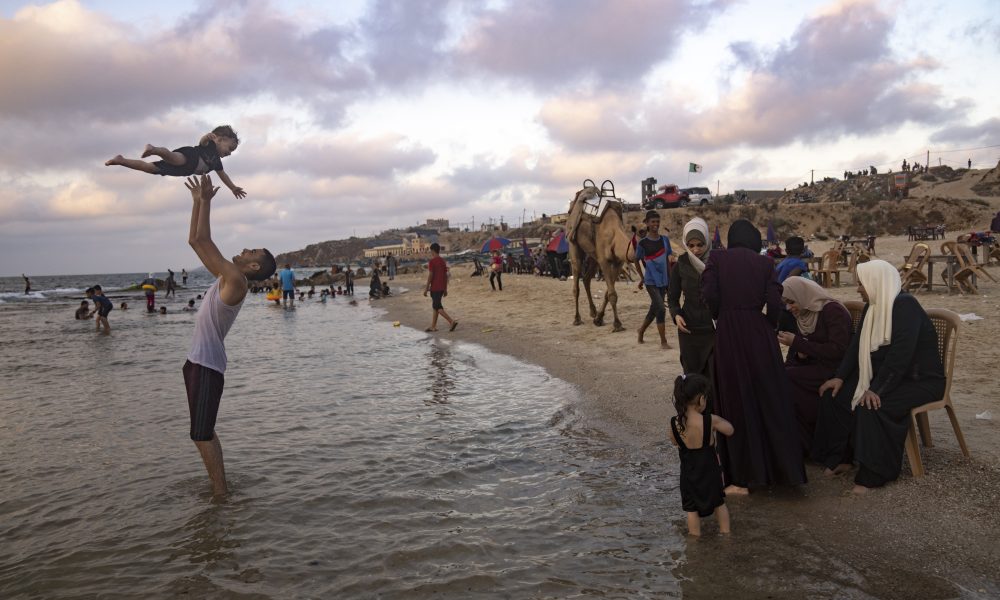
As a counterpoint to the gray moonscape that jumps to mind when most think of Gaza, Almoghayer lovingly reconstructs the city’s sensorium in saturated color. Sounds of the adhan mingle with Fairouz’s ethereal voice. The beach is a world all its own, with distinct subcultures of fishermen, surfers, seasonal quail hunters, and friends picnicking into the night to Umm Kulthum’s throaty contralto. Smells of fresh-ground coffee, a livestock market, zaatar tea waft through his prose. And on nearly every page are Gazan flavors: freshly harvested peas; crimson strawberries; Sheikh Ijlin grapes; fresh green almonds; pickled green olives; knafeh; eggplant mutabal; maqluba; Almoghayer’s grandmother’s bamia stew. The foods are a testament to the richness of the land and its people’s bond with the soil and one another. Someone is always handing the author a cup of refreshment, a bag of produce, a handful of pea pods, or a plate of dry bread, even if that is all they have.
This is what it means to love a place, as Almoghayer shows in his affecting work of topophilia. He showcases not just his own love, but his many interlocutors’ deep bonds with Gaza’s spaces.
In their everyday lives, Palestinians create spaces that negate Israeli violence. This is one of the meanings of sumud: the philosophy of holding one’s ground, subverting the militarization and diminishment of the built environment by repairing and preserving it. Transmuting destruction into life, the way Gaza’s parkour enthusiasts use mounds of rubble to hone their flips. “We love life,” says Mahmoud Darwish, “if we find a way to it.”
This philosophy of sumud has guided Palestinian life since the Nakba and the 1967 military occupation; it became even more crucial since 2007, when Israel imposed the catastrophic blockade on Gaza. Imports and exports were severely restricted, especially basic foods, fuel, and medical supplies. Sustenance from the sea was cut off, when Israel imposed a strict limit of three to six nautical miles on fishing, despite the Oslo Accords allowing Palestinians 20 miles to access more lucrative catch of tuna and mackerel. Gazans needing exit for medical treatment or study abroad were seldom granted Israeli permits. Egypt’s government actively colluded, keeping the Rafah border crossing shut most of the time. Within one year, 98 percent of industries were shut down and tens of thousands of jobs lost in farming and industry.
Only a year after the blockade, Mary Robinson, former president of Ireland, visited Gaza in late 2008. “Their whole civilization has been destroyed,” a shaken Robinson told the BBC, “I’m not exaggerating.”
Why had Israel’s government turned its already existing closure policy into a full-fledged blockade? It is startling to recall that this was a response to a free election. In 2006, Hamas won Palestinian elections in both Gaza and the West Bank and formed a government. The win reflected Palestinians’ frustrations with the incumbent Fatah movement, especially its “security coordination” with Israel, which essentially meant Palestinian security forces repressing their co-nationals on behalf of Israel. Stunned and unwilling to accept its loss, Fatah began undermining the Hamas-led government.
The US, Britain, and the EU egged Fatah on. These Western powers also cut off funding to the Palestinian Authority, knowing that civil servants would go unpaid and now direct their ire at Hamas.
For its part, Israel slowed food and fuel imports to a drip-feed and openly admitted it. “The idea is to put the Palestinians on a diet, but not to make them die of hunger,” said an adviser to Prime Minister Ehud Olmert. Covertly, US, Egyptian, and Jordanian security forces trained Fatah armed men to instigate a coup against the Hamas government. The latter got wind of the plot and acted first, routing Fatah’s men from Gaza in June 2007. In short order, the Israeli cabinet declared Gaza “hostile territory” and formalized the closure into a blockade.
Eid and Almoghayer take up the challenge laid down by Palestine’s poet, years ago: “We do injustice to Gaza if we glorify it, because being enchanted by it will take us to the edge of waiting and Gaza doesn’t come to us,” wrote Mahmoud Darwish.
Thus started a “slow genocide,” according to Eid and other scholars (long before a roster of academics and rights groups began using the term in 2023). Ten years later, Gaza had the world’s highest unemployment rate (54 percent, with youth unemployment at 70 percent). Every second person lived in poverty and 68 percent of the population was food insecure. Electricity averaged 6.2 hours per day. Polluted water was the leading cause of child mortality; lack of fuel disabled water treatment plants, and sewage was dumped into the sea. Eid expressed Gazans’ anguish at the world’s indifference, not least Arab governments that did little beyond send occasional aid. “The bitter reality is that we are alone, beleaguered, under siege, undesirable even to some of those who are supposed to be our brethren.” As the Goldstone report spelled out, the point of this decade of slow genocide was to make life so intolerable that Gazans would either turn Hamas out of office, or leave.
Neither happened. Instead, the people of Gaza—brutalized by the combined impacts of military assaults and blockade—tried to survive. Some did leave, encouraged by and paid for by the Israeli government.
But many others participated in the most sustained grassroots campaign since the First Intifada: the Great March of Return protests of 2018–19, unarmed mass actions held weekly for nearly two years at five muster points near the fortified fence. The brainchild of civil society activists from all political factions, the protests sought to mobilize global action to lift the ruinous blockade and assert Palestinian refugees’ “inalienable right” to return to their homes or receive compensation, as stipulated by international law. Keenly aware of the constant lecturing of Palestinians that they must engage in peaceful protests, organizers set up the march on the model of South Africa’s anti-apartheid and the US civil rights movements. Countering the reflexive Israeli government claim that Hamas forced tens of thousands of people to participate, Eid wrote at the time that “The Great March of Return is the beginning of our long walk to freedom to undo this injustice of 1948.”
Despite Eid’s stirring words, these protests were framed in Western media (when they registered at all) as Palestinian provocations. This response helped normalize Israeli snipers’ use of live ammunition against protesters, medics, and journalists. The use of force led to 214 demonstrators killed and 36,143 injured. One Israeli soldier was killed and seven were injured. A pair of snipers told an Israeli reporter that they had hit 42 Palestinians’ knees in one day; “In the end you want to leave with the feeling that you did something, that you weren’t a sniper during exercises only.”
Israel’s unremitting use of violence, whether against Gazans engaged in armed resistance or unarmed protests, explains why the Oslo process was abandoned by many Palestinians, including Eid. “Oslo” became a dirty word, signifying permanent abdication of Palestinian national rights and deference to Israeli unilateralism. Immersed in the experience of South Africa, where he studied (and now lives), Eid and other Palestinians turned to the power of global solidarity.
Central to this pivot is Boycott, Divestment, Sanctions (BDS), a movement founded by Omar al-Barghouti in 2005 to end corporate and state complicity with Israel’s apartheid. BDS and a steadfast refusal of erasure anchor a futuristic vision of liberation that Eid articulates even in the midst of genocide. What Eid offers is a new compact that is no less resonant for its distance from our crushing present:
Liberation for us aims to transform the relationship between Palestinians and Israelis into one based on total equality and justice. The settler society is expected to abandon all colonial privileges and display real willingness to accept responsibility for past crimes and injustices. The compromise that indigenous Palestinians are expected to offer is to accept settlers as equal citizens in the new state between the Jordan River and the Mediterranean Sea.
By turns heartrending, joyful, ruminative, and infuriating, these two books bring into focus a Gaza rarely seen and even less commonly rendered, save in a stray photo by an inspired photographer, or a poem dashed off by one of its many wordsmiths. We come to see why municipal planners chose the phoenix as Gaza’s genius loci, its guardian spirit.
And birds—mythical, real, and metaphorical—also flit through Eid and Almoghayer’s pages, hewing to the tradition of confined peoples nourishing visions of liberation as barrier-breaking movement. In his most lyrical essay, Eid imagines the souls of his parents as two birds, “wing in wing,” flying back to their birthplace, the village of Zarnouqa. And in 1998, even as Israel enclosed Gaza with the fence, a towering bronze statue of the phoenix—Palestinians’ rising bird, Gaza’s symbol of renaissance—was erected in Gaza City’s center, Palestine Square. It has now been destroyed by Israel.
And Muin Bseiso, in a prologue to Gaza Diaries, tells the story of a broken bird. A storm separates him from the flock midflight, and he lies shivering and featherless under a tree. The flock finds him and encircles his denuded frame. Each bird pulls out a feather from its breast or its wing and plants it on the bird. Covered in feathers, he stretched his wings and rose. “And so, you will rise, o homeland.” 
This article was commissioned by Ben Platt.
- Muin Bseiso, Dafatir Filastiniyya (Dar al-Farabi, 1978), p. 17. ↩
- In her four decades tracking Gaza’s engineered debility, Sara Roy expresses its many-sided predicament: “Gaza’s state of exception, which Israel has successfully nurtured, is expressed in the unmaking of shelter and sustenance, in social space that is never insulated from violence and incoherence, where violent excess is affirmed and made intimate, in policy that regards ‘peace’ as an instrument of oppression, where consent is rarely given and compromise rarely made; where Israel remains unquestioning and unchanged.” ↩
- Muin Bseiso, Gaza Diaries (Dar al-Farabi, 2014), p. 17. ↩
- Salman Abu Sitta, “Gaza Strip: The Lessons of History,” in Gaza as Metaphor, edited by Helga Tawil-Souri and Dina Matar (Hurst, 2016), p. 106. ↩
- Norman Finkelstein, Gaza: An Inquest Into Its Martyrdom (Oakland: University of California Press, 2018), p. 104. ↩
- Finkelstein, Gaza, pp. 201-02. ↩