Advertisement

I wrote the first draft of this essay over a year ago. Russia’s attacks on Ukraine have intensified since then. At a moment when this essay appears in print, following Russia’s incessant bombing of Ukraine’s critical infrastructure, millions of people, including the most vulnerable, many living hundreds of kilometers away from the frontline are exposed to freezing temperatures in their own homes, having intermittent or no access to water and/or electricity, and being targeted by missiles and drones. Peace negotiations are ongoing, and nobody wants peace more than Ukrainians, and as millions of Ukrainians know: Russian occupation is not peace, peace is inseparable from freedom and justice.
Articulation I
In the second year of Russia’s full-scale invasion of Ukraine, and the ninth year of the Russo-Ukrainian war—on June 6, 2023—the Kakhovka Dam was breached. One of the largest in Europe, the Kakhovka Dam held 18.2 km3 of water. As a result of flooding and shallowing (according to an assessment by the Ukrainian Nature Conservation Group), the disaster impacted wildlife over an area of at least 5,000 km2. More than 60,000 buildings were flooded.
On the day of the catastrophe, the Mykolaiv Chapter of the Ukrainian PBS Suspilne posted a video with the title “Kherson Residents Are Evacuating Their Animals.” The video opens with two women walking in the water up to their ankles. The base of walls, fences, and trees framing the street are submerged in water. One of the women, Yana, is carrying a big dog. She says that the street she is walking from has water up to her waist. Another woman, Liudmyla, is trotting behind. When the camera focuses on her, she comments: “This is it. You can now fish at home. There is water, everything is swimming.” The camera turns to the view of the street turned into a water channel; we hear the interviewer asking Liudmyla: “Are you planning to evacuate somewhere?” “No, no,” she replies with a slight smile on her face, “we won’t go anywhere from our home.” Then Liudmyla looks directly into the camera and says, “Perebudemo, everything will pass, and everything will be well.”
In this context, perebudemo translates from Ukrainian as “we’ll wait it out.” Notice the plural form used by Liudmyla here. Notice the “we.”
Liudmyla is using the verb perebudemo (the future tense form, first person plural, of the verb whose infinitive is perebuty). This future plural is an articulation, where “articulation” means “the way in which you express your feelings and ideas.” This Ukrainian word is composed of two parts: the prefix pere-, meaning “over-” or “trans-”; and the verb buty, which means “to exist, to be.” She is specifically using the word to refer to her decision to remain in the flooded city, to stay.
And yet, Liudmyla is also gesturing toward the future. “Everything will be well,” she adds.
I speculatively suggest here that it is possible to translate what Liudmyla said as more than just “we will wait it out.” Perhaps perebuty could be understood as to over-exist, to over-be; perhaps perebuty could also articulate the conditions of life of those on the ground in times of war. Among the available prefixes I choose over-, where the prefix over- has hints of what is left over, as well as the abundance of existence overflowing.
Here, I am attending to this life that is carried over, the life that overflows.
Liudmyla articulates perebudemo from a very particular temporality: from the very heart of the catastrophe, which you have not had time to process, which is still happening. As the water is rising (faster than one could reflect on it), as we do not know yet when it (the war, the flooding) will stop, Liudmyla utters with a slight smile, looking at the camera, looking at us: we’ll over-exist. We’ll later-be. Even in that moment of the catastrophe, for Liudmyla, it is “we” that will over-be.
To over-exist is to wait for the war to end, to face the fact that its time is not permanent. But to over-exist is also to firmly remain within the war: as Liudmyla remains in the flooded Kherson, as one stays in a shelter until the air raid is over, as one refuses to shelter and sleeps through the howls of sirens at night, as one postpones apartment renovation until after, as one keeps the tape crisscrossing windows in case of attack.
Perebudemo addresses the war, inhabits it. There is an element of endurance in perebudemo, in recognizing the violence, the need for it to be over, to end. There is bleakness, hardship, impossibility. I pause, to let the mute sorrow of it sink.
There is also a sense of resistance in over-existing, in carrying on, carrying the existence over. And I hold on to this elusive element of futurity in perebudemo, different from the more certain perezhyvemo, “to live through,” “to survive.” Indeed, there is no promise of surviving in perebudemo.
Still, I cling to the possibility of the after-the-war, of the after-the-occupation, after-the-violence. I hold onto the futurity of some form of existence, to the buty in perebuty, as furtive as it is. I cling to the expectation that the temporalities of the war and the occupation are not infinite or endless, at least for some of us.
Perebudemo: to over-exist from within violence.
Downstream from Kakhovka to the Dnipro-Buh Estuary, and to the Black Sea, the water carried roofs, land mines, pillows, fertilizers, and bodies.
To over-exist is an articulation. Articulation relates to language: the sounds falling into place, becoming words, “the way in which you express your feelings and ideas.”
In the face of extreme violence, any articulation seems by default inadequate, if not meaningless. In times of war, says poet Iryna Shuvalova, “language is truly powerless.”
Still, I search for ways to articulate. If we withdraw from articulation, we may obstruct processing and understanding. We may impede possibility of building communities rooted in mutual listening, across experiences, across violences, across ways of living. It’s an imperfect gesture, but I nonetheless think of articulation as simultaneously reciprocally envisioned and inviting reciprocity.
What does it mean to narrate a war, particularly from a place where the war has been lasting for years? In A Landscape of War, anthropologist Munira Khayyat listens to “those on the front lines of living,” which includes people, plants, and animals. She attends to the “resistant ecologies” that emerge in the time-space of war. “In a place like South Lebanon,” she writes, “it is impossible to parse war and life, they are co-present, they coexist”
I read Khayyat’s book as a critique of false binaries that distort our narration and understanding of the contexts of war. Whether in academic writing, or media, war is often represented through the binaries of violence versus care, destruction versus hope. These clichés abstract and flatten the complexity of experiences, the messy honesty of living in a place of war. To narrate ways of inhabiting the war, I search for other articulations.
Articulation II
The word “articulation” also relates to bodies, including Khayyat’s bodies “on the front lines of living,” whether people, plants, or animals. Articulation is also the joints aligning into shape, a hand pointing, “the point where two bones connect to allow movement.” Here, I also think with these other, bodily articulations.
In February 2022, Russia escalated its eight-year war on Ukraine into a full-scale invasion. At that moment I was in Scotland, and my mother was in Kyiv.
Over a year later, in the summer of 2023, the two of us were finally able to return to my hometown of Mykolaiv together. A city in the south of Ukraine, Mykolaiv is built on water. It is surrounded by two rivers, the Southern Buh and the Inhul. Where these rivers meet forms what in Ukraine we call lyman: a salty ecotone of the rivers being called by the sea and falling into the Black Sea.
At the beginning of Russia’s full-scale invasion, the Russian forces almost surrounded Mykolaiv; for months, the city was intensely shelled. The munitions hit residential houses, streets, port industries, grain storage facilities, schools, and other places designated by Russia as targets. And when they did not hit those “targets,” a neighbor told me, they fell into the water. Remembering those days, they said that the river looked as if it was boiling.
Mykolaiv is surrounded by water. One of its central beaches is where my mother and I always hang out when we are in Mykolaiv. There, in just one day of searching in June 2022, sappers located four cluster munition elements. In other places, elements from multiple rocket launchers were located, too.
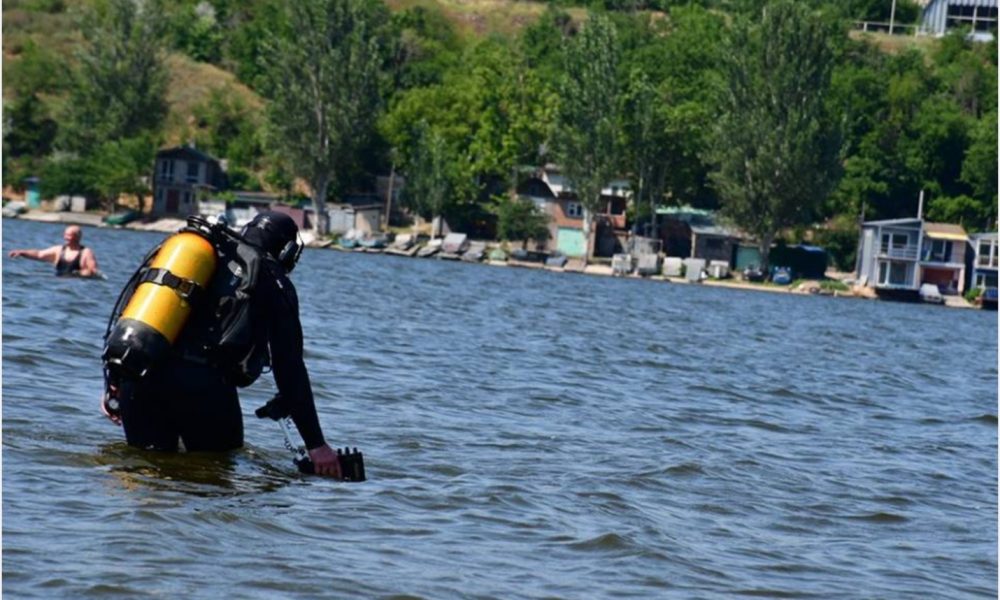
From afar, I study the photos provided in the news report. They feature diver sappers dressed in full-body black suits, their solemn figures making the beach look estranged.
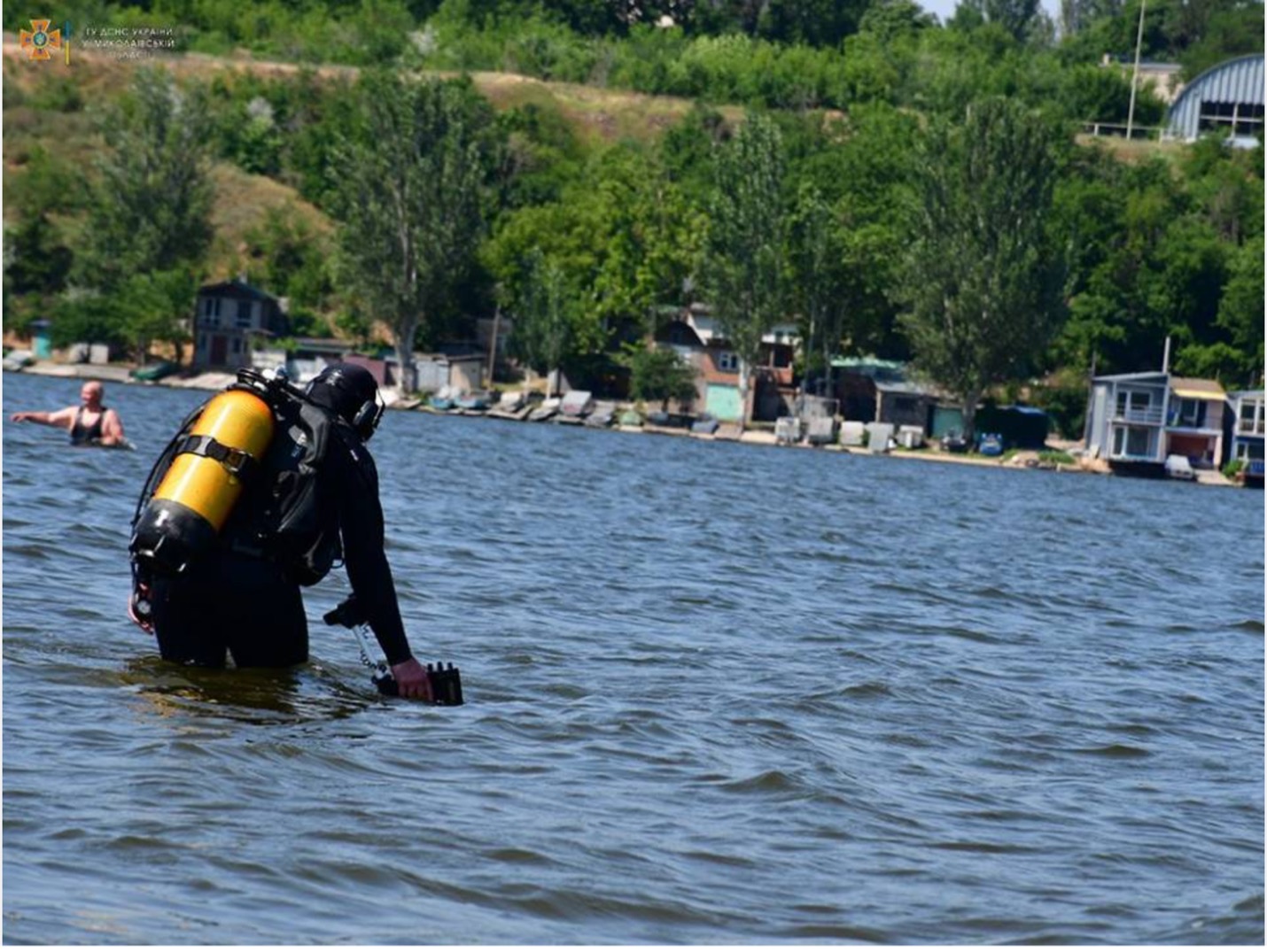
One of these images foregrounds a sapper in the water up to his thighs. His back is marked by the yellow diving tank, his arm is directed downward, submerging a device beneath the waterline. The horizon line is dramatically tilted, echoing the instability of a wave, the power of the current, the turbulence of the times.
Behind the sapper, we see a row of boats by the tree-covered shore. We also see a figure of a woman in a one-piece black swimming suit. It is important here that the woman was captured unintentionally. She looks as if she is exiting the frame, her hand almost touching the far-left edge of the image. She almost escaped it.
When I enlarge the photo, her face is blurred. Still, her figure is an articulation: coconstituted by the figure of the sapper, the tension of the water, and the space we cannot see. The woman’s arm is extended above the water, away from the sapper looking for unexploded ordnance. She is almost gesturing, almost outside the frame.
This image is from 2022. When my mother and I were on this same beach in the summer of 2023, local authorities had issued a recommendation not to swim in the city’s rivers and estuaries. It was the summer of the Kakhovka disaster. The summer in which the dam, occupied by the Russian military since 2022, was breached.
Downstream from Kakhovka to the Dnipro-Buh Estuary, and to the Black Sea, the water carried roofs, land mines, pillows, fertilizers, and bodies. A terrified roe deer was documented all the way down to Odesa, brought there on a small reed island.
The Kakhovka disaster is not the only event that contributed to the pollution of the aquatic ecosystems of the city. Mykolaiv is an industrial city; the Russian military targeting factories, port infrastructure, and storage facilities—all in close proximity of the water—has often resulted in contamination.
Satellite images of the Buh Estuary, analyzed in June and July 2022 by Oleksii Vasyliuk and Eoghan Darbyshire, reveal an unreported discharge of a brown-colored substance in the water. According to their study, the discharge came from the Halytsynove wastewater treatment facility, which had been shelled repeatedly. On several occasions, drone attacks caused severe contamination of the Southern Buh River with spills of vegetable oil; one of the biggest ones was in January 2025, when 1,800 tonnes of oil was released into the river. Since the start of the Russian full-scale invasion, Mykolaiv Alumina Plant, one of the biggest in Europe, has been struggling to maintain the two open-air bauxite residue or red mud fields located in the proximity of the Buh Estuary. Red mud is an industrial waste, which, if not stored and maintained properly, poses severe environmental and health risks.
Consequently, when my mother and I were back home in the summer of 2023, there were plenty of reasons not to swim in Mykolaiv. And we did not. In fact, we were coming to the beach just to sit by the water. Other people did swim; very few people, but they did.
It was a hot summer. The hottest on record, back then. Mykolaiv is located in a climate risk area, prone to heat waves, dust storms, and droughts—which all make it harder to stay away from the water in the suffocating dry air of the summer.
In the summer of 2024, I could not return to Ukraine, but my mother traveled to Mykolaiv several times. It was her third summer of the Russian full-scale invasion. During this third summer of the full-scale war, she, too, started swimming.
Every time we talked, I told her: “Watch out, be careful in the water.” Every time she went to the beach, I worried, and every time, we argued, the same way we argue about her going to the shelter, something my mother long since abandoned doing. “I am too exhausted,” she says; “I cannot take it anymore,” says my mother. Whenever I called, she talked about how wonderful the water was, and how much joy she felt at the beach.
Anthropologist Azra Hromadžić also documents her experiences of swimming in the context of the war. Reflecting on her adolescence in besieged city of Bihać, in Bosnia and Herzegovina, she writes about the Una River and how “the river allowed one to suspend the outer world of violence and destruction” and brought joy and a sense of community to the residents of her hometown. “War swimmers,” writes Hromadžić, and I think of my mother inhabiting this category, in another time and another place.
This past summer, when my mother and I returned to Mykolaiv, I too swam in the river. I went in not trusting the ground under my feet, I felt scared and at the same time ashamed of my fear. My mother went in with joy. I had never seen the river so shallow. Once it used to sail ships that would travel the world—Mykolaiv was founded as a shipbuilding city. In August 2025 you could walk to the middle of the Buh, the third biggest river of Ukraine.
As I was sitting on the shore, Mom kept walking farther and farther away. I was worried, watching her with intensity, I kept thinking whether sappers would have checked for the unexploded ordnance so far out. She kept walking against the sun low on the horizon, until she almost vanished, her figure so small, a hardly visible dot.
When she returned, she said she was afraid to swim. Not because of the war, but out of fear of impacting her knees, ailing after the cold months she spent in the bomb shelter in 2022. After swimming, she explained, she struggled to get up and straighten her legs without hurting them further.
Life also exists in the very moment of being inside the war: in the flooded Kherson of Liudmyla’s testimony, in the contaminated water, precisely in the point of waiting for the violence to end.
Perebudemo, says Liudmyla in the flooded Kherson. We will over-exist this.
Perebudemo, I repeat after her. I say the word, again, as I keep paying attention to the articulations of life on the ground, to the possibility of the overflowing of that life, of the over-being that outlives erasure and annihilation, and therefore exists beyond the war, beyond occupation, beyond violence, after.
Yet, that life also exists in the very moment of being inside the war: in the flooded Kherson of Liudmyla’s testimony, in the contaminated water, precisely in the point of waiting for the violence to end, always stubbornly waiting and knowing that it will indeed end, it must end.
And that is exactly why one, like Liudmyla, remains to perebuty. It’s a lifeline, a line, a gesture of extension to that distant and often unimaginable after, to that shore one is unable to see. And yet, it is that shore to which one speaks and which one reassures that we will indeed over-exist. Perebudemo, says Liudmyla, in plural. 
This article was commissioned by Ben Platt.