
Being reviewed:
Advertisement
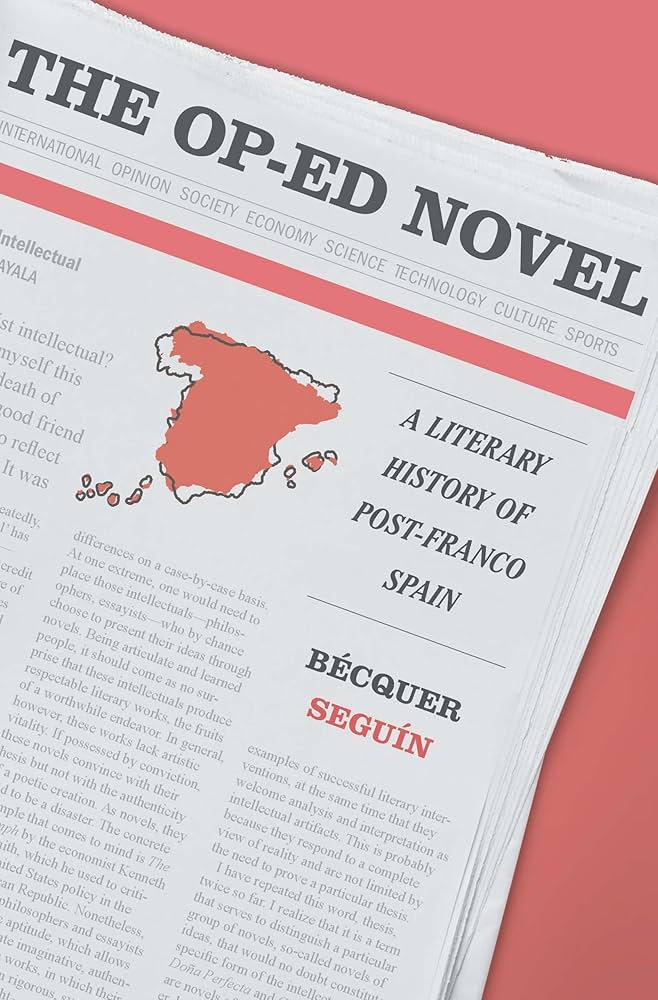
In the years following the end of Francisco Franco’s regime, Spain’s most important newspaper employed many novelists as writers of op-eds. But why? Outlining the literary careers of these prominent Spanish writers, Bécquer Seguín traces how their literary production relates to their output as opinion columnists. The Op-Ed Novel: A Literary History of Post-Franco Spain addresses the relationship between contemporary narrative and opinion journalism, particularly the role of the newspaper El País—a pillar of the emerging Spanish democracy during the Transition, which began in 1975—and of the heterogeneous community of writers whose work appeared in its pages.
An associate professor of Iberian studies at Johns Hopkins University, Seguín has omnivorous academic interests, including the crises of social mobilization and populism in contemporary Spain, transatlantic romanticism in Mexico, and paragons of Latin American culture such as Jorge Luis Borges and Ayrton Senna. He also maintains a presence as a public intellectual, appearing regularly in media outlets such as The Nation, Slate, Dissent, and Public Books. His work elegantly and entertainingly examines the condition of literature, the role of journalism in society, and the sometimes elusive power of those novelists who make opinion part of their business.
This interview was forged during informal meetings in Philadelphia, over several phone calls, innumerable text messages, and finally a long video call about the cultural conditions of contemporary Spain. It has been edited for clarity.
Xavier Dapena (XD): During Franco’s dictatorship, Spain experienced a long period of authoritarian rule that ended with a delicate transition to a parliamentary monarchy. In this context, your book’s first chapter is dedicated to the newspaper El País, famously described by writer Gregorio Morán as the “organic intellectual” of the transition. This term refers to a person or institution that actively contributes to shaping or replacing the political, economic, and cultural forces at play. What was the role of El País—and the press in general—during Spain’s transition from dictatorship to democracy?
Bécquer Seguín (BS): El País was founded in 1976, just a few months after the death of Francisco Franco, the fascist dictator who ruled Spain for over 30 years. The newspaper was fundamental in the country’s transition to democracy. It based its project on contemporary newspapers in France and the US, rather than looking to Spanish history for institutional models. El País began to open up a space for people from across the political spectrum, not only those associated with the newspaper. This differentiates it from journalism in France, England, and Germany. It was an attempt to cultivate a brand of opinion writing unavailable to Spaniards before 1976.
But to answer your question: At its origins, El País was not precisely the center-left newspaper that it later became. It was founded by a group of figures who essentially wanted to modernize the government but had substantial business interests; it was, in fact, very close to the former regime.
Take a figure like Juan Luis Cebrián, whose father had been an editor at one of the major newspapers during the dictatorship. There’s a political transformation: the editors were driven by a need to make El País profitable but also tended to cleave to the new party in power. As Cebrián admits in his memoirs, he was involved in specific backroom conversations with the heads of the new government, and that created a privileged position for the paper. El País was the only major left-of-center newspaper in Spain. There were no other newspapers competing for that readership, at least nationally. It built up hegemonic power and became crucial to the government policies during the early PSOE [Partido Socialista Obrero Español, Spanish Socialist Workers’ Party] governments. So naturally, novelists were attracted to this forum that allowed them to reach much broader audiences.
XD: In the opening paragraph of your book, you ask why Spain’s most influential newspaper featured so many novelists as opinion columnists. Given El País’s unique role in Spain’s political and cultural transition—originating close to the old regime, then becoming the dominant left-of-center voice—what inspired you to focus on this connection between novelists and the newspaper? How did this question emerge during your research?
BS: I came to this project after I had begun writing about contemporary Spain for The Nation and closely following the Spanish press. Spain has a long tradition of crossover between journalism and literature; for example, Mariano José de Larra, the most famous Romantic in 19th-century Spain, was a newspaper man first and foremost. He edited and wrote for several newspapers, and some of his most famous stories were published in papers, not as columns but as short stories or chronicles.
So you have literary figures occupying preeminent roles in newspapers up to the present day, which differs from what one finds in the US context, for example. By examining that difference, I became interested in the op-ed as a form. And more generally, I wanted to think about how opinion circulates in modern societies.
XD: Besides your academic work, you regularly write on Spanish politics and culture for the popular media. Your book combines these two interests: literature and mass media.
Is there a relationship between this duality in your work and your interest in tracing the connections between literature and journalism? What have been the most significant challenges you’ve faced in adapting your communication style as you toggle between these academic and journalistic modes?
BS: In my journalistic work, I aim to explain what is happening politically, culturally, and socially in Spain, especially to a left-of-center American audience. But as a scholar, I am interested in how the novel functions as a genre, history, and theory. That’s the core of my teaching and research. I have always been interested in questions of art and how it reflects a particular political moment. I am intrigued by how writers migrate and take their previous work into a new context.
Moving between audiences and contexts is more about how I adapt as a writer than about how I feel about issues and topics. Once you start writing for journalistic publications, editors insist on the need for clarity and concision. The process of being edited has helped me become a more precise writer.
XD: I found your book very literary in its style and structure. For example, each chapter’s first sentences grab the reader’s attention: “Juan Luis Cebrián was nothing if not ambitious” or “Antonio Muñoz Molina was not a fan of Pulp Fiction.” How did you arrive at this specific form?
BS: I wanted to begin all of the chapters in an anecdotal fashion, because if you can get into the argument and narrative of the chapter smoothly, people keep reading. Given that I wanted to appeal to varied audiences, I needed to find a way to make it entertaining.
Take the Muñoz Molina chapter, for example: I talk about his hatred of Pulp Fiction, which synthesizes his moral vision for his newspaper column. Muñoz Molina has what we might call a hypermoral sensibility, which drives his newspaper writing and, I argue, simultaneously drives his novel writing. So talking about a film nearly everyone has seen and showing him saying something controversial about it captures the reader’s attention.
XD: In your book, you focus on the story of a group of novelists in post-Franco Spain, which includes Antonio Muñoz Molina, Javier Marías, Javier Cercas, Almudena Grandes, and Fernando Aramburu. You argue that their fiction was transformed when they became columnists. How did you select these novelists for your study, and who was left out? I’m thinking here of Manuel Vázquez Montalbán, as well as other notable cases such as Juan José Millás, Manuel Rivas, and Elvira Lindo.
BS: There are two sets of people who were left out: other novelists who write opinion columns and other novelists who do not write opinion columns but are nonetheless intellectuals. One could write several books about this phenomenon from different angles, and I chose these novelists precisely because of their influence and power. In this cultural space, they are the elite of the elite.
XD: By focusing on op-eds and literary novels, you challenge the notion that journalism is “literature, yes, but of a second order.” Do literary and journalistic writing belong to the same order? What specific argumentative strategies do they share?
BS: Many people put literature on a pedestal, in a certain sense, and for me, literature is just another dimension of writing. The fictional element makes it categorically different, but it’s not more or less privileged than other forms of writing. It’s just different.
In that sense, I treat them on an equal plane. The distinction, again, is that of nonfiction versus fiction. How do we understand that? Why are some works treated as fiction when they essentially act as nonfiction?
Take the case of Javier Cercas, who is, in my view, a master of autofiction. What’s interesting to me is that when people critiqued historical inaccuracies in his 2001 novel Soldados de Salamina, he decided to respond as a historian, not as a novelist. And he said, essentially, “Oh no, this is not a factual inaccuracy of the book. Here is my research, here are the few books I read, here are the historians I talked to; they told me all about these events that I’m describing, which are true.” This is very weird. Why does a fiction author have to defend the nonfiction in their fictional book? As a fiction writer, why do I have to prove my historical expertise to you?
But of course, Cercas doesn’t do that. He defends himself in public because he’s interested in how this blurring of the nonfiction/fiction distinction benefits his intellectual persona and his ability to act as an intellectual in public, as a historian in public, and not just as a mere fiction writer. And of course, if you’re a historian in the public sphere, you have a much broader ability to opine on matters of public interest than if you were just a fiction writer. You have that legitimacy.
Ultimately, that’s what someone like Cercas is after when he uses autofiction in this historical way. Cercas’s work pushes a particular version of history, so as to persuade readers of the correct way of interpreting the world.
XD: In what way are novels like Anatomía de un instante and Soldados de Salamina part of this strategy?
BS: Cercas uses autofiction to accrue legitimacy as a historian in the public sphere without writing academic scholarly history, or even popular history. He wants to be able to simultaneously have the facts, to use a set of historical events, historical circumstances, historical research—he is very proud of all the research that he does, going to archives, talking to people, talking to historians, etc.—but he’s not interested in strictly telling a narrative that is only about the facts. And that is, in part, because he’s very interested in psychology: literature can allow him to play around with understanding how people’s psychology works in different historical episodes.
So, for example, Soldados de Salamina (2001) is essentially a story of a journalist investigating this very peculiar episode in the Spanish Civil War. It’s a true story: a fascist ideologue is put before a firing squad, escapes, and is found again by a Republican soldier, who spares his life and does not turn him in to his fellow soldiers. In the novel, Javier Cercas is the narrator and is very present throughout. Essentially, the novel describes a research trip. He talks to people, he interviews people, he talks to his partner, he talks to everyone about this story; then he writes that story; and ultimately he finds the anonymous Republican soldier who saved the life of the fascist ideologue.
In his next major novel of historical autofiction, Anatomía de un instante, Cercas is not participating in the way he did in the first one. Instead, he uses the third person and an even more objective lens through which to understand history. His switch to third person was in response to the debates around Spanish history in the 2000s and critiques of Soldados de Salamina in the public sphere. In the new novel, he tries to avoid the critiques made of his first novel.
Cercas was surveying what people thought of his works and his presence as an intellectual in the public sphere. He was saying, in effect, “To become a more respected intellectual, I need to remove myself from my own autofiction,” which is wild. And yet it’s still autofiction, attempting to accrue legitimacy by leaning on history.
XD: How do you view the career of someone like Antonio Muñoz Molina? He started as a novelist but has come to be seen as a public intellectual who champions a certain Spanish nationalism and maintains a particular perspective on historical memory.
Why does the op-ed still hold sway over writers who want to be intellectuals or want to have some public presence?
BS: The indignados movement made many important critiques, including critiques of the elites. And these novelist intellectuals are the elite of the elite of a particular type of cultural figure in Spain. Yes, they were critiquing figures like Muñoz Molina and Javier Marías, who were very interested in preserving a specific idealized version of the transition to democracy: one that made it unimpeachable, off-limits to any critique.
But Muñoz Molina didn’t start like this. He began as a novelist in the late ’80s, writing novels that were postmodernist in flavor but international in references. He was very interested in bringing in cultural artifacts from across the globe, especially jazz, into Spanish literature. What’s curious to me about Muñoz Molina—and the reason I start with the anecdote about Pulp Fiction—is that even as he brings these cultural artifacts from across the globe into his literary writing and also into his column writing, he still adds this powerful moral bent to the literature and the essays he writes. They are very charged with moralism. That’s what I see as quintessential about Muñoz Molina in particular.
But in the ’80s, when he started, I don’t know if Muñoz Molina was as critical as he later became of people who wanted to criticize the transition to democracy. The Muñoz Molina of back then was more cautious than someone like Javier Marías, who will go out on a limb and say that certain aspects of the transition to democracy were terrible. Still, perhaps it’s a case of Muñoz Molina being in one position for so long that he falls back into a particular conservatism he wishes to defend.
What’s curious about these writers is that almost all of them reached literary fame very quickly. They exploded onto the scene, and perhaps that has much to do with their subsequent novel writing and opinion columns.
A writer who has produced opinion columns for a long time and has had to deal with all the ramifications of those columns, the reactions and the criticisms, might be more sympathetic to a plurality of perspectives and less likely to rigidly adhere to their thinking. But one who shoots into literary fame very quickly and then suddenly gets a column in El País doesn’t have time to become as open and self-reflexive as some of these novelists should have been.
Perhaps that has a little bit to do with why, by the 2010s, many of these writers came to be seen by the indignados movement and others as just another part of the staid Spanish elite. They were seen as a group that couldn’t change its opinions and didn’t want to entertain alternative views of Spanish history or call for a new transition.
XD: Moving on to Javier Marías, I remember the profound impact that Tu rostro mañana had on me, even though I remember absolutely nothing of its plot. … Tell me about Marías’s notion of “literary thought” and its role in his approach to novel and opinion writing.
BS: Javier Marías takes this idea of literary thought from his father, Julián Marías, a well-known moral philosopher in Spain during the 20th century. Marías’s father’s tastes were very eclectic, and literature was one of his primary interests. Marías takes on the concept of literary thought, which is that literature can produce contradictory arguments and thinking. If you’re in the natural sciences or any scholarly or nonfiction form of writing or thinking, you have to have some coherence, but for him, literary thought didn’t have to have any coherence. It could tell two truths at the same time that might appear to be contradictory.
So why is this important? Well, a novel has many characters, and the views of these characters are all legitimate, to a certain extent. They’re just different opinions about one particular situation, moment, or circumstance. You don’t have to have the coherence that one would have as an engineer trying to solve a specific technical issue, where there can be multiple solutions but the solutions are clear and definite.
The solution for literary thought is not clear and definite. It’s about truth, and truth, according to Marías, is a much more open category than we have in other domains.
Now, literary thought is convenient to point to when you’re trying to make arguments in the public sphere. You can say, “Oh, but this is literary thought, and therefore I can contradict myself without having to uphold argumentative and persuasive standards, standards of evidence that one would need to prove a point in an op-ed. I can get around this with my idea of literary thought.” And that’s striking to me. Yes, obviously Javier Marías is an excellent literary writer who knows how to develop characters who are opposite to each other, who do not share the same political beliefs, who do not share the same family backstory, the same character traits, etc. But at the same time, novels like Tu rostro mañana seem very clear in their ideological and political orientation. What literary thought does is essentially deflects particular critiques that one could make of a novel and certain ideological views that that novel wants to advance, that one might want to challenge. Literary thought allows Javier Marías, the novelist, to decline to say whether his opinion is this one or that one or whether he has any coherent opinion at all. It’s a distraction mechanism.
XD: When I was reading your book, I felt that Almudena Grandes sits uneasily in this group of writers, both ideologically speaking and regarding her role in the Spanish cultural field. Do you feel that discomfort or not?
BS: Yes, in part. Almudena Grandes is much more to the left than the other writers I cover, besides being the leading female novelist I studied in the book. But I chose Grandes because she too broke into the El País opinion page. She started writing for El País Semanal in the late 1990s, and in 2007 she finally got a column on the back page of El País, in the opinion section. This was a momentous change, not only for Grandes in her career but also, I would say, for the opinion pages of El País. But the real argument I wanted to make is about ideology. Almudena Grandes fits with this group not because of her left-wing political commitments, which are further to the left than her male counterparts. She’s here because of how she used literature to promote those political commitments.
The chapter I wrote on Almudena Grandes is about the novel of ideas, the novela de tesis. Grandes is recovering a form of fiction that flourished in the late 19th century with realists such as Benito Pérez Galdós and others. She did this in order to express her very left-wing political ideas. One of the tendencies that she and other novelists fall into—whether it’s Aramburu and his literary populism or Muñoz Molina and his high moralism—is that they become very dogmatic in the way that they present their ideas, both on the opinion page and in their novels. The book that I studied from Grandes, El corazón helado, is an excellent novel; essentially, it’s about two middle-aged people, a man and a woman, who fall in love and simultaneously investigate the past of their own families during the Spanish Civil War and the dictatorship. One of those families went into exile in France, and the other one essentially stole land and property from the family that went into exile.
But how she presents political ideas in that novel is dogmatic, even schematic. And that is what brings her together with these other writers like Javier Marías or Muñoz Molina, who also present their political ideas in very dogmatic and schematic ways, such that, if you know where to look, you can see those parallels. While Almudena Grandes is distinct in certain ways, she falls into those same traps.
XD: Let’s talk about Fernando Aramburu and his novel Patria. As I was reading Patria, I felt a certain uneasiness: although the novel appears to offer a balanced account of the Basque conflict, the treatment doesn’t feel balanced. Do you share this uneasiness? What are the implications of this on the reading Aramburu offers of the Basque conflict?
BS: Patria is essentially about two families. One is the family of a man who is murdered by an ETA [Euskadi Ta Askatasuna, Basque Country and Freedom separatist organization] cell. The other is the family of a teenager who is a suspect in the murder. These families were friends, and then all of a sudden, this murder breaks them apart. It’s a story of how they begin as friends, experience a rupture in that friendship, and come together again at the end.
When I read the novel for the first time, I was struck by the ending, in which these two women are essentially hugging it out. It was a very stereotypical image. Then I started reading Aramburu’s opinion columns and found one from 2011, right after the ceasefire, where he concludes with that same image, which would become the novel’s final and most powerful image.
What’s interesting to me is that Aramburu is doing something very 2016, which is making a populist gesture, in the sense that he wants to cast himself as being above ideology. You can see this on the left as well as on the right. In literary or opinion-journalistic terms, to say that you’re balanced is a coded way of saying that you don’t have an ideology, or that you are beyond ideologies, precisely because you claim to give equal weight to both sides of this political conflict.
In the novel, he makes choices in order to say that he is balanced. Specifically, he dedicates essentially the same amount of time and space to the family that is the victim of violence as to the family that is the supposed perpetrator of that violence.
When I read the novel, I found it unsettling that almost half of the characters who were supposed to be fundamental characters were completely underdeveloped: “flat protagonists,” in the words of Marta Figlerowicz. It was clear that Aramburu was not interested in their political ideas in the same way he was interested in the political ideas of the other family. The result is an extremely unbalanced novel that still manages to present itself as balanced.
People may think I’m more critical of Aramburu than of someone like Muñoz Molina or Marías. Perhaps it comes across that way because I wrote the Aramburu chapter first and was trying to prove a point. But the wild thing is that with almost all of these writers, I enjoy their novels aesthetically, especially Patria, while finding many of them extremely questionable politically.
XD: Your book reflects on the situation of journalism and literature through its writers and their historical conditions. As conditions shift—including the transformations we have seen in the media landscape in recent decades—what kinds of figures might supplant the op-ed novelist? Or will this figure continue to be relevant?
BS: This book is a study of a group of novelists and a moment in time that has, to a certain extent, been exhausted. These prominent figures came into political and literary consciousness in the ’80s and ’90s, when newspapers were so influential that the popularity and influence they achieved through column writing is just unattainable now.
The op-ed is “journalism’s sonnet,” according to Francisco Umbral, which is a beautiful way to understand an ephemeral piece of writing that is not so ephemeral after all. I take Umbral to mean that the op-ed has formal features that will continue to live on, because they have become ingrained in our understanding of argumentative writing and opinion writing.
Today, you have think pieces and other forms of internet writing. For example, what is a Twitter thread? It’s an op-ed, just broken down into more digestible chunks. But the purpose is the same: I’m going to make a claim, I’m going to provide some evidence, and I’m going to give you a conclusion, and you’re going to think differently about this topic from now on. It’s the same as the op-ed.

So in that sense, that form of writing will last much longer than we anticipate. I don’t know if it’s going to be replaced, but you can see that even today, one of the things that many young writers and even middle-aged writers want to achieve is to have an opinion column. Think of writers like Isaac Rosa, Marta Sanz, or younger writers like Sergio Del Molino and Ana Iris Simón, author of Feria. Or the Catalan writer Irene Solà. I don’t know if she was even 30 yet when she got her first opinion column. What’s remarkable is that this has cut across generations, ideologies, and worldviews. If you’re a more conservative ruralist, you still go to the El País opinion page. If you’re a young Catalan novelist, you still go to the opinion pages of Ara and the other Catalan daily newspapers. There’s still some gravitational pull that I don’t think is going away, even for the younger generation.
The other question is whether this is still influential in the grand scheme of things. Does this still give them the public influence that Marías, Cercas, and Muñoz Molina had in their heyday? Probably not. I don’t think that opinion columns generally have that same sway today.
But what’s more interesting for me is, why does it still hold sway over writers who want to be intellectuals or want to have some public presence? And that, in turn, points to some of my thinking in the book: that in the mind of a writer, opinion columns and novels are much more closely related than we might think. 
Acknowledgment: Many thanks to Neil Anderson for editorial help with this piece.
This article was commissioned by Nicholas Dames.