
Being reviewed:
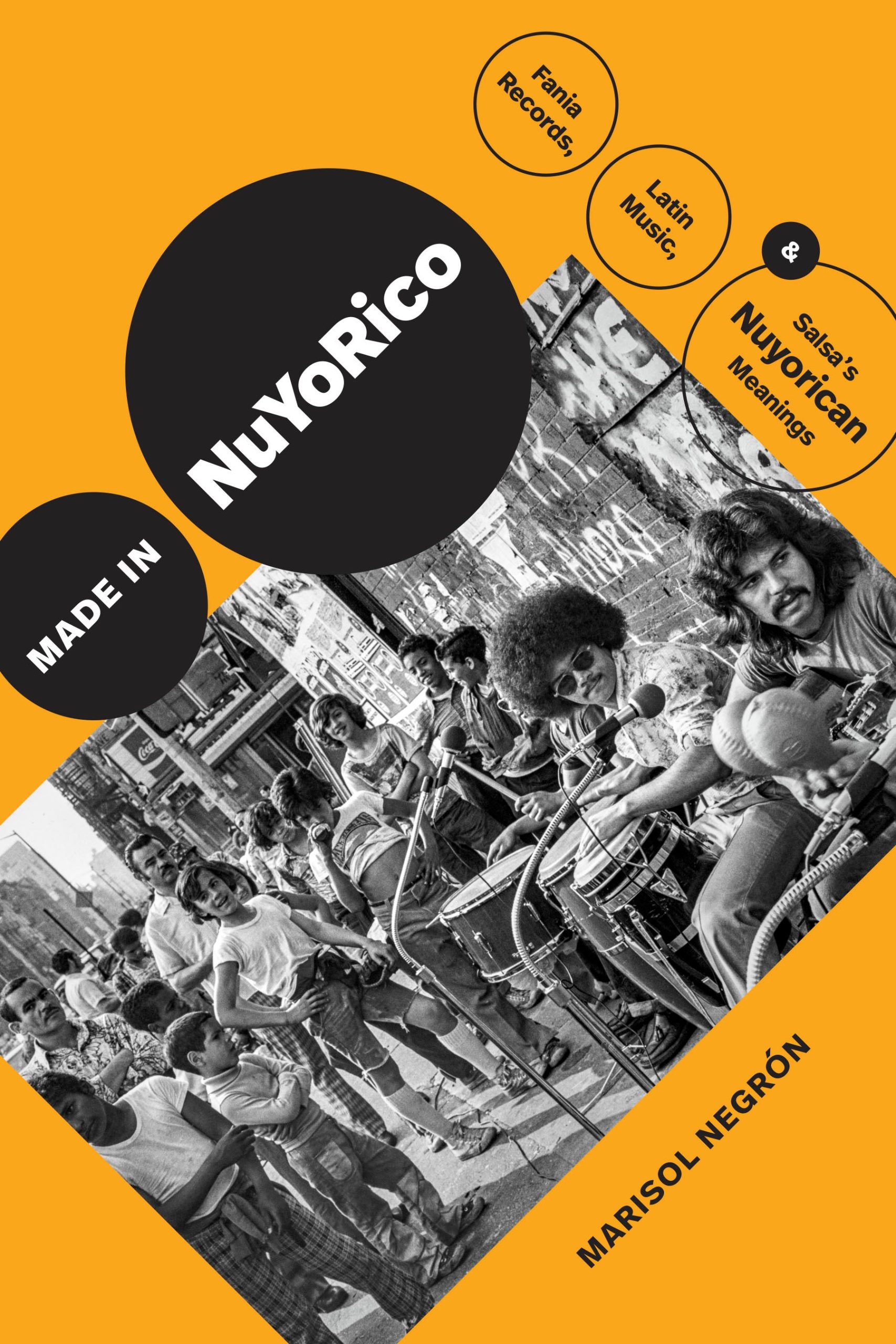
Made in NuYoRico: Fania Records, Latin Music, and Salsa’s Nuyorican Meanings
Advertisement
Si te quieres divertir
con encanto y con primor (pero ¿qué es esto?)
Solo tienes que vivir (¿y este frío?)
Un verano en Nueva York (Un ratito na‘ má’)
[If you wanna have fun
With charm and delight (But what’s this?)
You just have to live (And this cold?)
A summer in New York (Just for a bit)]
—Bad Bunny, “NUEVAYol” DeBÍ TiRAR MáS FOToS (2025)
Let me begin at the end—with what I have valued most in this book: its potential to ignite a conversation about salsa, not merely as a musical and discursive genre but as both a commodity and a site of poetic singularity. From the outset, it is just as significant to affirm: Without the experience and community of the Puerto Rican diaspora in New York, the very qualities that render salsa intelligible, possible, and arrestingly beautiful would remain unrecognizable. In the second half of the book, Negrón undertakes a thorough examination of the legal disputes and lawsuits that shaped Fania Records, the most consequential orchestra and enterprise in the emergence of salsa. Her “cultural history” of Fania, traced “through the streets of ‘Latin’ New York,” presents the basic context in which salsa constructed its “Nuyorican meanings” and how these circulated among New York, Puerto Rico, Latin America, and broader international contexts. Chapter 4 focuses on former Governor Rafael Hernández Colón’s use of salsa’s cosmopolitan appeal in the Puerto Rico pavilion at the 1992 Universal Expo in Seville, showing how the slogan “Puerto Rico es salsa” mobilized a “Nuyorican imaginary” to project national exceptionalism from a colonial position that remains unspoken for the governor himself, along with economic ambition—while ultimately, as she argues, reinforcing transatlantic structures of whiteness and inequality.
The final chapters examine Rubén Blades’s and Héctor Lavoe’s divergent modes of authorship, focusing on “El Cantante”—written by Blades, first recorded by Lavoe, and later performed by Blades himself. Negrón shows how the song’s portrayal of the singer’s private suffering and the mask of performative joy crystallized Lavoe’s tragic persona, becoming a lens through which to consider diaspora, fame, and loss. The thoroughness of this section leaves little room to doubt how the record industry—and particularly the owners and principal administrators of Fania—carefully orchestrated, or rather, offloaded onto their musicians and composers a systematic theft and expropriation of value and capital, made possible through their marketing strategies and identity-driven rhetoric.
Marisol Negrón presents Made in NuYoRico: Fania Records, Latin Music, and Salsa’s Nuyorican Meanings as a reconstruction (or Rican/Struction, to use Ray Barretto’s metaphor) of salsa’s 50-year cultural history, anchored in the 1964 founding of Fania Records. Negrón examines album covers, liner notes, magazines, newspapers, press releases, and legal documents “to examine salsa’s significance across a variety of musical and nonmusical contexts.” Crucially, she conducted numerous interviews and incorporates sources now accessible online, such as interviews and profiles published across various media, including the now-defunct Descarga Journal, digital programs like El show de Rubén Blades, and videos produced by Salserísimo Perú. This book is the most comprehensive updating of the institutional, governmental, media, commercial, and legal materials that shaped the context in which the Fania All Stars enterprise emerged.
Through those interviews, archival contents, close readings of song lyrics, and media artifacts—offering musically insightful commentary on arrangements and performances—she argues that salsa’s Nuyorican aesthetics disrupted “normative mobilizations of Americanness and Puerto Ricanness,” forged alternative public spaces for working-class Puerto Ricans, and became entangled in commercial, legal, racial, gendered, and political currents. Negrón maintains that Fania mobilized a “Nuyorican imaginary” to captivate a global audience, asserting salsa’s pivotal place in articulating Nuyorican identity and subjectivity.
The book unfolds in two parts. Part I, “Anatomy of a Salsa Boom (1964–1979),” begins with “Our Latin Thing: Salsa’s Nuyorican Histories,” locating salsa’s emergence in New York’s Puerto Rican neighborhoods and Fania Records’s role in shaping a Nuyorican imaginary through a reading of the legendary musical documentary Our Latin Thing (Nuestra Cosa) (1972). “Los Malotes de la Salsa: Salsa Dons and the Performance of Subjecthood,” examines how male musicians Willie Colón and Héctor Lavoe “drew on popular representations of virile masculinity on the periphery of the US economy to perform subjecthood,” and “Salsa’s Dirty Secret: Liberated Women, Hairy Hippies, and the End of the World” explores how “women become the boundary that separates abjection and subjecthood,” among other topics. Part II, “After the Boom Is Gone (1980–2000s),” turns outward: “Puerto Rico’s (Un)Freedom: The Soundscape of Nation Branding” analyzes salsa’s use by the colonial government in Puerto Rico’s 1992 Seville Expo campaign; “Entre la Letra y la Nota: Becoming ‘El Cantante de los Cantantes’” traces the history and relationship of the song “El Cantante,” from Lavoe to Blades; and “(Copy)Rights and Wrongs: ‘El Cantante’ and the Legislation of Creative Labor” examines legal disputes over authorship, labor, and cultural capital.
These paragraphs lay bare Negrón’s hermeneutic and political drive: to reveal the forces shaping salsa while grounding it in the struggles and desires of the Puerto Rican diaspora:
Made in NuYoRico shows not only how salsa reclaimed the public sphere in New York from which Puerto Ricans were repeatedly expelled literally (through urban renewal) and symbolically but how the music’s Nuyorican imaginary became the site for the performance of musical, cultural, political, legal, and economic authority.
Made in NuYoRico illuminates how Nuyorican subjectivities embedded within salsa impacted the music’s trajectory in both New York and Puerto Rico, sounding a colonial contestation that produced alternative meanings of Puerto Ricanness in each space.
For anyone who believes (because for the majority it is a matter of believing) that a musical genre—or even a discursive or literary one—is some kind of realist device designed to enable the tracing, identification, subscription, or reinscription (moral fall) of a class, gender, racial, or identitarian subjectivity, this book is required reading (although nowhere does it explore the paradoxical and uncertain condition of all subjectivity—a subject is subjected, is the product of an interpellation, and enacts an identification).
But who are these readers? Do these studies reach beyond the perimeter and professional lexicon of scholars and academics ensconced in the discursive silos of their area studies and curated “archives”? This book reflects more on the institutional “frameworks” and practices that Puerto Rican migration in New York endured or sparked—even examining the very institutions that claim to read or regulate Puerto Rican culture in the US and Puerto Rico—than on the poetry, discourse, and musicality that converged in salsa and moved through that imaginal space. Today, as the US government openly attacks immigrants, minorities, and especially universities, we can no longer ignore the decades-long entanglement and institutional acquiescence of area studies, identity-centered disciplines, and cultural studies in confronting—or failing to confront—this ongoing devastation.
This book exemplifies the conflation of politics with identity, and identity analysis with the moralizing stance adopted by “leftist, radical, liberal or woke” intellectuals and politicians, marked by self-absorbed totalizations. This conflation is a gesture defeated and hounded by today’s relentless corporatization of experience—which it has also embraced and perpetuated—and exhausted by the policing and management of a glossary of wounds and damages that many disciplines exploit for institutional power, publicity, and visibility. What is at stake is not merely the recognition or “making visible” of these racializations, abuses, gendered violence, and above all the extraction of value from everything, but the possibility to disarticulate and desist from the naturalized modes of intervention these regimes of meaning impose—and to open ourselves toward other practices and ways of existence, beyond the surveillance of inter- and multidisciplinary confines. This is another way of doing politics, not merely the acquisition of institutional power. The enemies of democracy have already seen the stitches holding this together and attack through them with their own templates.


In the spirit of listening closely to the radical difference of anyone at all, rather than performing a ready-made identification, it is important to interrogate the moral soundscape of this critical discourse. At times, it is astonishing: so much effort to “discover” that a sonero, sonera, or musician raised in a machista, homophobic, and racist culture and family inevitably ends up inhabiting such a subjectivity or subscribing to its poetics. Really? Made in NuYorico unfolds in a woven lingo of critique—“mapping,” “performance abjection and a hypermasculinity amid homosociality,” “reify[ing] the coloniality of power,” “decolonial praxis,” “normative belonging,” “heteropatriarchal recuperations of the dance floor,” etc.—a litany of charged phrases that echo more like a liturgy of certainties than an invitation to think otherwise.
This discourse neither can nor wants to see itself reflected in its own concepts (reify, overdetermination, commodity, synecdoche, archive[Derrida]), which too often function as mere adjectives or labels rather than as open‑ended zones of reflection fraught with uncertainty and paradox. Even the scant, unexamined appearance of notions drawn from psychoanalysis could be understood as the affirmative work of every negation, as Freud reminds us: to deny that something is being done (that this is not a history of salsa, not an origin story for lo salsero) is precisely a way of unconsciously affirming it. The “archive” here is a wall of authorities and notions that never face questions, nor receive challenges or critical interrogation from Negrón.
Her reading of the operatic song “Bandolera” in Héctor Lavoe’s voice is both compelling and bold, as she dares to confront what many critics have avoided: the raw gender violence embedded in much salsa music. However, her reading of “Qué lío” rests on a misunderstanding and overwrites what is clearly the sonero’s inhabiting of Puntilla’s voice to narrate the trouble his friend (pana) encountered in his relationship with Mariana. Negrón believes it is “presumably” an act of mockery and distancing from Puntilla’s feminine becoming. Her comments on Colón and Lavoe’s album Asalto Navideño (1970, 1973) highlight the temporal and rhythmic multiplicity that made this album essential in Puerto Rican homes regardless of their location.
It seems that in this book, every process of meaning-making is always determined by the subject’s location and/or its moral or heteronormative proclivities. There is also no consideration of the image as a form of work with language, or as shaped by its materiality or medium beyond naturalistic or social representation, or as a practice of shaping and exploring language, or as something shaped by its materiality and medium—beyond veristic or simple social representation. What materials constitute an image, and how does it come to touch us? Are all images simply spaces containing information that invariably denote or describe? Here, the image always functions as a plausible, sociologizing description, and its historicity is only perceptible or visible when filtered through anthropological, legal, realist, and informational interpretive protocols. The “Nuyorican meanings” consistently appear as institutional responses or counter-responses (press, state, law), and thus this study perpetuates the tradition of denying the written, poetic, and historical dimensions of the composers largely ignored by dominant salsa scholarship.
Is identity—any identity—the quintessential theme of salsa? What themes or recurring images define salsa’s generic and discursive practices?
The book acknowledges the Afro-Caribbean and Puerto Rican musical richness that shapes salsa and notes how “the persistence of desire in the cultural politics of pleasure is particularly salient for poor and working-class communities.” But it does not address how these connect to the paradoxical poetics of jouissance, goce—the immediacy and intimacy at the heart of Caribbean musicality, sustaining its sabor and lo sabroso. The genre’s undisputed poet—without whose songbook salsa’s edifice would collapse—Catalino “Tite” Curet Alonso, is reduced here to a mere “celebrated songwriter.” Although Roland Barthes and Michel Foucault have examined authorship and meaning, Negrón instead turns to Kant and Hegel to analyze the copyright disputes and claims of authorship among Rubén Blades, Héctor Lavoe, and Fania over Lavoe’s signature song, “El Cantante.” Blades’s own “legal strategy” is even complicit in relegating “LaVoe to the status of legal nonsubject.”
This book exemplifies the institutional dynamics of the so-called “turns” and area studies in university discourse—transcultural, affective, decolonial, identity, racial, ontological, hybridity, archipelagic, Latinx, and cultural studies, among others. They currently serve as academic merchandise, merch: seasonal labels that promise novelty yet instrumentalize what is thinkable within coordinates set by the corporate university—peer reviews, conferences, publishers, and tenure-track processes. This discursive formation imprints their “products” with striking predictability and foreseeable “findings.” Their circulation responds less to existential stakes or openness to the unthought than to the mantras of visibility, belonging, and market-driven consumption within academic knowledge and networks. Each “turn” or area study becomes a brand, slogan, and symbolic capital that “updates” discourses without disrupting its own certainties, seeking validation from authorities who standardize the field by making it visible. What is proclaimed as a challenge to the “normative” often proves a calibrated reiteration designed to be cited, funded, and applied. It oils the gears of the institutional machinery.
This neither denies the depth of specific research nor assumes these fields are monolithic. Yet it is unsurprising that such studies end up addressing the very power they claim to interrogate—already shaped and interpellated by that power—and tailor their lexicon to institutional legitimacy protocols. Under many disciplinary emphases, the doxa of these turns dissolves the dissonant force of what they read, subordinating it to categories ensuring academic intelligibility and circulation.
Of course, everything hinges on framing—a hegemonic act that stuffs and disciplines emptiness, complexity, death, nada. Any object or subject thus framed becomes part of a ventriloquism act: Experiences, historicity, and subjectivities are narrated—or replaced outright—by the prerequisites of disciplinarity, then staged before archives and institutional gatekeepers of “relevance” and “visibility.” Interdisciplinarity, even when posed as openness or renewal of academic knowledge, acts as a framing device: it orders knowledge within preestablished coordinates that translate the unspoken, the unsettling, into the sayable, the palatable, according to languages legitimized by the disciplines endorsing it. Its critical capacity is limited because it presupposes prior agreements about what counts as problem, method, or evidence, closing off what still lacks name or obstructs function. These approaches conform to—or openly seek to control—institutions dedicated to shaping feelings, desires, and moral sensibilities through discursive, social, cultural, and political practices. They “illustrate” (train) to align with prevailing institutional norms, ideologies, and power structures, while also navigating (or “negotiating”) the potential to disrupt those alignments. Ultimately, all these efforts end up as rubrics, templates, syllabi, CVs, and PowerPoint presentations: pedagogical pulp, the stuff of syllabi.
“Me voy, me voy, me fui: I am outta here”
Negrón’s refusal—or rather reluctance—to engage with the poetic fantasy of Lavoe in “Paraíso de dulzura” reveals a mode of reading that openly turns its back on the text itself, a tendency long present in hegemonic critical salsa scholarship:
Plena’s use of improvisation, its narratives of everyday life, and its identification with LaVoe’s hometown of Ponce likely encourage him to credit the music with “la sabrosura rica y sandunguera” of Puerto Rico. While LaVoe immediately answers the question about where he is coming from, what remains unasked and unanswered is “¿Adónde estoy?”—“Where am I?”
That unasked, unanswered question belongs to Negrón, not Lavoe—a question about a song that doesn’t exist, or one she wishes she had heard. “Paraíso de dulzura” is not about identity (not centered on fixed modes of being [ser], the “idem”), but about journeying, being in motion, immersed in the flow or shifting imaginal terrain of sabor, here flowing from a halcyon Puerto Rico. It is the song of a poetic subject or sonero in transit, in constant offering:
¿Qué de adónde vengo?
¿Qué pa dónde voy?
¿Qué de adónde vengo?
¿Qué pa dónde voy?
Vengo de la tierra de la dulzura.
¿Qué pa dónde voy?
Voy a repartir ricura.
La sabrosura rica y sandunguera que Puerto Rico puede dar, Lolelolai, Lolelolai, lolelola.
Where do I come from?
Where am I going?
Where do I come from?
Where am I going?
I come from the land of sweetness.
Where am I going? I’m going to spread richness.
The rich and lively sabrosura that Puerto Rico can give, Lolelolai, Lolelolai, lolelola.
—Héctor Lavoe, “Paraíso de la dulzura”

For Negrón, the “here” of a salsera, poetic, or even visual utterance is always something that can be pinpointed on a map, and this location is pure self-determination: the site of any alternative or non-normative way of being Puerto Rican. Is identity—any identity—the quintessential theme of salsa? What themes or recurring images define salsa’s generic and discursive practices? Could someone please verify the list of the best-selling or most listened-to salsa songs during Fania’s heyday? The true theme of salsa is salsa itself: sabor as condition, lo sabroso as experience (ex-periri), an inescapable work with the negative, a journey through danger and the ignition of misfortune—a calamity endured by a subject and a community that is, and will always be, a multiplicity. When will we finally listen to a song for what it is, rather than for what it should have been? 
This article was commissioned by Gustavus Stadler and Gayle Wald.