Advertisement

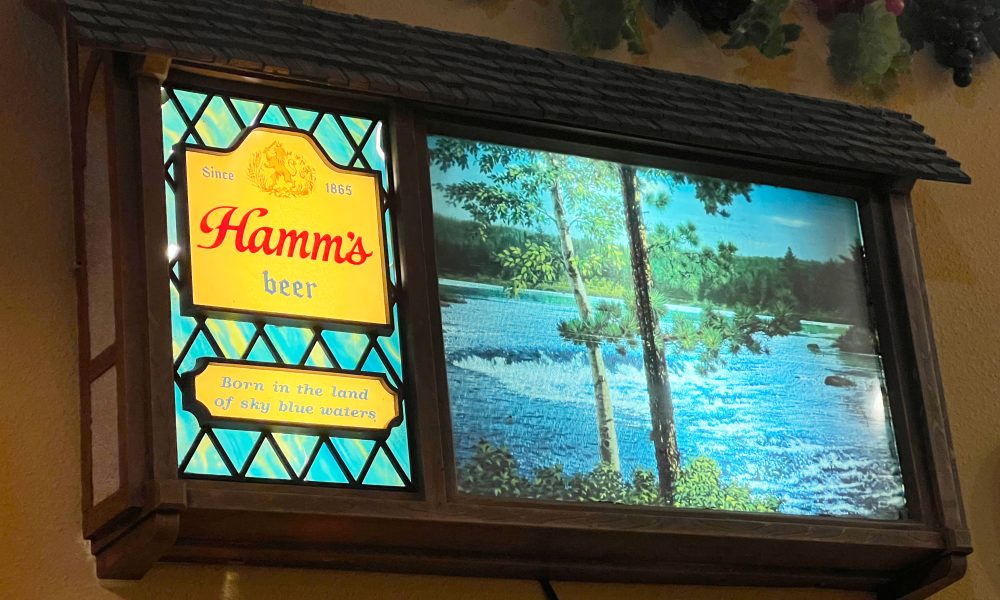
On the backlit sign, words glow in blue italics: “Born in the land of sky blue waters.” They appear on a Hamm’s Brewing Company “Scene-O-Rama” light box, made in Minneapolis in the 1960s. Next to the ad copy, a scene continuously scrolls: tall pines surround a lake and waterfall, a tent stands close by a campfire, and a red canoe floats on a stream. A halo of light emanates from the box, making the smoke rise and the water run and glimmer. In its modest way, the light reminds me of the iridescence in a Fra Angelico angel, and both disappoint in reproduction. The sign promises temporary peace: an escape into nature, to fishing and camping. It’s Francis Bacon’s “purest of human pleasures,” in his essay “Of Gardens”: a return to Eden in the shape of a light box.
Hamm’s sign might light up an older locals’ bar in any midsize town; but here in Southern California, at the border of Arcadia and El Monte, it shines on the wall of an aging pizzeria. Like many ads, it tries to conflate two incommensurable things, in this instance, beer and pristine nature. In the ’80s, Wrigley’s sold chewing gum using identical twins and a touch of sex in their Doublemint ads. Heublein attempted to make its mustard a status symbol with Bach and a Rolls-Royce (“It even has wine!”). Advertising shifts with the public mood, but the end is always the same—to associate a product with something desirable: status, pleasure, sex, or even virtue. If its inclusion in Collectors Weekly means anything, the “Scene-O-Rama” is a coveted item, if not of art, then of the novelties some call “collectibles.”
Despite its commercial intent, Hamm’s light box and its ad campaign still invite the imagination, even more so now—in their obsolescence—than when they were new. Our culture surrounds us with empty, noisy artifacts like “pop-ups” and billboards. It gives us “content creators” who try to deflate their embarrassment when mentioning sponsors with irony or wide-eyed sincerity. But the Hamm’s sign, and advertisements like it, remind us of another time. Our associations with them have become richer because the ads are more distant from us. Time makes us imagine more, even as we forget the history we’re trying to invoke. It’s easy to project our fantasies onto a past that we can’t quite remember. The ad is seductive but transparent. We don’t believe the copy but appreciate its innocence.
The original “Born in the land of sky blue waters” ads appeared in the early ’50s as black-and-white television commercials. They mix live-action images of the Great American North with a cartoon bear dancing a tattoo on a log. One commercial opens on a stream running toward a full moon in the middle of the frame while a voice intones, “This is the land of sky blue waters, the land of cool enchantment.” This “cool enchantment” is much like other midcentury fantasies: Disneyland’s “Enchanted Tiki Room,” Martin Denny’s album The Enchanted Sea, or the ’50s travel film about touring South Africa titled Byways of Enchantment. They promise liberation, untamed nature, “exotic” locales: any place other than where you are, in spirit if not in miles.
In another commercial, the director superimposes a glass of foaming beer over the moon, illuminating it like a vision of the grail. The voice-over tells us Hamm’s is “the beer that captures for you the wonderful refreshment of this enchanted Northland,” which, coupled with the grail-like image, shades into Germanic fairy tales and magic. A noirish shot, which looks like B-roll from The Lady from Shanghai, shows a couple drinking Hamm’s by moonlight, enveloped by trees overlooking a brook. It underlines their “enchanted evening.” They are smiling and toasting each other. They’ve just arrived in their perfect world—a place untroubled by modern life.
“Born in the land of sky blue waters,” in any of its media, is not a significant aesthetic experience in the strictest sense. It’s kitsch. It’s what Milan Kundera describes in his novel The Unbearable Lightness of Being as the portrayal of a world without shit: uprooted from complexity, from unsentimental feeling. The images are inviting, beatific. They inhabit the cultural space of Thomas Kinkade, or the bronze sculptures of children caught mid-frolic meant to artify malls across the US. Like them, the ads offer a bathetic glance at a life without liquor stores, office parks, and the other visual flotsam in our cities, while relying on them to give it value. The ads work because they’re so far from our lives.
Though kitsch, the Hamm’s sign is a pleasant contrast to the rest of the pizzeria. It’s more vibrant than the few yellowing prints on its walls, the pleather seats, and the gingham on the tables. If you look out the window to the strip mall parking lot, only a few sodium lamps and some asphalt wait. It’s like every other lot zoned for commerce in the West. You could be in Tempe or San Jose and see the same tepid light, hear the same cars passing.
From a psychological point of view, “Born in the land of sky blue waters” shows how little the imagination needs. Though the natural scenes are attractive, it’s hardly Titian. And though Coleridge may wake up with verses about “caverns measureless to man” and a “sunless sea,” most of us dream of missing an exam or our clothing.
Even something as humble as a light box can make us dream. We surround ourselves with trivial and artless things, but we still have our fantasies about them, even if this is not a serious aesthetic experience. Much of our psyche consists of images and what they connote. Our empathy with something so simple as an ad can give us the semblance of meaning in a world of disconnected objects. We can view the Hamm’s sign as a visual distraction—an ad to ignore—or we can connect with the images and imagine ourselves sitting by its fire and watching the lake flash its “dragon scales,” as in Amy Lowell’s “Wind and Silver.” We find meaning in our associations. It is an activity more than a property in things.
The light box is part symbol. Its incandescent water resembles the fluid in a glow stick more than it does the Great Lakes. It suggests the bare idea of a stream and allows us to imagine it, even if we only see a cartoon resemblance. The canoe and “laughing” waters evoke enough of Longfellow’s Song of Hiawatha to make us think of Minnehaha. Or they might remind us of Disney’s cartoon Little Hiawatha from the 1930s—a better match to Hamm’s commercial with its animated dancing bear. The canoe could make us think of E. B. White’s essay “Once More to the Lake” or our own tripping outdoors. These associations are personal and innumerable. But the designer intended us to supply our own images—to share with it something of our own life.
The more troubling issue is that successful advertising makes it difficult to separate a once-untainted image—the wilderness in Hamm’s ad—from the product it’s trying to sell.
The light box is not the pizzeria’s only attempt at “magic” (in R. G. Collingwood’s sense of “art” with a preconceived end). Like most commercial design, it attempts to create a space for the imagination, if only to appeal to customers.
We think of decoration as primarily a matter of form and color, but it succeeds only when it conjures a picture within us. The gingham tablecloth implies comfort and familiarity; we’re to imagine we’re in an “authentic” osteria. Though only a sheet of checkered polyester, it connotes modesty and economy. The only details missing to summon Italy in the demotic American imagination are candles stuck in Chianti bottles and the reedy hum of accordion music. Dry, colorless prints of Roman tourist attractions are tacked to the walls. The owner of the pizzeria doesn’t expect us to admire the photographs’ compositions but to fantasize about the places within them—to see ourselves wandering around the Flavian Amphitheater or St. Peter’s. We can inhabit its picture of the Colosseum, either as a historical fantasy or as a tourist: We could watch a gladiator—in galea and manica—slaughter some poor, bewildered leopards, or imagine ourselves sitting on the cold stones of the imperial box.
Some of these objects fail the imagination because they are clichés: dead metonymies. From overuse, a gingham tablecloth says little except “cheap” and “artificial.” Much like dead figurative language, some objects signify but don’t evoke a corresponding image. When we say “A bird in the hand is worth two in the bush,” for example, we get its meaning without its sense. Most of us don’t see birds or bushes or hands, but a vacant space where a picture should be. Objects that once would connote suffer the same fate as their counterparts in spoken language: they wither into abstract meaning.
The Hamm’s light box speaks to the imagination in part because of its age. It suggests another era, when “enchantment” was a viable advertising concept. Age adds the clarity of distance in objects meant to provoke the imagination. It frames them as distinct from what surrounds them while creating another layer of associations. The Hamm’s sign shows us the “Googie” era, with its novel lighting and “technological” motion. It says “stereophonic sound” and the space race. The irony of its “space age” technology is that the ad appropriates a veneer of medieval craftsmanship. It has a trompe l’oeil casement window with a field of blue diamonds and “Hamm’s” printed in red italics on a white badge. The case is plastic but molded to look like a cottage with a shingle roof.
It’s a cluttered temporal image. We see a renewed Eden with running waters and Native American motifs in the revolving part of the box, framed by a cottage-like exterior that suggests European fairy tales. This pastoralism contrasts with our modern sensibility, which sees it as a product of the ’60s. It’s too naive for a recent ad. The sign gives us three historical fantasies. In its time, it gave us two. Now, it’s doing what the novelist Douglas Coupland once called “decade blending.”

To its era, the box seemed “woodsy,” American. Its medieval cottage in the middle of Ojibwe territory paired rustic coziness with wild, untamed nature and stylized natives with their “exotic” canoes and tipis. The ads show us a typical romance of the time.
One commercial from the Hamm’s campaign shows a caricatured, squat cartoon Indian performing a rain dance and Looney Tunes–style antics with Hamm’s mascot bear. The Indian conjures rain over the bear by pointing maracas at a cloud. Later in the sequence, the bear tries to outwit him with an umbrella, but the magic rain falls from its canopy. In the interlaced live-action shots, we see a stream crashing over rocks and splitting into rivulets. An apparition of a pilsner glass levitates behind a waterfall. The imagery reinforces the pastoral idea and that of “refreshing” beer. The company aims for a conditioned response in the audience: Hamm’s is nature, adventure, relief.
In another, animated bears march in full band regalia through the woods. Their leader spins a baton, and the troupe plays music full of whimsical signifiers—slide whistles, clown horns—that mimic or “Mickey Mouse” the scene’s action. The cartoons and the live-action sequences share the light box’s surreal quality, with its revolving picture and glowing water. Their superimpositions and “magic” create a coherent aesthetic for the campaign and make the transitions between animation and live-action seamless.
This advertising works in synchrony. We get not only the light box or the single commercial but a “campaign” with a set of motifs. Advertising is pop culture’s Gesamtkunstwerk: The Hamm’s campaign is a mini-Wagnerian opera for canned beer. It includes jingles, live-action sequences, animations, and print. If we engage with the ads, we experience them as a gestalt rather than a series of independent images. They present us with a complex but coherent fantasy.
Though the light box is not art, it has its attractions. Its medievalism extends well beyond its plastic imitation of stained glass. The designer mimics the sensibility of medieval artists who made their romances and religious paintings glitter. Medieval pictures, with their jewels, “ruddy gold,” iridescences, and holy radiances, are alluring, even considering their inherent unreality, or perhaps because of it. In a romance like Wolfram von Eschenbach’s Parzival, we read about the knight Gahmuret’s “dazzling” armor: “With what was his shield embellished, you ask? A priceless boss of gold of Araby had been riveted onto it. … It shone with a reddish luster so that you could see your own face in it. … His tabard … shone like a live fire burning in the night. There was no spot of faded colour. Its dazzling light did not elude one’s gaze—a weak eye could have cut itself upon it!”1 The Hamm’s light box, in its cottage frame, with artificial stained glass and imitation wood, jewel tones, and halo of light, satisfies the taste of the age it signifies. It has the same luster: It is a “fire burning in the night.” If Aquinas, meditating in his cell in the 13th century, had a vision of its glowing streams, he would have thought it a wonder of “claritas,” of light and vivid color. It is our habituation to electricity and our cynicism about advertising and mass production that make it unremarkable.
The box displays a simple aesthetic calculated to make an immediate impression. “The medievals took pleasure in anything luminous, colored, or brilliant,” writes Umberto Eco in The Aesthetics of Thomas Aquinas, “and their love of color was characterized by immediacy and simplicity. We have only to think of medieval illuminations to see that the artists always employed elementary colors, simple juxtapositions, straightforward color patterns in which sfumatura is unknown.”2
This immediacy is also a mark of good advertising. The light box has seconds to attract notice before our attention scatters among the restaurant’s checkered cloth and candles. While its first aim is to draw our eye, we also need time to appreciate its images. A complete revolution of the scene takes about five minutes, from the smoke drifting above a cooking pot to a cascade just beyond two trees. The slow movement lends it a sense of tranquility. It’s a meditation that places you within the scene, observing the landscape from a privileged height. The manufacturer designed it to be pleasing, even if it is only a humble sign.
Like all advertising, the light box suffers from its limitations. Its associations are mismatched, if not incoherent. If the product carried the images the ad was trying to convey, the ad would be redundant. The products are often incompatible, if not opposed to what the advertisers are trying to summon from the air. Although some may experience nature as a beery escape to fishing, most of us have no easy connection between the Great American North and drinking. The more troubling issue is that successful advertising makes it difficult to separate a once-untainted image—the wilderness in Hamm’s ad—from the product it’s trying to sell.
Advertising is a kind of imaginal pollution, creating noxious associations with an otherwise pleasant object. In Hamm’s case, “nature” is impossible to compromise because its meanings are too comprehensive. Nature is everything. A sea of images dilutes the associations.
This imaginal pollution helps explain the once-common stigma of “selling out”—the compromises artists make when attaching their work or “image” to advertising. Commerce blurs the art, makes it indistinct. It reduces a song like Nick Drake’s “Pink Moon” to a Cabrio jingle; it no longer sounds like wild phlox and the awakening spring but like driving at night. It makes Orson Welles’s Falstaff a shill for Paul Masson wine.
In a culture that inundates us with pictures that compete for our attention, we should appreciate something as harmless as a light box showing luminous waters and a red canoe. Not everything is so innocuous.
We don’t forget the ad’s commercial interest in us when we try to view it aesthetically, so we can’t consider the light box art in even a limited sense. Our inability to see advertising as aesthetic is a failure of the imagination, but an inescapable one, given the medium. An ad only “works” when we can’t separate the product from the fantasy. We can try to hold what the ad is selling at a distance in our imaginations, but this deadens our aesthetic interest in the ad through a kind of split consciousness. It may, however, protect us from meaningless associations. Ads are non sequitur couples: nature and beer, mustard and status, gum and sex. What is metaphor and connotation in poetry is only proximity in advertising. It floods the imagination with trivial images.
Most of the things we surround ourselves with are mute. It is our memories and imaginations that give them voice and meaning. Meaning is elective. We choose the objects to invest with life as much as they choose us. We can either attend to images or ignore them. As kitsch, Hamm’s advertising doesn’t show us a vital experience of the world but a fleeting escape from it, and it distorts even this sense of escape because we see its insincerity. But advertising surrounds us—on screens, sidewalks, and receipts. It has only gotten more invasive since the era of our harmless light box. For most of us, this means not paying advertising any attention. Others treat it with detachment or irony. A few may try to dissociate the product from its images. Most of us don’t think of advertising at all. But given how much it now shapes us—how our brave new world is an “attention economy” whose only motivation is to captivate us long enough to sell something—we should.
In the clutter, we occasionally find something as promising as a “Scene-O-Rama.” It is advertising in its youthful kitsch and innocence. In a culture that inundates us with pictures that compete for our attention, we should appreciate something as harmless as a light box showing luminous waters and a red canoe. Not everything is so innocuous. However much it’s compromised by advertising’s incoherence and contradiction, I’m grateful for the small mercies of a simple picture.