
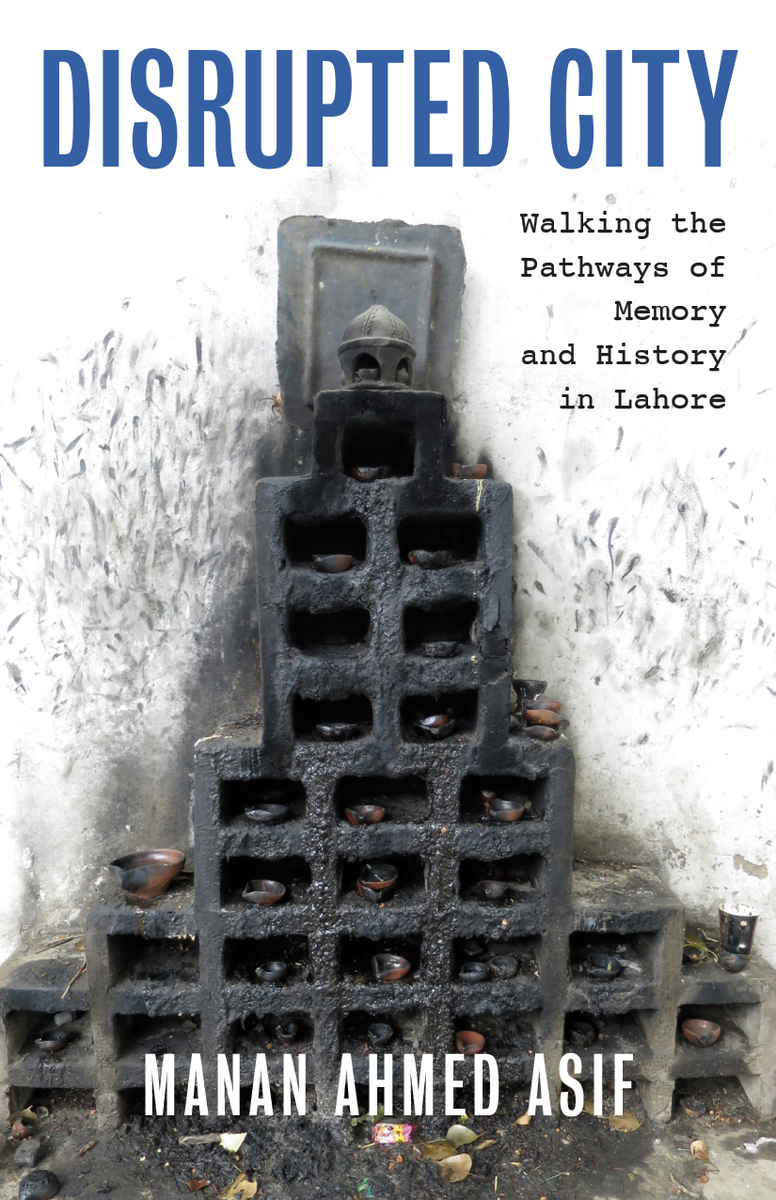
Being reviewed:
Advertisement
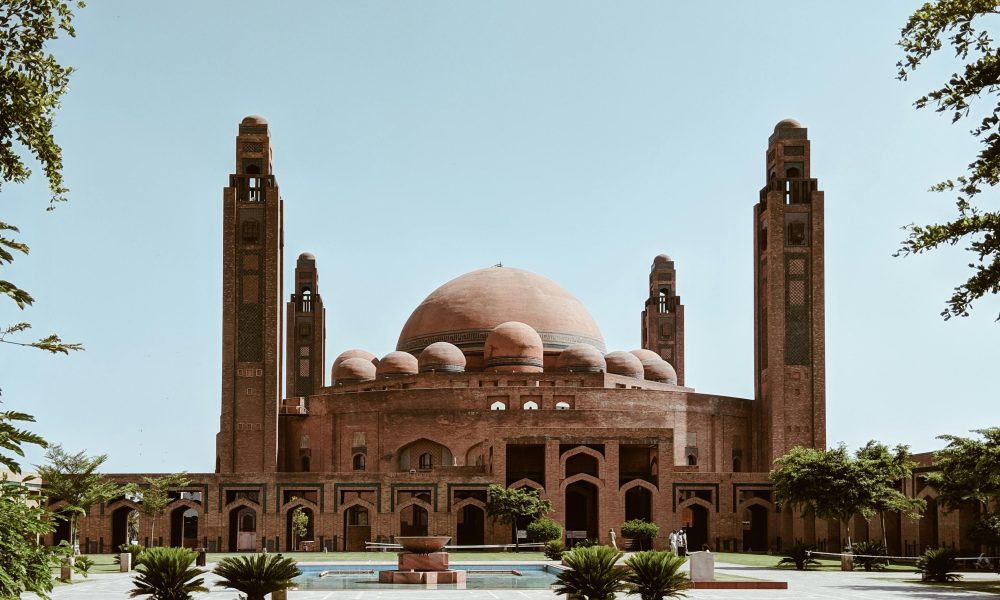
On a sunny Sunday morning in February 2018, I took a taxi from my guesthouse in the center of Lahore to the outer fringes of the Pakistani metropolis. My destination was the Grand Jamia Masjid in Bahria Town, a new gated community occupying thousands of acres on the city’s southwestern frontier. The mosque, designed by the eminent Pakistani architect Nayyar Ali Dada, provides this real estate development with an iconic centerpiece. Its immensity reflects the vaulting ambitions of its patron, the billionaire business magnate Malik Riaz. The complex has an indoor capacity of 25,000. Its outdoor corridors and courtyard can hold 45,000 more. The gigantic central dome is surrounded by 20 smaller domes, and the interior is elaborately decorated with Turkish carpets and 50 Persian chandeliers.
The mosque was opened to the public in 2014, but at the time of my visit four years later, the rest of Bahria Town still felt like a work in progress. Wide boulevards bordered by young palm trees were mostly empty of vehicles. Rows of completed houses were punctured by empty plots. In the Sector C market, a few open shops (mainly global coffee chains) were outnumbered by concrete building frames surrounded by bamboo scaffolding. But the Grand Jamia Masjid was busy with activity. Families in all their finery snapped photos in the courtyard. Security guards patiently checked handbags and directed worshipers entering the building. In addition to providing a picturesque venue for socializing and a vast space for prayer, the mosque attracted visitors to the exhibition in its Quranic Library, where rare handwritten transcripts were on display alongside models of the historic battlefields of Uhud and Badr.
The masjid’s central dome dominates the Bahria Town skyline, but it is not the only attraction on offer. It competes with a 260-foot-high replica Eiffel Tower only a few blocks away. Elsewhere in the development, there is a scale reproduction of Trafalgar Square, though Nelson has been displaced from the top of his column by a calligraphic sculpture. In the Ahram-e-Misr section, there are giant sphinx sculptures and a monumental Egyptian gateway. The Bahria Town master plan promises shopping malls, a spa, a cinema, a zoo, a theme park, a golf course, and more. The roads connecting this landscape of consumption and spectacle are decorated with elaborate sculptures and patrolled by security 24 hours a day.
Bahria Town has its own schools, shops, and other facilities, all accessed through heavily fortified gates. As Manan Ahmed Asif notes at the end of Disrupted City, the development is in Lahore but has no reason to look to Lahore. Far removed from the crowds and noise of the city’s central neighborhoods, it is quiet, well maintained, and framed, importantly, as a safe place to park capital. It is also, Asif suggests, a dramatic example of a dominant logic in Lahore’s recent history: its transformation from a city of gardens into a city of concrete and walls, a “series of segregations.”
Malik Riaz’s real estate empire is one of the largest in all of Asia. Bahria Town Lahore follows Bahria Town Rawalpindi, and there are other developments underway in Karachi and Nawabshah, both in Sindh. Since the 1990s, Riaz has used his wealth to gain influence with Pakistan’s military establishment, judiciary, and police as well as civilian politicians. He has been the subject of several corruption allegations, and in 2018 the Supreme Court affirmed there were “massive illegalities” in the land procurement processes for major housing projects in Sindh and Punjab. The Bahria Town Karachi project has been particularly controversial due to the forced eviction and destruction of existing villages on its 46,000-acre site, with police forces assisting the displacement by threatening, harassing, and arresting residents.
The architect Dada’s relationship with Bahria Town is, on the surface, a perplexing one. Dada has long been an advocate for a sensitive, humanist approach to the built environment in Pakistan. Alongside his involvement in many high-profile restoration projects, he has been a leading voice in wider conservation and heritage campaigns in Lahore. His origins are in the left-leaning Pakistani arts scene of the 1960s and 1970s. Dada’s most famous building is the Alhamra Art Center, which opened in 1980 and remains a major landmark on Lahore’s old colonial thoroughfare, the Mall Road. The Alhamra, whose form was inspired by the red-brick ramparts of the city’s 16th-century Mughal fort, was commissioned in the socialist era of Zulfikar Ali Bhutto (1971–77). Partial funds were allocated by the communist poet Faiz Ahmad Faiz, then serving as director of the National Council of the Arts.
Riaz, meanwhile, is a product of economic liberalization in Pakistan. Major shifts in the country’s economy and patronage networks took place in the 1980s under the military dictator Muhammad Zia-ul-Haq, the man who overthrew Bhutto in a coup in 1977. But it was not until the 1990s that the Pakistani government, under the civilian Prime Minister Nawaz Sharif, embarked aggressively on a program of privatization and deregulation. Riaz is associated with the emergence of the Navay Raje, or “New Lords,” during this period: figures from lower middle-class backgrounds, disconnected from older, established elites, who have accumulated huge amounts of wealth as entrepreneurs and business owners in Pakistan.
Riaz also commissioned Dada to design a mosque for his Bahria Town Karachi development. In contrast to the red brick of the Lahore masjid, this building, which is still under construction, will be faced with Sindhi stone and Balochi marble to, in Dada’s words, “make the mosque emerge in harmony with that terrain and with that locale.” When completed, it will be the third largest mosque in the world after Mecca’s Masjid-al-Haram and Medina’s Masjid-e-Nabawi, with capacity for 800,000 namazis (worshipers)—40,000 in the central prayer hall alone.
Dada’s architectural ambitions have been enlivened by the generous resources provided by Riaz. The Lahore mosque is framed by four 160-foot-high minarets. It is decorated with 4 million 2.5-inch handmade Multani tiles, carefully laid on the building façade by craftsmen. Pervaiz Vandal has praised Dada as a contemporary version of the great colonial-era architect Bhai Ram Singh (1858–1916), and this comparison is instructive. Vandal intended to compare two talented architects who were trained in Lahore (when many of their peers were trained elsewhere) and whose work incorporates local building traditions. Singh was responsible for some of Lahore’s great 19th-century civic landmarks, from the Lahore Museum to the General Post Office. But Singh’s buildings were also monuments to established power, in his case the British Raj. Bahria Town is only the latest in a series of entanglements among architecture, wealth, and authority in Lahore.
Lahore’s contemporary predicament is often explained as a product of its particular local histories, but here, on the front lines of climate change, in these glimpses of risk and rot, of retreat and refusal, the story of Lahore is also the story of our world.
Asif describes the emergence of elite colonies like Bahria Town—but also Paragon City, Lake City, Dream Gardens, and, in a different key, the vast, military-run Defence Housing Authority—to demonstrate how new economic wealth is changing the historic capital of Punjab. Much of this wealth is remittance capital, funneled to Lahore via the considerable Pakistani diaspora, of which many members are eager to invest in land. Dada might have grounded the Jamia Masjid in its environment with his use of Multani mitti (clay), but Riaz has been explicit that his inspiration for commissioning the structure was derived from his visits to new mosques in Malaysia and Abu Dhabi.
Remittances from migrants to the Gulf, in particular, have formed a crucial part of Pakistan’s economy since the 1970s. Connections with Saudi Arabia and the United Arab Emirates were cultivated under Bhutto, and the stream of Pakistani labor to Gulf countries accelerated in the 1980s under Zia. The impact of these flows on Lahore’s built environment stretches far beyond the emergence of elite colonies. In older residential areas, two-story homes became three- or four-story buildings, growing to accommodate expanding families. Owners frequently acknowledge their blessings with calligraphic decorations above doorways: Mashallah; Alhumdullilah; Allahu akbar.
The Gulf connection is part of Asif’s story too. His father, Sultan Ahmad Asif, migrated from Lahore to take a job in Doha, Qatar, in 1975. He spent 25 years working in the region as an electrical engineer, 15 of them away from his family. Asked by Asif to share memories of this period, Sultan Ahmad emphasized the physically grueling work and the lack of civic and political rights. He was particularly critical of the treatment of unskilled Pakistani laborers in the Gulf, describing it as a form of slavery. But the promise of considerably higher wages has sustained these migrations for decades. In 2024, a record 34.1 billion USD in remittances were sent to Pakistan, the majority from Gulf states.
Asif himself writes about Lahore as an emigrant. Though he was born in the city, he spent a period of his youth in Qatar and has lived in the US for most of his adult life. Asif’s account of Lahore in Disrupted City is, he writes, inflected by “the strange in-between-ness of immigrant and diasporic life.”
Asif’s Lahore is not, however, the luxurious fringe of Bahria Town. A scholar of medieval and early modern India, he is drawn instead to Lahore’s historic center. In the densely inhabited neighborhood of Anarkali, just south of the thousand-year-old Walled City, he found the inspiration for his book.
In early 2009, Asif was in Lahore, “browsing a long row of books displayed on the pavement of a busy thoroughfare.” He stumbled upon a photostat edition of a 19th-century text, Tahqiqat-e Chishti (Chishti’s Researches), an eclectic urban history compiled by Maulvi Nur Ahmad Chishti (1829–67).
Chishti was employed by the East India Company as a language teacher, training British officials in Urdu and Persian. In the 1860s, the company commissioned him to write this guide to a city they had recently conquered, having wrested control of Lahore from the Sikh empire in 1846. Chishti’s monumental work, unfinished at the time of his death in 1867, draws together chronicles of the city’s great leaders, genealogies of prominent families, oral histories and local legends, descriptions of streets and architectural forms, and a detailed mapping of Lahore’s sacred sites. It is, Asif writes, an “account of the city as an ecosystem of power and belief.”
Asif began retracing some of the walks described by Chishti: first, a journey from the Walled City’s Delhi Gate to the shrine of Madho Lal Hussain, some two hours by foot in the direction of the Mughal-era Shalimar Bagh. “I found the walk, but also the connection of the walk to a nineteenth-century text, exhilarating,” Asif recounts. Following Chishti’s steps, the historian identified a method for his own study. By walking the city, he might identify but also trouble some of the “disruptions” that have characterized Lahore’s recent history, opening himself up to surprise and chance encounter in an urban environment increasingly determined by security and segregation.
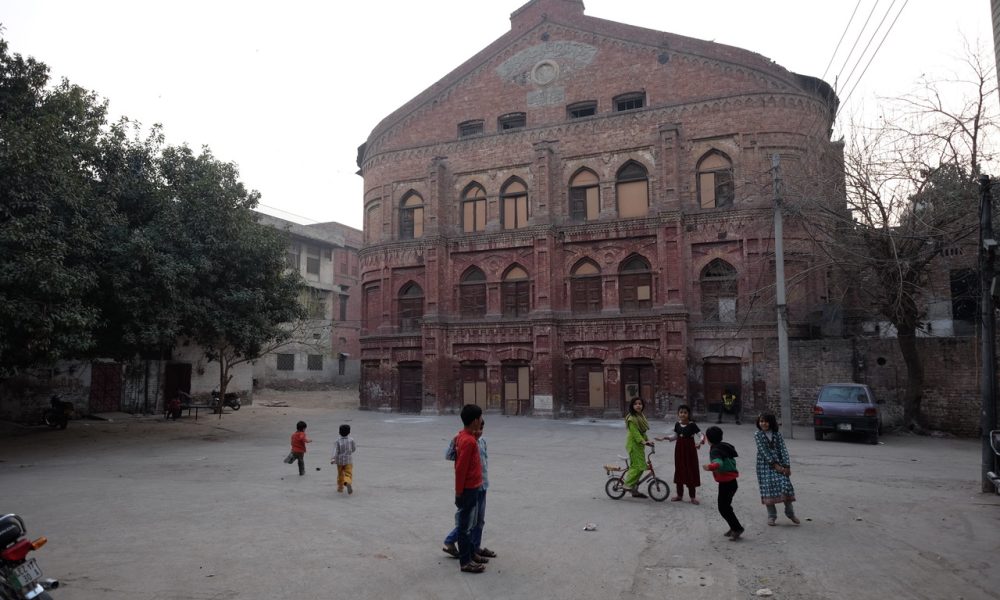
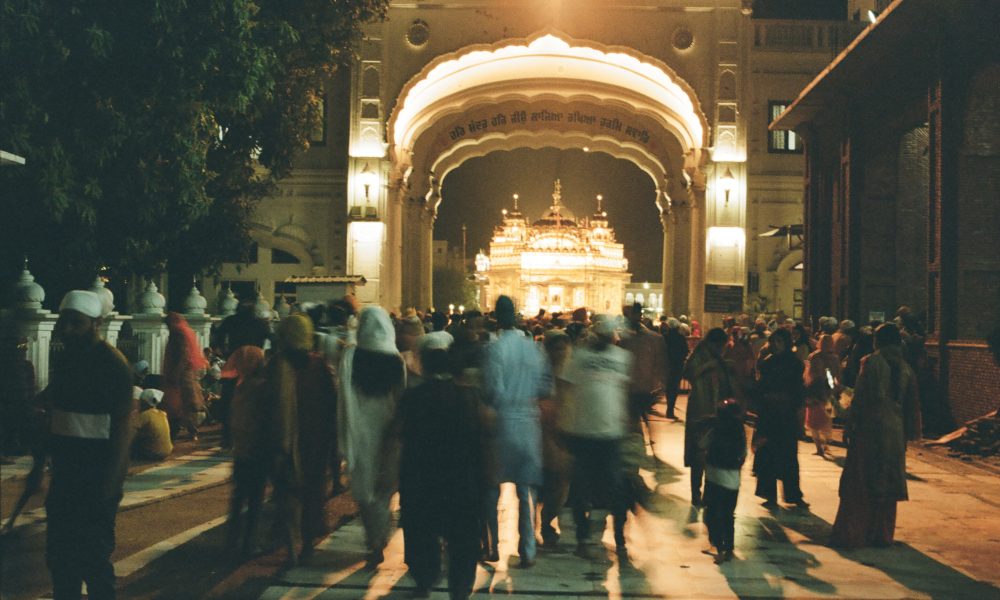
At the crossroads of several important trading routes, Lahore has been shaped by invasions, conquests, and power struggles, ruled at various points by the Hindu Shahis, the Ghaznavids, the Delhi Sultanate, and importantly the Mughals, who made the city a major imperial capital in the 16th century. But the signal “disruption” that Asif is concerned with in his book, and which he argues has been most consequential for the city, is that of 1947 and the partition of British India. Lahore became part of the new state of Pakistan and in this process lost around half of its population. The city’s sizeable Hindu and Sikh communities migrated to the new state of India, spurred by a wave of violence that swept across the subcontinent and crashed heavily on Lahore. The 25-mile path between Lahore and its historic sister city, Amritsar, was severed by an international border. Muslim refugees, arriving in great numbers from India, were moved swiftly from camps into properties abandoned by Hindus and Sikhs. Partition utterly transformed Lahore, not simply in terms of its population but also in the way the city’s multivalent histories would be understood in the present.
Disrupted City describes how, in the scramble to consolidate a new Pakistani “nation,” Lahore was partitioned from its past. Asif introduces the civil servants, historians, journalists, religious figures, and politicians who contributed to this partisan project. He tells us about the emergence of the “Muslim hero” and the demonization of the external/foreign as well as internal/blasphemous “other.” Traversing Lahore by foot, Asif explores the effect of partition on urban space, but also identifies its limit points and ambivalences: a monument to the 13th-century Turkic general Qutb-ud-Din Aibak (1150–1210) near Anarkali Bazaar; the grave of Islamist icon ‘Ilm Din Shaheed (1908–1929) in Miyani Sahib; the offices of the Urdu monthly Hikayat in Patiala Ground; a corner of Gol Bagh where a young Afghan refugee mends bicycle tires; a home in the Defence Housing Authority where a Christian woman works as a domestic servant.
Walking in contemporary Lahore is, for Asif, an illuminating but freighted activity. In a city that has for decades prioritized car and motorbike users in its urban planning, the people who walk are typically those who have no other choice. Walking has clear class and caste connotations: it is for waste pickers, laborers, or the unhoused. Asif describes the curiosity and suspicion attracted by his unhurried strolls: he was “followed, queried, asked to leave, outright ignored and occasionally worse.” Attitudes toward walking were not always this way. Accounts from the 19th and early 20th centuries evoke Lahore as a city of walkers, especially around the Walled City, then surrounded by a garden, and also along the colonial Mall Road, cluttered with teahouses and coffee shops. In recent decades, and in line with the city’s expansion, Lahore has become a city of motorways, overpasses, and underpasses. It was only in 2020 that the first metro rail line opened—a small but significant development in the public transport infrastructure for a city of some 14 million residents.
In Bahria Town, those who walk on the long boulevards are servants, maintenance workers, or guards. The palm trees provide little shade in a city increasingly subject to extreme heat spells. Outside of the small neighborhood parks and public squares, there are no benches. This frontier of the city is designed for cars, connected to central Lahore by a gigantic Ring Road. I arrived at the Grand Jamia Masjid, remember, via taxi. The families taking selfies in the courtyard would almost certainly have asked their drivers to wait around the corner, in the mosque’s crowded parking lot.
If Asif, following Chishti, could walk from the Walled City to Shalimar Bagh in two hours, it is a much taller task to walk from central Lahore to Bahria Town. Once past the 1980s and 1990s residential colonies clustered along Multan Road and beyond the busy transit hub of Thokar Niaz Baig, the path becomes more exposed, dusty, full of debris, and marked by pockets of construction. The artists Shahana Rajani, Zahra Malkani, and Abeera Kamran have written about the Bahria Town Karachi project in terms of “exhausted geographies.” These are places of extraction, of disappearing ecologies, of “ubiquitous borders proliferating [on] the landscape.” Bahria Town Lahore occupies an important place in the contemporary city’s ecosystem of power and belief—one that is increasingly shaped by speculation, securitization, and material (not to mention aesthetic and ideological) connections to the wider Muslim world, oriented west, away from South Asia to Dubai, Riyadh, and Istanbul.
In one of the most striking walks described in the book, Asif joins Malik, an old surkha (leftist), to trace an open-air wastewater drain across the south of Lahore. They set out from the sprawling Packages Mall, following the drain west toward the Ravi, the formerly grand river now reduced to a trickle due to damming upstream. About halfway through their 11-mile walk they pass Green Town, where Malik lives, and the stench of the drain becomes unbearable. They are on a one-way road; there is no shade. Malik recalls the resistance poetry of the 1970s and 1980s, which spoke of a “rotting body politic.” Asif calls it the “stench of a decaying city.” They don’t make it to the Ravi, in the end. It is too hot. On another attempt, Asif finds his access blocked by an industrial area. By this point, the waste drain is the width of a two-lane highway. It is one of 10 sewage drains and 5 industrial waste drains emptying into the Ravi.
Even this extraordinarily polluted, exhausted geography is not free from the hungry speculation demonstrated in Bahria Town. In August 2020, then Prime Minister Imran Khan inaugurated the Ravi Riverfront Urban Development Project. The scheme, which will cost upward of 30 billion USD and cover some 100,000 acres of land, seeks to rehabilitate the Ravi as a freshwater river while building an entirely new, planned city along its banks. A Singapore-based architectural firm was commissioned to conduct feasibility studies. A total of 1.4 million residential units will be built; 6 million trees will be planted. And along the way, hundreds of thousands of farmers, laborers, and business owners will be displaced from their land. The government is using legislation that allows it to acquire privately owned property for public purposes, and yet Ravi Riverfront City will be a commercial enterprise. Billions of dollars in foreign investment have already been generated, much of it from China. Protestors warn of corruption, land grabs, and accelerated environmental damage. But glossy brochures and computer-generated images forecast clean streets, crowded boardwalks, and luxury yachts in the water.
Asif’s book ends with an image of a man crossing the shallow, “sludge-inflected” Ravi in a rowboat. The author has paid him to be ferried to a Mughal heritage site, the 16th-century baradari (pavilion) of Kamran Mirza, son of Babur, located on a narrow island in the river. “Watch out,” the boatman warns his fare. Asif should not touch the water; “you will get a rash.” Disrupted City concludes with this scene of environmental danger, a sign of the great disruption ahead.
Lahore’s elites greet this future with escapist indulgence—shopping malls and replica Eiffel Towers—and the enhanced security provided by state-of-the-art gated enclaves. Lahore’s contemporary predicament is often explained as a product of its particular local histories, but here, on the front lines of climate change, in these glimpses of risk and rot, of retreat and refusal, the story of Lahore is also the story of our world. 
This article was commissioned by Ben Platt.