Being reviewed:
Advertisement
Since the start of the second Trump term, each return to campus has felt like descending into the abyss. There has been little relief from the Trump administration’s assault on higher education, producing new forms of capitulation from universities and the entities that govern them. Meanwhile, AI and private equity have wormed their way into learning management, among many other university activities, without faculty input. Many regional economies are reeling from layoffs and downsizing due to the withdrawal of federal funding. This does not even include the widely reported extortion agreements between some of the nation’s most elite universities and the Trump administration.
But higher education leaders are not contiguous with the publics they purport to lead. All indicators suggest that an increasingly organized cadre of faculty, staff, researchers, and students are fighting back.
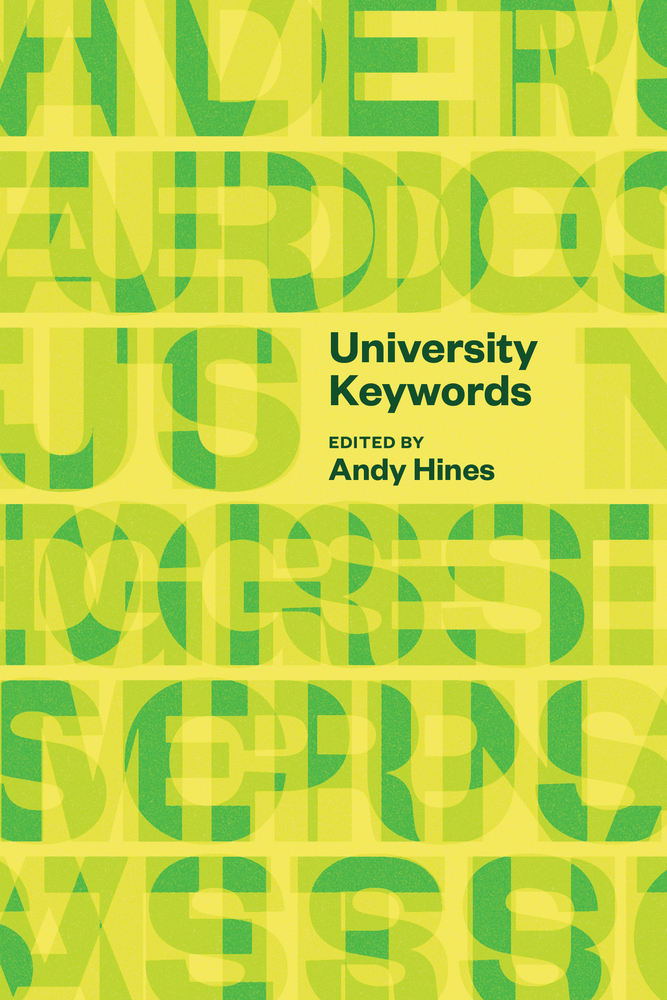
In the last two decades, researchers and activists have been studying these dynamics of social and political struggle within higher education under the heading of “critical university studies.” This interdisciplinary approach is highlighted in a book I edited, University Keywords, that offers expert interpretation of 27 relevant terms for analyzing and strategizing in US higher ed.
In August 2025—and again that December—I gathered four of the book’s contributors to talk about what they wrote, how that thinking prepared them for the Trump administration’s attacks on higher education, and the better university we might build.
Andy Hines (AH): Can each of you tell us about your entry for the University Keywords book? Has writing it helped orient you to the attack on higher education since the beginning of the second Trump administration?
Vineeta Singh (VS): My keyword was discipline. I wrote about how scholarly disciplines arrange labor time in space; and, in so doing, disciplines impose a scarcity model on knowledge production. This inspired in me a practice of looking, especially for how internal contradictions between interdisciplinarity and the rise of interdisciplinary studies contribute to the streamlining of the neoliberal university. That is, writing about disciplines felt like a microcosm of how I now feel called upon to defend these liberal institutions, even though they were always never enough. There’s always been a disidentificatory way of being in the university, but trying not to be of it; and, for me, disciplines are a real way of working through some of that.
I also used this occasion to think about expertise and its construction. That’s been something that I’ve really been grappling with, since the assaults on higher education are two-pronged: attacking expertise itself, and attacking scholars to ensure they can’t talk about scholasticide in Palestine.
We all agree that expertise is a good thing to have; expertise is actually a threat to the current regime. So I have been thinking about my own contradictory relationship to expertise—on the one hand, wanting to proliferate the types of expertise that we recognize as such, but on the other, being called upon to defend a very specific institutionalized idea of expertise.
Finally, I was thinking about the sociality of study. That’s another thing that is a big threat to authoritarian regimes. The university is one of those places—like the public bus—where I interact with people who aren’t a part of my regular circles, who I would not have otherwise encountered in the very segregated practice of daily life. The university is a place where those kinds of encounters can happen—and that has made it a target for eradication.
Annie McClanahan (AM): My entry is ed tech, and the most immediate provocation for writing was the intermediate stage of the pandemic, when there were mixed modalities of education happening. Between 2021 and 2023, we had one year that was entirely online; then, we had another that was very disrupted with lots of hybrid courses. The situation was being used as an opportunity to make fairly significant investments in ed tech “tools” without, in most cases, any real buy-in from the faculty. Why was the artisanal metaphor of “tool” used? Why was this term used to describe the intrusion of what are essentially forms of automation or mechanization into an otherwise craft-oriented profession?
Those pandemic years normalized online education: particularly asynchronous, fully online courses. And to justify this online expansion, many deployed equity and access language. I found this particularly galling in my own institution, UC Irvine, which has done very little to enable part-time or adult or other so-called nontraditional students from attending. But suddenly these kinds of students were brought up as the reason that we needed to have more fully online courses.
This interest brought me to the amazing body of extant scholarship and literature from critical university studies on ed tech. It tended to focus on privatization, privacy, and intellectual property, but I found very little on the question of labor. That was because the labor question with these tools wasn’t then immediately obvious. We didn’t yet know that the use of learning management systems—Canvas, Blackboard, et cetera—constituted a transformation in the labor process for faculty. (Even as this becomes more obvious, it is a complex transformation, because these tools often don’t necessarily lead to automation.) Teaching was once perceived as artisanal or craft labor, and thus an impossible barrier to automation. But then the rise of asynchronous online education proved the first form of automation to break through.
Learning management systems contracts mean that faculty do not, in fact, retain intellectual property rights over their course materials in the way that they think that they do. As a result, videos, modules, assignments, and even curricula can all be taken over by the university, and then used without the person who created them at all.
Finally, I saw what happened after the UAW grad student strike at the University of California. It resulted in significant, historic increase in the compensation—though it is not enough and not what the workers demanded—but the university administration also suggested that the solution to the increased cost for graduate students was to automate much of their labor.

Dan Nemser (DN): Our chapter on revenue looks at how universities make money. To visualize the primary revenue streams on which a university depends, we propose a shorthand called the “four flows model.” After looking at a lot of financial reports and budget documents from many kinds of institutions, it became clear to us that pretty much all higher education institutions can be described in terms of some combination of the following four flows: 1) state appropriations; 2) tuition and housing; 3) research funding (whether public or private); and 4) distributions from endowments and gifts. Each flow has unique characteristics and requirements, opportunities for growth, and vulnerabilities.
We developed this model because we were unsatisfied with the conventional language to describe the crisis in higher education: I am thinking of words like “privatization,” “corporatization,” or “neoliberalization.” These words point to important phenomena, but they also privilege declining state funding as the main driver of the crisis and effectively limit our explanations to just two of these flows, state funding and tuition. That narrative misses a lot of what is happening at these institutions, and it does not even get the history right. As Chris Newfield has shown, many of the tuition increases occurred before substantial state funding cuts began.
Another reason we developed this model is that we thought it would be helpful for campus-based activists and organizers to be able to map out the revenue streams on which their institution depends. Paying attention to the “four flows” can provide a strategic framework for envisioning how to pressure university administrators, by developing campaigns or tactics to interrupt those streams.
In terms of the Trump administration’s attacks on higher education, while we wrote the chapter with a movement perspective in mind, it is also the case that this model helps us see why these attacks have taken the form that they do. Indeed, Trump’s attacks target the flows over which the federal government has leverage. We see it in cuts to federal research funding. We see it in tuition, via the limitation on international students and pressure on student loan availability. We also see it in the attack on endowments through the idea of an endowment tax.
The four flows model thus reframes these revenue streams as a battlefield or a site of struggle with many different actors competing from widely divergent interests.
Rana M. Jaleel (RMJ): I wrote about Title IX, because changing interpretations of laws like Title IX expose the legal and social contradictions of concepts like sex and discrimination. These interpretations are subject to political fluctuations, which are as much about organizing and social movements as they are about any particular political party.
For those not familiar, Title IX was signed into law by President Richard Nixon in 1972 as part of the Education Amendments. It says, “No person in the United States shall, on the basis of sex, be excluded from participation in, be denied the benefits of, or be subjected to discrimination under any education program or activity receiving Federal financial assistance.” Title IX was the result of intense feminist organizing and it was intended to supplement Title VI (which prohibits discrimination by race and national origin) and Title VII (which prohibits employment discrimination).
It can be easy to critique any liberal legal structure, but the organizing around Title IX was multifaceted: many people saw it more as a tool for future struggles, rather than as a liberatory end in itself. Passed in an era of intense feminist legal activity, the law was shaped by women-of-color organizing as well as movements that suggested reproductive capacity ought not to determine social roles. The law was meant to fix an access problem. It addressed material barriers to education.
This dimension of Title IX’s history has been suppressed, much to our detriment. The Trump administration has minimized the question of discrimination as an issue of access; instead, it used the statute in the service of a paternalistic protectionism. We see this through his executive orders, such as “Defending Women from Gender Ideology Extremism and Restoring Biological Truth to the Federal Government.” The whole point of this order is to “protect” women from so-called male predators who self-identify as women, to demonize trans people, to justify reproductive control, and to then use these flawed rationales to legitimize state intrusion into domains like higher education.
But it is important to remember that what set the stage for the federal government’s influence over higher education via these laws was President Barack Obama’s use of Title IX. His policies amped up the power of Title IX administrators on campus, further bloating university bureaucracy. The Trump administration has, in some ways, only followed this earlier paradigm of increasing federal influence with its use of Title VI. Deals with universities regarding Title VI began with President Biden, not President Trump, when Johns Hopkins University made a settlement with the federal government prior to Trump’s inauguration. Still, Trump is using these tools to disrupt the possibility of democratic spaces on university campuses, rather than using them to challenge discrimination.
The Trump administration is also deploying provisions like Title IX and Title VI to compromise academic freedom and institutional autonomy by unmooring the Civil Rights Act from its foundational commitments to addressing structural discrimination and questions of access. Instead, the administration has weaponized language around protections or feelings that are not connected to goals of the law.
On this note, I want to plug a new American Association of University Professors (AAUP) report on the use of Title VI that analyzes how the Trump administration is redefining and hijacking discrimination in order to erase the nation’s history. Brushing away or repurposing trans rights, women’s rights, racial justice, and anti-semitism significantly undermines the work of research and teaching, as well as facts themselves.
I was thinking about the sociality of study. That’s another thing that is a big threat to authoritarian regimes.
Vineeta Singh
AH: Listening to your answers, I’m reminded of a challenge that the book attempts to address. How do we generate a narrative that can connect the many different parts of the higher education system, as well as the many populations that encounter the system in myriad ways? And, if we do generate this narrative, does it become too abstract to be useful?
I’m sympathetic to Dan’s suggestion that we need to be more precise about how the university accumulates. And in all your answers, I recognize how social and political developments redefine critical dimensions of how universities work.
To connect all these parts, I try to think about universities as a critical site of social struggle. On the one hand, that feels satisfying. It seems to pull together the inevitably linked histories of deskilling; race, gender, and access movements; labor struggle; political reconfigurations; et cetera. On the other hand, it may be simply too baggy to get any useful analytical or strategic ground.
RMJ: I’m always a little suspicious of the grand overarching narrative, because there are always so many different histories operating within it.
For instance, I don’t understand why so many people have conceded that the university is a left space. Can someone show me a Marxist university president? What people seem to invoke with that narrative is that many have fought for a long time to have the ability to discuss race, gender, disability, as well as other histories and ways of living that do not comport to the dominant US narrative. But just because these discussions exist within a place does not make them contiguous with the place as a whole. What gets left out of this story is how in the last decade many right-wing activists, like Milo Yiannopoulos, were frequently on campuses giving talks, as well as the long-standing presence of a conservative ecosystem in higher education.
I know this doesn’t answer the question. Still, much of what unites the different fronts of this current attack is the idea that the university is out of control in some way and can no longer govern itself.
AM: Here’s one example I always give against the idea that the university is an inherently leftist space. A number of years ago, I had a grant where I took lots of undergraduate econ classes. I sat in on a class where the faculty member—who had been tenured at UCI for something like 30 years—used tenure as his example of an inefficient employment model to his three hundred undergraduates, over and over again. I’m not teaching Marx to three hundred undergrads the way that this guy is telling people that the very system from which he benefits is inefficient.
Marxism is all about big narratives and categories so impossibly baggy that they seem to pull in everything at once. So I’m not allergic to how CUS (critical university studies) as a project does what you are suggesting, Andy.
That is especially true for what we might think of as a second generation of CUS scholars. The CUS essay in the book, which is terrific, really identifies these two generations. As someone who has seen the field move, one of the interesting things to me is that many within the field and beyond now resist the narratives of exceptionality or enclaves about colleges and universities, which also often shows up in public discourse. (We have seen this especially in the recent coverage of Columbia, Yale, Harvard, Brown, et cetera.) Certain kinds of institutions get treated as exemplary when, in fact, they’re not. The exemplary institution is a community college. The exemplary student is a nontraditional student, probably taking a lot of their classes online. If we’re looking for the statistical average, that’s where it is. It’s not at Harvard.
The first generation of CUS tried to think through that problem. Still, at times, those scholars fell prey to an enclave narrative of their own: a nostalgia for the postwar university of the GI Bill era, or the liberal university of the kind formed by the California Master Plan. Today’s second generation of CUS scholars resists that narrative. But we are also trying to think about ways to generalize productively, so that we can have conversations about, say, revenue across a range of different kinds of institutions, or how a process of expropriation, like ed tech, is going to impact different students in different ways. The likely outcome for ed tech is going to be that the enclave institutions continue to provide personalized, artisanal, superannuated, obsolete, but deeply human versions of education. Institutions with less resources will not be able to do that.
The question of how to think across a range of institutions seems to me to be one of the key affordances of this second generation of CUS. CUS is no longer nostalgic or idealist about what the proper university of the past might have looked like.
DN: This is really interesting. I want to pick up on one thing that Annie said about the second generation of CUS that has tried to generalize productively and think about connections across a variety of institutions. A really impactful argument for me was the one made in “Abolitionist University Studies: An Invitation” about how universities and prisons perform a similar function: they absorb surplus populations, albeit in very different ways. That kind of analysis can be useful both for understanding what these institutions do and also for building coalitional movements across differences and sectors.
It’s interesting that both Annie and Rana talk about the idea of the university as a leftist, Marxist, or even liberal institution to explain why it’s being targeted. Regardless of whether it actually is leftist or not, the right’s declaration that the university is leftist, or liberal, or Marxist, or progressive—they don’t seem to care about that distinction—proves useful in generating broad effects for their lines of attack. The lines of attack are not just an attack on the university, but an attack on K–12 schools, and an attack on society and the gains that have been won since the civil rights movement. That’s scary.
At the same time, these lines of attack also present opportunities for coalitions and broader movements that can organize together to resist. What would it look like for faculty unions and graduate student unions to collaborate or work together with K–12 teachers’ unions to push back against anti-DEI legislation or book bans?
VS: If there’s a narrative connecting the attacks, the connection is the source. Together we may be looking at four tendrils that are coming at the university, but there are sixteen other tendrils aiming at different institutions. If I try to think about why these institutions and not others, I come back to the idea of expertise and authority.
An authoritarian regime needs to concentrate authority in itself. In this frame, any institution that can create the conditions of possibility for insurgent knowledges, that can threaten the unitary authority, are not just suspect. In fact, they should be debilitated as much as possible. Defunded, defanged, all of the de- things!
As for the extent to which the university is capable of producing insurgent knowledges, it’s because it is a site where there’s a concentration of many different types of workers, coming into contact and collaborating, co-laboring together. There is a reason university students are so often part of the vanguard in any revolutionary action, and it has to do with this contact.
Right now, there is such a dearth of any principled leadership anywhere. But university students are one of the few places where I look to for role models of leadership. They have shown how to have an analysis and say, “If the right thing to do is to defend the people of Palestine, then I’m going to do that and put myself on the line.” I don’t see that from any other leadership.
The question becomes: What happens to those students? They are the real threat to the concentration of authority in the patriarch. (The goal of this authoritarian regime is to establish patriarchy, in both a domestic and biblical sense.) There’s this true narrative that your kid goes off to college, meets all these different kinds of people, and then comes home a Marxist or a lesbian, and now they’re completely out of their parents’ control. They can no longer be dominated the way that they have been for the first 18, 20, 32 years of their life. In other words, that exposure to the concentrated resources of the university campus—including the library, and other people living their lives—foments the threat to the singular authority of the patriarch.
RMJ: God forbid we produce more Marxist lesbians!
[Everyone laughs.]
Regardless of whether it is happening or not, the narrative you describe, Vineeta, is convenient. After all, as other folks have said, such a narrative becomes a means for furthering other kinds of control in other spaces.

AH: Your answers have me thinking about two things which I have been puzzling through.
The first, building on something Dan said earlier: How can we expand our ideas of the coalitional possibilities beyond the current configuration offered by higher education? One generative example for me has been connecting higher ed and healthcare workers. Besides the fact that we sometimes share bosses, the significant federal cuts across both of these sectors reveal how we share other connections, perhaps ones even previously unrecognized.
The second is about what Annie draws our attention to regarding CUS 2.0. I am interested in the attention given to different kinds of institutions and how connections across those institutions exist in both a metaphorical and a material register. In Bankers in the Ivory Tower Charlie Eaton writes about how the most selective institutions were heavily invested in for-profit colleges. The enclave narrative, as well as the media and politicians’ intensive focus on whether or not these institutions are producing Marxist lesbians, obscures how capital flows through universities to create some of the most exploitative conditions within the system. That is, there are very different narratives about higher education’s operation that draw attention to how the project of education yokes together a wide array of accumulative activities within the state, civil society, elite, and mass institutions, among many other areas.
Drawing these together seems more essential than ever in this moment as we look to develop an argument for a better higher education system, rather than one that seeks merely to retain what we had.
AM: Dan, what do you think about this new tax on the endowments? I ask because there’s a part of me that thinks if these wealthy institutions are not going to spend this money and accrue billions of dollars, then it should be taxed. I’m curious if this is a revanchist position.
DN: No, I agree with you! A small group of very elite universities have billions of dollars invested in the worst possible things, from the genocide in Gaza to climate change. They sit on and profit from this money, and they don’t pay any taxes. It’s terrible. So, it would be great for there to be a tax on those endowments.
At the same time, the federal government is not going to take the revenue from the endowment tax and invest it in social programs or public education. They are going to take that money and, say, hire more ICE agents and send more weapons to Israel.
In this context, the endowment tax is part of a broad attack on higher education. As we were discussing before, many of these lines of attack target dimensions of the university that few of us on the left would defend. For example, most of us would not defend the corporate DEI model as a liberatory win. DEI’s expansion was a recuperatory, counterinsurgent response to the 2020 uprising. When the federal government starts attacking DEI, though, it puts us in a weird position, because we find ourselves defending something we don’t even really support in its current form. But we can’t really concede either, because the attack is, in fact, part of a reactionary, white supremacist project.
Whether it is DEI, or the endowment tax, we have to navigate these types of contradictions.
AH: Along the lines of those contradictions, Rana and Vineeta earlier mentioned how universities being “out of control” is what animates the right’s attack on higher education. But what you have been talking about, Dan, recalls how the left has also made similar arguments about the university being out of control, albeit with a very different character. This is not to suggest that there is a substantive alignment between the left and the right on the university, but rather the shared observation that within the university there are certain levers of redistribution that ought to be realigned to match the very different broader social vision of these movements.
We have mostly left the center out of our discussion. Still, they have implicitly been endorsing the conservative movement by starving public institutions of resources, and tacitly endorsing the various fronts of the right’s culture war.
VS: We don’t have to take the mechanisms deployed by the aggressor and use them on their terms. I’m always sending people to Isaac Kamola’s AAUP Report, Manufacturing Backlash, about how there has been time and effort and money put into creating the campaigns that we are fighting against—and, largely, we are not even doing that. We don’t have those kinds of capacities and often end up responding to what the right is saying on the terms that they’ve set.
Pay the taxes and then give those proceeds to our schools, right? Yale should pay taxes, and those taxes should go to New Haven city schools. What are we doing? This is not complicated.
For instance, maybe the right stumbled on something true when they say that the position of associate vice provost for diversity is bullshit. Sure, so let’s have students have voting positions on boards of trustees instead. That’s how we want to do diversity.
Certain kinds of institutions get treated as exemplary when, in fact, they’re not. The exemplary institution is a community college.
Annie McClanahan
AH: OK, one final question. Recognizing the challenges of this moment, what are inspiring or hopeful possibilities that you have seen emerge from this struggle?
RMJ: The material connections you mentioned have me thinking about different kinds of movement work being done. There’s the work of making big, abstract connections, and that’s where big narratives can be useful.
Then there’s the work of drilling down to the place that you’re in, and figuring out how the bigger thing is happening there and trying to do the organizing. Grassroots, coalitional work can be hard and sometimes can even be thwarted by some forms of corporate unionism: the people who should be your allies, theoretically, are not always your allies. Still, this grassroots work seems to me the thing that people really work for and it is grounded in what’s happening materially at a given place. These details can get lost in the grand narrative, but they are what people fight for.
What has been exciting to me in my AAUP work is watching faculty—some of whom are unionized, others of whom are involved in advocacy—get really fired up. Faculty are grappling in concrete ways with what is happening on their campuses and trying to negotiate networks of power. This is often unglamorous work. It doesn’t help with your job. It doesn’t necessarily gain you friends, and you can’t put it on your résumé.
Still, it is the work that needs to be done to create the conditions necessary to have an education that is in service of everyone. That is inspiring work, and it is happening all over the place.
AM: I agree with so much of what Rana just said. The Trump cuts have impacted faculty in the STEM and health fields, who may not have previously felt the impact of austerity, and that is really radicalizing. It makes faculty unionization more possible than it has ever been.
I’m also inspired by the model of wall-to-wall unions. These models include the medical sector of campus, as Andy suggested, and also create alliances between different forms of instructional labor across the university.
The other thing I’ll say—and I have been writing about this a little bit—is that in a period where productivity gains are likely to be very minimal, union efforts are turning away from an older language of fair wages and toward the demand for the cost of reproduction. Look at how graduate unions have thought about tying their demands directly to the cost of housing, or how a range of service unions—teachers, nurses, warehouse workers, gig workers, et cetera—have been making demands around noneconomic issues, like Cops Off Campus and disability justice.
There is a real transformation happening in the contemporary labor movement that is necessary, that is inspiring. And it’s what I hope will inspire faculty, including tenure-track faculty, who have historically not been that committed to labor politics.
VS: I’m going to try to say this without using any proper nouns and hope it still makes sense: when they call three different kinds of cops on university students, it becomes very visible that there is no college bubble, and that students and faculty are subject to the same state forces as all the other people who live in a city.
That can be a moment where the campus/not campus divide feels weaker, in ways that lead to more people collaborating in new ways.
DN: I agree with what everybody has said and just want to add two things. On my own campus, I’ve been surprised to see faculty actually doing some organizing. The Faculty Senate has even been pretty aggressive. There are all kinds of limits on what a body like that can do, limits that are bound up with the political project of the shared governance model; still, as Rana said, people are really fired up. There are opportunities for faculty unionization there, but also coalitions between university spaces and those outside the university, as well as joint organizing between faculty, students, and staff, which doesn’t happen very often. That’s really exciting.
The other thing, perhaps controversial, points in a different direction. To the extent that the attacks on higher education are successful and universities become increasingly hostile spaces, emptied of their potential, there are and will be new projects emerging around autonomous forms of education and study. This is already happening and is exciting. Andy’s cowritten chapter with Eli Meyerhoff on “Alternative Institutions” points to some interesting examples. As Vineeta said at the start, we on the left find ourselves in the uncomfortable position of defending liberal institutions that have never worked and never been enough. Autonomous education projects have the potential to build other forms of learning and study that can go beyond what the liberal university has offered. It is difficult work and shouldn’t be romanticized, but it’s also really inspiring.
RMJ: We should have these autonomous spaces. At the same time, there has got to be a way to encourage autonomous learning and existing institutionalized spaces. Movements put in so much work to even get ethnic studies, gender studies, disability studies, or any of these approaches within the university. As such, I’m hesitant to abandon that accumulated work to this version of the state.
One of the mistakes that we make is defending the university as it is, rather than defending its possibility. I don’t mean this as a reform project, but rather as a way to hold space open so that better knowledge and democratic possibilities can be made.
VS: We can’t forget the reach and distance of the current higher education system. Students come to an institution where they are physically in community—rather than online in community—with a lot of different kinds of people and that is a valuable experience that we need to have a way to give to as many people as possible.
Defending the university is not about defending the institution itself, but rather understanding the institution as a condition of possibility for other things to emerge. I think of Donna Murch’s work and the relationship between Merritt College and the Black Panthers. These new formations happen at the edge of the university where there is such a concentration of contact, difference, and, thus, possibility. 
This article was commissioned by Dennis M. Hogan.